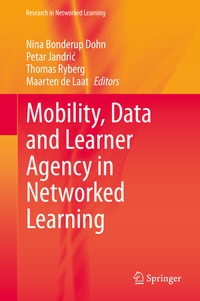
Mobility, Data and Learner Agency in Networked Learning
Description

The chapters in this book are based on selected peer reviewed research papers presented at the 11th biennial Networked Learning Conference (NLC) 2018 held in Zagreb and were chosen as exemplars of cutting edge research on networked learning. The chapters are organized into three main sections: 1) Aspects of mobility for Networked Learning in a global world, 2) Use and misuse of algorithms and learning analytics, 3) Understanding and empowering learners. The three main sections are flanked by chapters which introduce and reflect on Networked Learning as epistemic practice. The concluding chapter draws out perspectives from the chapters and discusses emerging issues.
The book focuses on the nature of learning and interactions as an important characteristic sought out by researchers and practitioners in this field.
Reviews / Votes
"This book gives a coherent, thorough and up-to-date account on research in networked learning. The volume is well structured in three parts, focusing on mobility for networked learning in a global world, use and misuse of algorithms and learning analytics, and empowering learners. Within this structure, individual chapters address an amount of interesting issues such as the changing landscape of higher education, Learning in the wild, and cognitive load in networked learning. Two chapters, serving as, respectively, intro and outro to the body of the book, present an analysis from with-in on how networked learning have developed into a field of research and practice. The concluding chapter explicates and discusses insights concerning the central themes of the book and uses these insights to point forward at emerging foci within the field of networked learning." (Ann Bygholm, Professor, E-learning Lab, Aalborg University, Denmark)
"This book is an essential collection for anyone interested in networked learning. It manages to combine a broad coverage of the main areas of interest, with an in-depth, critical analysis of the topics. Through chapters examining unbundling in higher education, analytics and the role of the learner in networks the key issues not just in networked learning but higher education more broadly are given thoughtful treatment. The introductory and concluding chapters provide a historical and critical reflection on the field of networked learning, which provides much needed longitudinal context to a field that frequently suffers from amnesia." (Martin Weller, Professor, Institute of Educational Technology, The Open University, UK)
More details
Other editions
Additional editions