

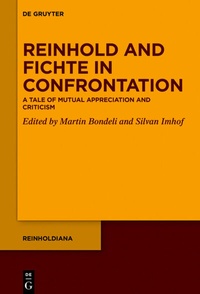
Reinhold and Fichte in Confrontation
Description

From the early 1790s until after the turn of the century, a very productive but also controversial exchange took place between Reinhold and Fichte. Though many key aspects of post-Kantian philosophy were discussed, the philosophical confrontation between Reinhold and Fichte is most instructive for the understanding of post-Kantian philosophy.
The exchange started when Fichte published his verdict on Reinhold's Elementarphilosophie and disapproved of its fundamental principle. In 1794 Fichte challenged Reinhold by presenting his Wissenschaftslehre . Reinhold was not convinced of Fichte's foundation of philosophy at first, but announced that he accepted the Wissenschaftslehre in 1797. While Reinhold and Fichte officially collaborated in the following three years, tensions concerning fundamental questions were still present. When Reinhold adopted Rational Realism, his relation to Fichte deteriorated and the exchange between the two finally ended.
The contributions in the present collection focus on the central systematic issues at the different stages of the confrontation between Fichte and Reinhold, thereby illuminating questions that are essential to the understanding of the evolution of post-Kantian German philosophy.
More details
Other editions
Additional editions
Persons
Content
- Intro
- Table of Contents
- Abbreviations
- Introduction
- "Wie der blinde von der Farbe."
- "Gehe der Unbedingtheit des Ich nach."
- Reinhold's Principle of Consciousness and Fichte's Third Principle
- "There is No Will without Choice"
- Reinhold's Transition to Fichte
- The "Weak Side of Critical Philosophy" or Why Reinhold Abandoned his Elementarphilosophie
- Die Freiheit des reinen Wissens
- Ist Reinhold je Transzendentalphilosoph gewesen?
- Rhythmus and Setzen
- Contributors
- Index of names
