

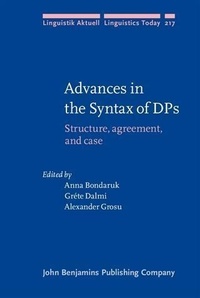
Advances in the Syntax of DPs
Structure, agreement, and case
1st Edition
Published on 14. October 2014
XVII, 320 pages
978-90-272-6969-0 (ISBN)
Description

The contributions in this volume are devoted to various aspects of the internal and external syntax of DPs in a wide variety of languages belonging to the Slavic, Turkic, Finno-Ugric, Semitic and Germanic language families. In particular, the papers address questions related to the internal and external cartography of various types of simplex and complex DPs: the position of DPs within larger structures, agreement in phi-features and/or case between DPs and their predicates, as well as between sub-elements of DPs, and/or the assignment of case to DPs in specific configurations. The first four chapters of the book focus primarily on the external syntax of DPs, and the remaining chapters deal with their internal syntax.
More details
Other editions
Additional editions
Anna Bondaruk | Grete Dalmi | Alexander Grosu
Advances in the Syntax of DPs
Structure, agreement, and case
Book
10/2014
John Benjamins Publishing Co
€104.94
Shipment within 10-15 days
Persons
Content
- Advances in the Syntax of DPs
- Editorial page
- Title page
- LCC data
- Dedication page
- Table of content
- List of contributors
- List of abbreviations
- List of figures
- Editors' note
- Preface
- Introduction
- References
- The overgeneration problem and the case of semipredicatives in Russian
- 1. Introduction
- 2. Some empirical and conceptual issues
- 2.1 "Divided" control
- 2.2 The problem of variation
- 3. Some alternative approaches
- 3.1 Vertical binding
- 3.2 Control as movement
- 3.3 A probe-goal and Agree account
- 3.4 A government and binding account
- 4. Comparison of approaches: Overarching issues
- 4.1 Agreement in case
- 4.2 Variation
- 4.3 Avoiding overgeneration
- 5. Semipredicatives versus other adjectives
- 5.1 Some data and puzzles
- 5.2 Direct assignment
- 6. Components of a solution
- 6.1 Some leading ideas
- 6.1.1 Agreement versus assignment
- 6.1.2 Dative versus instrumental
- 6.1.3 Arguments versus adjuncts
- 6.2 Predicate adjective agreement is local
- 6.2.1 Structure is parsimonious
- 6.3 Semipredicatives versus ordinary adjectives
- 6.3.1 Why ordinary adjectives do not enter into the SD
- 6.3.2 Why semipredicatives are not default instrumental
- 6.3.3 Why ordinary adjectives always have an instrumental option
- 6.3.4 Why semipredicatives must agree where ordinary adjectives can
- 6.3.5 Why agreement under obligatory Object Control is only possible for semipredicatives
- 6.4 Brief thoughts on variation
- 6.5 Movement, multi-attachment, timing, and feature sharing
- References
- Polish equatives as symmetrical structures
- 1. Introduction
- 2. Inventory of Polish equatives
- 3. How do equatives differ from predicational and specificational clauses in Polish?
- 3.1 Predicational and specificational clauses in Polish
- 3.2 Equatives vs. predicational and specificational clauses in Polish
- 4. Asymmetrical structure for Polish equatives
- 5. Symmetrical structure of Polish equatives
- 5.1 Pereltsvaig's (2001, 2007) analysis
- 5.2 Pereltsvaig's analysis applied to Polish
- 6. Summary
- References
- Syntactic (dis)agreement is not semantic agreement
- 1. Introduction
- 2. Two types of number mismatch
- 2.1 Singulars with plural agreement ('sg/pl')
- 2.2 Plurals with singular agreement ('pl/sg')
- 2.3 The proposal
- 3. Two types of number mismatch: Empirical evidence
- 3.1 Distribution: Copular clauses versus verbal predicates
- 3.2 Binding and control
- 3.3 Semantic properties of the subject
- 3.3.1 Quantification
- 3.3.2 Definiteness, specificity and genericity
- 3.4 Productivity
- 4. An analysis of phi-feature mismatches
- 4.1 Previous proposals
- 4.2 Against a one-level model
- 4.3 A two-level model of agreement
- 4.4 Application to pl/sg and sg/pl
- 4.5 Residual problems
- 5. Conclusion
- References
- A note on oblique case
- 1. Introduction
- 2. Oblique case, indeclinable nominals, and a Case Realization Condition
- 2.1 Undeclined nominals
- 2.2 Oblique case and a case realization requirement
- 3. The Puzzle
- 4. Oblique case is uniformly P-governed: The P-copying proposal
- 5. Conclusion
- References
- The structure of null subject DPs and agreement in Polish impersonal constructions
- 1. Introduction
- 1.1 Overview of the paper
- 2. Two types of impersonal constructions
- 2.1 The SIE construction
- 2.1.1 Cross-linguistic perspective
- 2.2 The -NO/-TO construction
- 2.3 Subjects in the SIE and -NO/-TO constructions
- 2.3.1 Availability of subject-oriented adverbials
- 2.3.2 Control and binding
- 2.3.3 Nominative subjects and oblique phrases
- 2.4 The phi-specification of a covert subject
- 3. How are the values of phi-features on predicative complements established?
- 3.1 Sigurðsson (2004, 2009), Frascarelli (2007), and Holmberg (2010a,b)
- 3.2 1st/2nd personal pronouns vs. 3rd personal pronouns
- 3.3 The Feature Geometry of Pronouns: Harley and Ritter (2002)
- 3.4 Some consequences and predictions for the theory of pronouns
- 4. The SIE particle
- 5. Agreement
- 6. Case
- 7. Conclusion
- References
- The feature geometry of generic inclusive null DPs in Hungarian
- 1. Introduction
- 1.1 The four major types of Null Subject Languages
- 1.2 Some facts about null DPs in Hungarian
- 2. The semantic interpretation of generic inclusive lexical and null DPs
- 2.1 Some interpretive differences between generic inclusive ONE and generic exclusive PEOPLE
- 2.2 The connection between generic inclusive ONE and PROGN
- 2.3 Generic inclusive lexical and null dative experiencer DPs of psych-impersonal predicates in Hungarian
- 3. The feature geometry of generic inclusive vs. unique reference DPs
- 3.1 The feature composition of generic inclusive vs. referential null DPs in Hungarian
- 3.2 The inventory of generic inclusive lexical and null DPs in a crosslinguistic perspective
- 4. Summary
- References
- Possessives within and beyond NP
- 1. Introduction
- 2. Ezafe-2 and ezafe-3: Formal properties
- 3. Ezafe-2 and ezafe-3: The position of the possessor
- 4. Ezafe-2 and ezafe-3: The size of the possessor
- 5. Ezafe-2 and ezafe-3: The interpretation of the possessor
- 6. Conclusions and significance
- References
- On pre-nominal classifying adjectives in Polish
- 1. Introduction
- 2. Classifying vs. qualifying adjectives (Rutkowski & Progovac 2005 and Rutkowski 2007, 2009, 2012)
- 3. Bouchard's (2002) representational theory
- 4. Bouchard's representational theory applied to adjectival modification in Polish (CPT 2011a,b)
- 5. The semantic interpretation of pre-nominal and post-nominal classifying adjectives
- 6. Information structure and the placement of classifying adjectives
- 7. Conclusion
- References
- Determiners and possessives in Old English and Polish
- 1. Introduction
- 2. Variant I: Determiner-possessive
- 3. Variant II: Possessive-determiner
- 4. Possessives and determiners in non-adjacent configurations
- 5. A note on the grammatical status of ten, ta, to and se, seo þæt
- 6. Conclusions
- References
- Agreement and definiteness in Germanic DPs
- 1. Introduction
- 1.1 Two patterns in Germanic DPs
- 1.2 Spreaders, realizers, and licensors
- and why we ignore licensors here
- 2. The weak/strong declension: Two licensor-free accounts
- 2.1 A spreader account of C
- 2.2 A realizer account
- 2.3 A brief comparison
- 3. Two licensor-free accounts for Danish -EN
- 3.1 A spreader account of -EN
- 3.2 A realizer account of -EN
- 3.3 A brief comparison
- 4. Some additional challenges
- 4.1 Icelandic
- 4.2 Double definiteness
- 4.3 Greek
- 5. Conclusion
- References
- Transparent free relatives
- 1. Introduction
- 2. The semantics of TFRs
- 3. Case-effects in FRs and TFRs
- 4. Summary and conclusions
- References
- Index
