

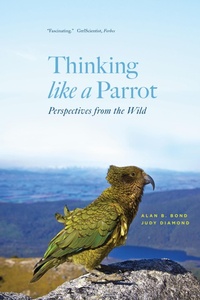
Thinking like a Parrot
Perspectives from the Wild
Published on 22. December 2022
368 pages
978-0-226-24881-3 (ISBN)
Description

From two experts on wild parrot cognition, a close look at the intelligence, social behavior, and conservation of these widely threatened birds.
People form enduring emotional bonds with other animal species, such as dogs, cats, and horses. For the most part, these are domesticated animals, with one notable exception: many people form close and supportive relationships with parrots, even though these amusing and curious birds remain thoroughly wild creatures. What enables this unique group of animals to form social bonds with people, and what does this mean for their survival?
In Thinking like a Parrot, Alan B. Bond and Judy Diamond look beyond much of the standard work on captive parrots to the mischievous, inquisitive, and astonishingly vocal parrots of the wild. Focusing on the psychology and ecology of wild parrots, Bond and Diamond document their distinctive social behavior, sophisticated cognition, and extraordinary vocal abilities. Also included are short vignettes-field notes on the natural history and behavior of both rare and widely distributed species, from the neotropical crimson-fronted parakeet to New Zealand's flightless, ground-dwelling kakapo. This composite approach makes clear that the behavior of captive parrots is grounded in the birds' wild ecology and evolution, revealing that parrots' ability to bond with people is an evolutionary accident, a by-product of the intense sociality and flexible behavior that characterize their lives.
Despite their adaptability and intelligence, however, nearly all large parrot species are rare, threatened, or endangered. To successfully manage and restore these wild populations, Bond and Diamond argue, we must develop a fuller understanding of their biology and the complex set of ecological and behavioral traits that has led to their vulnerability. Spanning the global distribution of parrot species, Thinking like a Parrot is rich with surprising insights into parrot intelligence, flexibility, and-even in the face of threats-resilience.
People form enduring emotional bonds with other animal species, such as dogs, cats, and horses. For the most part, these are domesticated animals, with one notable exception: many people form close and supportive relationships with parrots, even though these amusing and curious birds remain thoroughly wild creatures. What enables this unique group of animals to form social bonds with people, and what does this mean for their survival?
In Thinking like a Parrot, Alan B. Bond and Judy Diamond look beyond much of the standard work on captive parrots to the mischievous, inquisitive, and astonishingly vocal parrots of the wild. Focusing on the psychology and ecology of wild parrots, Bond and Diamond document their distinctive social behavior, sophisticated cognition, and extraordinary vocal abilities. Also included are short vignettes-field notes on the natural history and behavior of both rare and widely distributed species, from the neotropical crimson-fronted parakeet to New Zealand's flightless, ground-dwelling kakapo. This composite approach makes clear that the behavior of captive parrots is grounded in the birds' wild ecology and evolution, revealing that parrots' ability to bond with people is an evolutionary accident, a by-product of the intense sociality and flexible behavior that characterize their lives.
Despite their adaptability and intelligence, however, nearly all large parrot species are rare, threatened, or endangered. To successfully manage and restore these wild populations, Bond and Diamond argue, we must develop a fuller understanding of their biology and the complex set of ecological and behavioral traits that has led to their vulnerability. Spanning the global distribution of parrot species, Thinking like a Parrot is rich with surprising insights into parrot intelligence, flexibility, and-even in the face of threats-resilience.
More details
Other editions
Additional editions
Book
07/2019
University of Chicago Press
€38.44
Shipment within 10-20 days
Persons
Alan B. Bond is professor emeritus of biological sciences at the University of Nebraska and
Judy Diamond is professor and curator at the University of Nebraska State Museum. Together they have studied the social behavior, cognition, and vocalizations of wild parrots for more than three decades. They are coauthors of
Kea, Bird of Paradox: The Evolution and Behavior of a New Zealand Parrot and
Concealing Coloration in Animals. For more on their research, please visit the website of the Center for Avian Cognition, http://www.aviancog.org/.
Content
- Intro
- Contents
- Preface
- Part One: Origins
- 1. Rainbow Lorikeet
- 2. Evolution
- 3. Brain and Sensory Systems
- Part Two: Behavior
- 4. Sulphur-Crested Cockatoo
- 5. Expression and Response
- 6. Play
- Part Three: Sociality
- 7. Crimson-Fronted Parakeet
- 8. Relationships
- 9. Vocal Communication
- Part Four: Cognition
- 10. Kaka
- 11. Cognition in the Wild
- 12. Intelligence
- Part Five: Disruption
- 13. Rose-Ringed Parakeet
- 14. Expansion
- Part Six: Conservation
- 15. Kakapo
- 16. Contraction and Collapse
- Part Seven: Parrots and People
- 17. Captain Flint Meets Polynesia
- Acknowledgments
- Appendix A. Common and Scientific Names of Parrot Species Mentioned in the Text
- Appendix B. Analysis Methods for Brain Volume and Body Mass in Parrots and Corvids
- Appendix C. Comparisons of Form and Frequency of Play Behavior in Keas, Kakas, and Kakapos
- Appendix D. Kea Social Network Analysis
- Appendix E. Kea Vocalizations
- Appendix F. Kaka Vocalizations and Dialect Methods
- Appendix G. Conservation Status of Parrot Species Mentioned in the Text
- Notes
- References
- Index
