

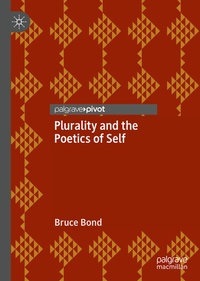
Plurality and the Poetics of Self
Description

Plurality and the Poetics of Self investigates the words "I" and "self" as suggestive of eight territories of meaning. Via poetry's lens into language and its limits, Bruce Bond explores the notion of self as identity, volitional agent, ego, existential monad, subjectivity, ontological origin, soul, and transpersonal psyche. Taking poetic meaning as our common currency, the book emphasizes the critical role of the un-representable and how embattled and confused assumptions threaten ever deeper alienation from one another and ourselves.
Reviews / Votes
"Bruce Bond's Plurality and the Poetics of Self works to mend the disjointed harmony of contemporary poetics' relation to self, a relation that errs in assuming that experience authorizes self-expression past scrutiny and that the self is but a construction. But the harmony of self is a complicated music, one Bond teaches us to hear in all its contraries. Delving into poetry across spans of time, into philosophy, theology, psychology, metaphysics, and myth, Bond demonstrates not only generous learning, but gives us a rarer gift, that generosity inside learning that hopes to return us to ourselves. The gift here is to allow us our own complexity, and to suggest a poem's difficulty might make us each more capable of understanding and expressing our own, that Gordian knot we tangle more each day, lost as we are in our single syllable whenever we, as daily we all do, say 'I.'" (Dan Beachy-Quick, Professor of English, Colorado State University, USA, and author of Of Silence and Song (2017))
More details
Other editions
Additional editions
Person
Bruce Bond is Regents Professor of English at the University of North Texas, USA. He is the author of twenty-three books including, most recently, Immanent Distance: Poetry and the Metaphysics of the Near at Hand (2015), Black Anthem (2016), Gold Bee (2016), Sacrum (2017), Blackout Starlight: New and Selected Poems 1997-2015 (2017), Rise and Fall of the Lesser Sun Gods (2018), Dear Reader (2018), and Frankenstein's Children (2018).
Content
The Broken Mirror.- Identity and Contingency.- The Metaphysics of Volition.- Ego: Structure, Complex, Drive.- The Existential Monad.- The Seer in the Seen.- Bodies, Souls, and the Poetry Between Them.- Original Consciousness.- Dynamics of the Transpersonal.- The Plural of I.
