

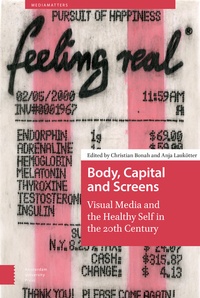
Body, Capital and Screens
Visual Media and the Healthy Self in the 20th Century
1st Edition
Published on 2. June 2020
348 pages
978-90-485-4031-0 (ISBN)
Description

Body, Capital and Screens: Visual Media and the Healthy Self in the 20th Century brings together new research from leading scholars from Europe and North America working at the intersection of film and media studies and social and cultural history of the body. The volume focuses on visual media in the twentieth century in Europe and the U.S. that informed and educated people about life and health as well as practices improving them. Through a series of in-depth case studies, the contributors to this volume investigate the relationships between film/television, private and public actors of the health sector and economic developments. The book explores the performative and interactive power of these visual media on individual health understandings, perceptions and practices. Body, Capital and Screens aims to better understand how bodily health has evolved as a form of capital throughout the century.
Reviews / Votes
"From the mid-twentieth century onwards, televisual media has actively shaped relations between human bodies, health practices and market forces. By paying close critical attention to the nuances of these connections, Body, Capital and Screens makes an important intervention in the field of European and global health history, and presents a convincing argument for the value of engaging with visual resources in historiographic research."- Fiona Johnstone, Durham University, European Journal for the History of Medicine and Health (2021)
"Die beiden Wissenschaftler_innen, die bereits zuvor in Co-Autorenschaft veroeffentlichten, verbinden elf Beitraege, die auf der Mikroebene visuelle Kommunikationsformen analysieren. Dabei bearbeiten die Autor_innen dokumentarische Filme, Lehrfilme und Fernsehformate ebenso wie Amateurvideos. So passt sich das Buch perfekt in die Reihe "Media Matters" der Amsterdam University Press ein, die den Fokus auf die Verflechtungen von Materialitaet und Performativitaet in alten und neuen Medien legt. [...] Den Herausgeber_innen gelingt es, strategische Gesundheitskommunikation und Medienwissenschaft zu vereinen. Diese interdisziplinaere Forschungsperspektive findet im deutschsprachigen Raum erst selten Anwendung."
- Charmaine Voigt (Leipzig), MEDIENwissenschaft 03-04/2021
"Der von Christian Bonah und Anja Laukoetter herausgegebene Sammelband ist ein ueberaus gelungenes Beispiel fuer die Implementierung der Funktionsprinzipien des zeitgemaessen historisch-kulturwissenschaftlichen Denkens in eine interdisziplinaere und international ausgerichtete Veroeffentlichung. [...] Die immense Vielfalt an inhaltlichen Positionen und Ergebnissen, die vor diesem Hintergrund an konkreten thematischen Beispielen deutlich werden, macht den Sammelband in seiner Gaenze zu einem hoechst anregenden und lesenswerten Text."
- Stefan Zahlmann, Institut fuer Geschichte, Universitaet Wien, H-Soz-Kult, 2021
More details
Series
Language
English
Place of publication
Amsterdam
Netherlands
Target group
Professional and scholarly
Edition type
Digital original
Illustrations
138 s/w Abbildungen
138 Illustrations, black and white
File size
3,90 MB
ISBN-13
978-90-485-4031-0 (9789048540310)
Copyright in bibliographic data and cover images is held by Nielsen Book Services Limited or by the publishers or by their respective licensors: all rights reserved.
Schweitzer Classification
Other editions
Additional editions
Christian Bonah | Anja Laukoetter
Body, Capital and Screens
Visual Media and the Healthy Self in the 20th Century
Book
06/2020
Amsterdam University Press
€181.80
Shipment within 10-20 days
Persons
Christian Bonah is professor for the history of medical and health sciences at the University Strasbourg, member of its Institute of Advanced Studies and principle investigator of the ERC Advanced grant BodyCapital. He works on comparative, social and material history of health, health products and services and bodies especially in connection with media and law. Anja Laukoetter is a historian of 19th and 20th Century European history working in the field of social and cultural history and history of science. She is a researcher at the Center for the History of Emotions at the Max Planck Institute for Human Development and co-principle investigator of the ERC Advanced grant BodyCapital. Besides other things, the main field of her research is the transnational/global history of media, the history of emotions and the history of psychology and pedagogy.
Content
Body, Capital, and Screens: An Introduction
Christian Bonah and Anja Laukoetter
Chapter One
Playing the Doctor, Playing the Patient: The Performance of Health Identities in Live Medical Television, 1958
Timothy M. Boon
Chapter Two
The BBC's Children in Need Telethon: The Currencies of Compassion
Karen Lury
Chapter Three
Let's Talk about S=: The Influence of Cinema Verite on Sex Education in French National Television around 1968
Christian Bonah
Chapter Four
Measuring Subjectification: The Reception of Health Education Campaigns and the Evaluation Conundrum
Luc Berlivet
Chapter Five
Swimming the Crawl to Educate the Modern Body-Visual Material and the Expanding Market for Participatory Sports in the USA, 1890s-1930s
Olaf Stieglitz
Chapter Six
Inside Magoo (1960): Cancer and Comedic Commentary on 1950s America
David Cantor
Chapter Seven
'One Feels so Much in These Times!': Emotional Education and the Construction of New Subjectivities: Sex Education Films in Early 1960s GDR
Anja Laukoetter
Chapter Eight
Revealing Norms and Sowing Confusion: VALIE EXPORT's Body
Sophie Delpeux
Chapter Nine
'Before Education, Good Food, and Health': World Citizenship and Biopolitics in UNESCO's Post-war Literacy Films
Zoe Druick
Chapter Ten
From Colonial to Global: Visuals and the Historiography of Body Government beyond Europe
Jean-Paul Gaudilliere
Chapter Eleven
Zika Virus, Global Health Communication, and Dataveillance
Kirsten Ostherr
Index
Christian Bonah and Anja Laukoetter
Chapter One
Playing the Doctor, Playing the Patient: The Performance of Health Identities in Live Medical Television, 1958
Timothy M. Boon
Chapter Two
The BBC's Children in Need Telethon: The Currencies of Compassion
Karen Lury
Chapter Three
Let's Talk about S=: The Influence of Cinema Verite on Sex Education in French National Television around 1968
Christian Bonah
Chapter Four
Measuring Subjectification: The Reception of Health Education Campaigns and the Evaluation Conundrum
Luc Berlivet
Chapter Five
Swimming the Crawl to Educate the Modern Body-Visual Material and the Expanding Market for Participatory Sports in the USA, 1890s-1930s
Olaf Stieglitz
Chapter Six
Inside Magoo (1960): Cancer and Comedic Commentary on 1950s America
David Cantor
Chapter Seven
'One Feels so Much in These Times!': Emotional Education and the Construction of New Subjectivities: Sex Education Films in Early 1960s GDR
Anja Laukoetter
Chapter Eight
Revealing Norms and Sowing Confusion: VALIE EXPORT's Body
Sophie Delpeux
Chapter Nine
'Before Education, Good Food, and Health': World Citizenship and Biopolitics in UNESCO's Post-war Literacy Films
Zoe Druick
Chapter Ten
From Colonial to Global: Visuals and the Historiography of Body Government beyond Europe
Jean-Paul Gaudilliere
Chapter Eleven
Zika Virus, Global Health Communication, and Dataveillance
Kirsten Ostherr
Index
