

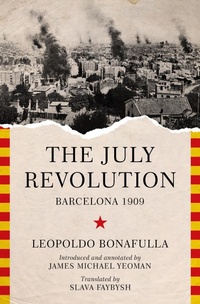
The July Revolution
Description

The "Tragic Week" in Spain, which took place in July 1909, began as anti-conscription riots, but soon evolved into a widespread uprising attacking the pillars of Spanish society: Church and State. It is known today mostly for its most famous martyr, Francisco Ferrer, the radical educator and founder of the Modern School who was executed by the Spanish army. But Ferrer was only one of hundreds of people who died that week in a brutal crackdown on anarchists and other radicals. Thousands were indicted by military courts, including at least fifty who received life sentences. In The July Revolution, the full story of these events is told for the first time in English, by an astute newspaper editor and eye-witness to the events. In a lively translation by Slava Faybysh and with a detailed historical Introduction by James Michael Yeoman, the notorious week is given its historical due and situated in its proper context of Spain's imperial ambitions and the revolutionary stirrings that were precursors to the Spanish Civil War.
More details
Other editions
Additional editions
Persons
Leopoldo Bonafulla was the pseudonym of the Catalan anarchist Joan Baptista Esteve. He was part of the militant Avenir Group, which published a newspaper of the same name, and edited the newspaper El Productor and collaborated on El Rebelde and La Revista Blanca. He took part in, and was imprisoned for, the events of the Spain's "Tragic Week" of 1909. Soon after, he participated in the founding congress of the CNT labor union and went on to become a major figure in Spanish anarcho-syndicalism. He died in 1922.
Content
Introduction, James Michael Yeoman
Translator's Note, Slava Faybysh
CHAPTER 1
Causes and background. The Moroccan mines - War in the Rif - Embarkation of the reservists - Upheaval and protests - Government repression - Disturbances and prisons in Madrid and Barcelona. Declaration of a general strike
CHAPTER 2
The popular protest is generalized - Bloody clashes and resistance - Barcelona under martial law - Revolutionaries at the barricades - Convents, friaries and churches set ablaze - Constitutional rights suspended all over Spain - Military reinforcements arrive. Last efforts of the rebels - Bloody epilogue - Injuries and deaths
CHAPTER 3
Heinous acts of capital's powerful and the false messengers of god - Manifesto of the regionalist deputies and senators - Message of the committee of social defense - Document of the prelate of this diocese - Agreements of the diocesan board - Endorsement of the parish churches of Barcelona - Declaration of Pope Pius X. The extremely timely reply
CHAPTER 4
Government brutality. Anomalies of the military courts. - Lack of internal struggle - There was no compassion, purity - Drumhead courts-martial begin - Life imprisonment - Sentenced to death - First firing squads - Ramon Clemente García - An astounding case
CHAPTER 5
The boy from the coal store - The facts of the case - Neighbors from carrer del carme and d'en roig - To the castle - The firing squad - Madrid's El País - Protest movement in some capitals - A tense session in Madrid City Hall - An alternative examination of the case
CHAPTER 6
Clean up Barcelona! - Schools - Deported to Cantavieja, Alcañiz, Siétamo, and other points - Deported to Almudévar, Ayerbe, and Huesca. More exiles and school closures in other points in Spain - The predominance of the church
CHAPTER 7
There was no leader - Sacristan Ugarte, supreme court prosecutor - Summons and arrest warrant issued for Ferrer - The arrest - Letters from Ferrer and Soledad Villafranca - Police circulars - The famous Lerroux letter - The defense witnesses are not heard
CHAPTER 8
Ferrer before the military tribunal - The magistrate reads his report - The prosecutor speaks - The defense - Ferrer's final statement - The sentence - The captain general approves the decision - Dictates of the universal consciousness
CHAPTER 9
Worldwide solidarity - France - Naquet answering the Marquis de Castellane - The automobile procession - England - The national council of the ILP - Italy - Belgium - Germany - Holland - Switzerland - Portugal - The Americas
CHAPTER 10
From prison to the castle - Ferrer in the chapel - Ferrer's testament - To the moat - Execution - Long live the Modern School!
CHAPTER 11
Serious disturbances in front of Spanish embassies and consulates - Paris under martial law - The mayor of Rome - A wave of indignation erupts all over Europe and the Americas - Spain
CHAPTER 12
Withdrawal of Sr. Maura's government - Replaced by Moret - Costa destroying Maura - Crime of the advanced political parties
CHAPTER 13
The reaction survives Maura - Imprisonment - Military tribunals continue - Path to prison - Amnesty is granted
Index
