

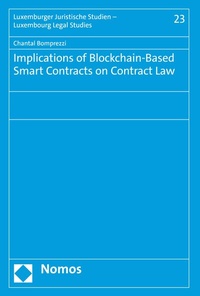
Implications of Blockchain-Based Smart Contracts on Contract Law
1st Edition
Published on 19. November 2021
266 pages
978-3-7489-3006-8 (ISBN)
Description

Dieses Werk bietet eine eingehende Analyse der wichtigsten Debatten über Blockchain-basierte intelligente Verträge und Vertragsrecht. Nach einer detaillierten Beschreibung der Technologie werden die bestehenden Regeln zu Technologie und Verträgen - von Automaten bis hin zu berechenbaren Verträgen - untersucht und auf ihre Anwendbarkeit auf Blockchain-basierte Smart Contracts überprüft. Der Schwerpunkt liegt dabei auf den Auswirkungen von Blockchain-basierten intelligenten Verträgen auf das Zustandekommen des Vertrages, die Vertragserfüllung und das anwendbare Recht sowie die Gerichtsbarkeit.
More details
Other editions
Additional editions
Chantal Bomprezzi
Implications of Blockchain-Based Smart Contracts on Contract Law
Book
11/2021
1st Edition
Nomos
€74.00
Shipment within 7-9 days
Content
- Cover
- INTRODUCTION
- I. Background
- II. Research problem
- III. Research objective and question
- IV. Methodology
- V. Structure of the book.
- CHAPTER 1: INTRODUCTION TO BLOCKCHAIN AND SMART CONTRACTS
- 1. Definition and functioning of blockchain.
- 2. Properties of blockchain.
- 3. Origins.
- 4. Evolution.
- 5. Typologies.
- 6. False myths surrounding blockchains.
- 7. Smart contracts.
- 8. Limitations of pre-existing blockchain platforms versus smart contracting platforms.
- 9. Ethereum.
- 10. Use cases.
- CHAPTER 2: BLOCKCHAIN-BASED SMART CONTRACTS IN THE CONTRACTUAL DOMAIN
- 1. Smart contract: a misleading expression.
- 2. 'Smart contract code' versus 'smart legal contracts'.
- 3. Nick Szabo's theories.
- 4. Characteristics of smart legal contracts.
- 5. Summary of existing legal literature.
- 6. Applicable form of regulation.
- 7. Types of contract.
- 8. Concrete scenarios.
- CHAPTER 3: FROM VENDING MACHINES TO SMART CONTRACTS
- 1. The historical impact of technology on contracts.
- 2. Sources of law in technological contracts.
- 2.1. Contract formation.
- 2.1.1. Conclusion of contracts through software agents.
- 2.1.2. Digital identity in electronic commerce.
- 2.1.3. Defects of consent: the mistake.
- 2.1.4. Form requirements.
- 2.2. Contract performance: contractual and non-contractual liability.
- 2.3. Jurisdiction and applicable law.
- CHAPTER 4: CONTRACT FORMATION
- 1. Are smart contracts 'contracts'?
- 2. The 'meeting of the minds': offer and acceptance.
- 2.1. Time of conclusion of the contract.
- 2.2. Revocation of offer and acceptance.
- 3. The language of the code.
- 3.1. Contractual intention.
- 3.2. The mistake.
- 4. The e-Commerce Directive and the Consumer Rights Directive. Information requirements.
- 4.1. Acknowledgement of receipt.
- 5. Form.
- 6. Smart contracts concluded 'smart'.
- 7. Smart contract code as a mean to express contracts or to perform already existing contracts?
- 8. Findings and conclusions.
- CHAPTER 5: CONTRACT PERFORMANCE
- PART 1: BREACH OF CONTRACT
- 1. Introduction.
- 2. Potential cases of violation of the contract.
- 3. Clarifications on the meaning of 'decentralisation'.
- 4. Clarifications on the meaning of 'validation' and 'execution'.
- 5. Analysis of the scenarios.
- 6. Application of existing rules on breach of contract.
- 7. Third-party service providers.
- 8. Identification of the liable party.
- 9. Findings and conclusions.
- PART 2: EX-POST INTERVENTIONS ON THE CONTRACT
- 1. Introduction.
- 2. Immutability of blockchain.
- 3. Ex-post interventions on contracts. Invalidity.
- 3.1. Termination.
- 3.2. Rescission.
- 3.3. Withdrawal.
- 3.4. Renegotiation.
- 4. The proposed technical solutions.
- 5. Applicability of existing rules. The subject matter of the contractual obligation.
- 5.1. The false myth of decentralisation.
- 5.2. Identification of the obliged party.
- 6. Ex-ante renounce to ex-post interventions. Invalidity.
- 6.1. Termination.
- 6.2. Rescission.
- 6.3. Withdrawal.
- 6.4. Renegotiation.
- 6.5. Limitations to contractual autonomy.
- 7. Findings and conclusions.
- CHAPTER 6: JURISDICTION AND APPLICABLE LAW
- 1. Introduction.
- 2. Blockchain and the Internet.
- 3. Criteria of determination of jurisdiction and applicable law. Location of contract formation.
- 3.1. Location of contract performance.
- 3.2. Place of residence, domicile, business, and administration.
- 4. Online Dispute Resolution.
- 4.1. Blockchain and ODR.
- 5. Findings and conclusions.
- CHAPTER 7: CONCLUSIONS
- 1. Summary of preceding conclusions.
- 2. False myths surrounding blockchain and smart contracts.
- 3. Applicability of existing rules.
- 4. Open issues.
- 5. Research question answers.
- BIBLIOGRAPHY
