

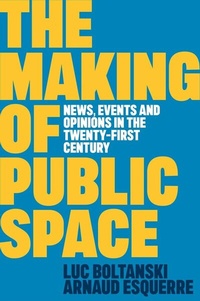
The Making of Public Space
News, Events and Opinions in the Twenty-First Century
1st Edition
Published on 18. November 2024
307 pages
978-1-5095-6700-3 (ISBN)
Description

This new book by Luc Boltanski and Arnaud Esquerre is a highly original analysis of the two key processes that shape the contemporary public sphere. On the one hand, there are the processes of news provision which select out a range of facts and events and bring them to the attention of a large number of people who have not, for the most part, experienced them directly. On the other hand, there are processes of politicization which problematize the facts made known by news provision and treat them as issues that concern citizens and the state. Politicization is typically characterized by a diversity of interpretations which, in turn, gives rise to a proliferation of commentary, discussion, polemic and division.
In order to study these processes and their interaction, Boltanski and Esquerre draw on a vast repository of user comments left on the site of a major daily newspaper, as well as the thousands of comments posted on an online video site. They uncover what is sayable by comparing published comments with those deleted by moderators. They capture opinions in the course of their formation, rather than describing views which have long become cemented; these are often reflexive and wise, deriving from responses to interviews or opinion polls. They map out the parameters of politicization today, touching on various hot topics such as feminism, the environment, immigration, religion, nationalism and Europe.
This is not just a book about the news and the press, but a major new work which shows how political opinion comes into being and the way in which it affects our daily lives. It will be of great value to students and scholars in media studies, sociology and politics, as well as to anyone interested in the state of politics and the media in our contemporary digital age.
In order to study these processes and their interaction, Boltanski and Esquerre draw on a vast repository of user comments left on the site of a major daily newspaper, as well as the thousands of comments posted on an online video site. They uncover what is sayable by comparing published comments with those deleted by moderators. They capture opinions in the course of their formation, rather than describing views which have long become cemented; these are often reflexive and wise, deriving from responses to interviews or opinion polls. They map out the parameters of politicization today, touching on various hot topics such as feminism, the environment, immigration, religion, nationalism and Europe.
This is not just a book about the news and the press, but a major new work which shows how political opinion comes into being and the way in which it affects our daily lives. It will be of great value to students and scholars in media studies, sociology and politics, as well as to anyone interested in the state of politics and the media in our contemporary digital age.
More details
Other editions
Additional editions
Luc Boltanski | Arnaud Esquerre
The Making of Public Space
News, Events and Opinions in the Twenty-First Century
Book
12/2024
1st Edition
Polity Press
€65.50
Shipment within 15-20 days
Luc Boltanski | Arnaud Esquerre
The Making of Public Space
News, Events and Opinions in the Twenty-First Century
Book
12/2024
1st Edition
Polity Press
€24.00
Shipment within 15-20 days
Persons
Luc Boltanski is Professor of Sociology at EHESS, Paris, and the author of many books including The New Spirit of Capitalism (with Eve Chiapello) and Enrichment (with Arnaud Esquerre).
Arnaud Esquerre is a sociologist and Director of Research at the CNRS, France. He is the co-author of Enrichment.
Arnaud Esquerre is a sociologist and Director of Research at the CNRS, France. He is the co-author of Enrichment.
Content
Acknowledgments
Introduction
News as a global culture
The corpuses of data on which this work has focused
The empirical analysis of the politicization and formation of 'opinions'
Crowds, masses, networks
Democracy as it is
I
Being immersed in the news
Chapter 1. The presence and periodization of the inaccessible
The consistency of the Now
Knowing by experience or by hearsay
The accessible and the inaccessible
What news in which history?
Time's arrow
Some problems of historical periodization
The formation of planes of news items
The news in the eyes of its critics (1): inauthenticity
The news in the eyes of its critics (2): fake democracy
Chapter 2. The process of the event
News, History and the need to select
Selection and censorship
The truth of facts, the adequacy of interpretations
Trouble with events
The coalescence of facts in the plane of news items
The de-composition and deconstruction of events
Precedents
Primary facts and derived facts: the worth and force of an event
Political facts as a series
Document 1. History (with a capital H) and history
Chapter 3. Political events and the formation of generations
The salience of events
Break or continuity: a question of scale
At what scale does Le Monde view the world (le monde)? The obituary test
Breaks in institutional continuity
The role of major political events in the formation of generations
Structural collectives and generational collectives
'Our generation!'
II
Politicization
Document 2. Plot
Chapter 4. Political discussion
Conversation or discussion
The risks of political discussion
Document 3. Medias
Chapter 5. Le Monde and its readers: between news and History
Le Monde as a news organ and quasi-institution
Le Monde and History
Journalists and their readers
Document 4. Censured
Chapter 6. The structure of comments on the news
Pre-texts and comments
The constraints on utterance
Contesting the truth of the facts: the 11 September 2001 attacks, with comments made on INA Société
Discussion, moderation and commercial censorship
Commenting is not denouncing
The irony of the commentators
Document 5. What are their names?
Chapter 7. The work of 'one'
The intense pleasure of comment
States of mind
Anonymity and mishmash
The 'one' of the news
Document 6. Readers' replies
Chapter 8. Politicizing the news
What are they thinking of?
What is a political problem?
The process of politicization
Medically assisted procreation, from the non-political to politics
Political shifts
Talking about Islam
Different shifts in the notion of environmentalism
When politics proves to be 'inextricable'
Document 7. 'Generations'
Chapter 9. The dynamics of politicization
Shifting positions and generation conflicts
Political problems and ideologies
Threats and remedies
Feeding into politicization
Document 8. 'Democracy'
Conclusion. The meaning of History
Interpretation: between adequacy and violence
'On the right' or 'on the left': the political description of interpretations
Towards the extreme
Politics and desolation
The digitalization of struggles
Appendices
Conceptual lexicon
Bibliography
Notes
Index
Introduction
News as a global culture
The corpuses of data on which this work has focused
The empirical analysis of the politicization and formation of 'opinions'
Crowds, masses, networks
Democracy as it is
I
Being immersed in the news
Chapter 1. The presence and periodization of the inaccessible
The consistency of the Now
Knowing by experience or by hearsay
The accessible and the inaccessible
What news in which history?
Time's arrow
Some problems of historical periodization
The formation of planes of news items
The news in the eyes of its critics (1): inauthenticity
The news in the eyes of its critics (2): fake democracy
Chapter 2. The process of the event
News, History and the need to select
Selection and censorship
The truth of facts, the adequacy of interpretations
Trouble with events
The coalescence of facts in the plane of news items
The de-composition and deconstruction of events
Precedents
Primary facts and derived facts: the worth and force of an event
Political facts as a series
Document 1. History (with a capital H) and history
Chapter 3. Political events and the formation of generations
The salience of events
Break or continuity: a question of scale
At what scale does Le Monde view the world (le monde)? The obituary test
Breaks in institutional continuity
The role of major political events in the formation of generations
Structural collectives and generational collectives
'Our generation!'
II
Politicization
Document 2. Plot
Chapter 4. Political discussion
Conversation or discussion
The risks of political discussion
Document 3. Medias
Chapter 5. Le Monde and its readers: between news and History
Le Monde as a news organ and quasi-institution
Le Monde and History
Journalists and their readers
Document 4. Censured
Chapter 6. The structure of comments on the news
Pre-texts and comments
The constraints on utterance
Contesting the truth of the facts: the 11 September 2001 attacks, with comments made on INA Société
Discussion, moderation and commercial censorship
Commenting is not denouncing
The irony of the commentators
Document 5. What are their names?
Chapter 7. The work of 'one'
The intense pleasure of comment
States of mind
Anonymity and mishmash
The 'one' of the news
Document 6. Readers' replies
Chapter 8. Politicizing the news
What are they thinking of?
What is a political problem?
The process of politicization
Medically assisted procreation, from the non-political to politics
Political shifts
Talking about Islam
Different shifts in the notion of environmentalism
When politics proves to be 'inextricable'
Document 7. 'Generations'
Chapter 9. The dynamics of politicization
Shifting positions and generation conflicts
Political problems and ideologies
Threats and remedies
Feeding into politicization
Document 8. 'Democracy'
Conclusion. The meaning of History
Interpretation: between adequacy and violence
'On the right' or 'on the left': the political description of interpretations
Towards the extreme
Politics and desolation
The digitalization of struggles
Appendices
Conceptual lexicon
Bibliography
Notes
Index
