

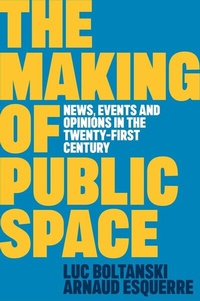
The Making of Public Space
Description

In order to study these processes and their interaction, Boltanski and Esquerre draw on a vast repository of user comments left on the site of a major daily newspaper, as well as the thousands of comments posted on an online video site. They uncover what is sayable by comparing published comments with those deleted by moderators. They capture opinions in the course of their formation, rather than describing views which have long become cemented; these are often reflexive and wise, deriving from responses to interviews or opinion polls. They map out the parameters of politicization today, touching on various hot topics such as feminism, the environment, immigration, religion, nationalism and Europe.
This is not just a book about the news and the press, but a major new work which shows how political opinion comes into being and the way in which it affects our daily lives. It will be of great value to students and scholars in media studies, sociology and politics, as well as to anyone interested in the state of politics and the media in our contemporary digital age.
More details
Other editions
Additional editions
Persons
Arnaud Esquerre is a sociologist and Director of Research at the CNRS, France. He is the co-author of Enrichment.
Content
Introduction
News as a global culture
The corpuses of data on which this work has focused
The empirical analysis of the politicization and formation of 'opinions'
Crowds, masses, networks
Democracy as it is
I
Being immersed in the news
Chapter 1. The presence and periodization of the inaccessible
The consistency of the Now
Knowing by experience or by hearsay
The accessible and the inaccessible
What news in which history?
Time's arrow
Some problems of historical periodization
The formation of planes of news items
The news in the eyes of its critics (1): inauthenticity
The news in the eyes of its critics (2): fake democracy
Chapter 2. The process of the event
News, History and the need to select
Selection and censorship
The truth of facts, the adequacy of interpretations
Trouble with events
The coalescence of facts in the plane of news items
The de-composition and deconstruction of events
Precedents
Primary facts and derived facts: the worth and force of an event
Political facts as a series
Document 1. History (with a capital H) and history
Chapter 3. Political events and the formation of generations
The salience of events
Break or continuity: a question of scale
At what scale does Le Monde view the world (le monde)? The obituary test
Breaks in institutional continuity
The role of major political events in the formation of generations
Structural collectives and generational collectives
'Our generation!'
II
Politicization
Document 2. Plot
Chapter 4. Political discussion
Conversation or discussion
The risks of political discussion
Document 3. Medias
Chapter 5. Le Monde and its readers: between news and History
Le Monde as a news organ and quasi-institution
Le Monde and History
Journalists and their readers
Document 4. Censured
Chapter 6. The structure of comments on the news
Pre-texts and comments
The constraints on utterance
Contesting the truth of the facts: the 11 September 2001 attacks, with comments made on INA Société
Discussion, moderation and commercial censorship
Commenting is not denouncing
The irony of the commentators
Document 5. What are their names?
Chapter 7. The work of 'one'
The intense pleasure of comment
States of mind
Anonymity and mishmash
The 'one' of the news
Document 6. Readers' replies
Chapter 8. Politicizing the news
What are they thinking of?
What is a political problem?
The process of politicization
Medically assisted procreation, from the non-political to politics
Political shifts
Talking about Islam
Different shifts in the notion of environmentalism
When politics proves to be 'inextricable'
Document 7. 'Generations'
Chapter 9. The dynamics of politicization
Shifting positions and generation conflicts
Political problems and ideologies
Threats and remedies
Feeding into politicization
Document 8. 'Democracy'
Conclusion. The meaning of History
Interpretation: between adequacy and violence
'On the right' or 'on the left': the political description of interpretations
Towards the extreme
Politics and desolation
The digitalization of struggles
Appendices
Conceptual lexicon
Bibliography
Notes
Index
Introduction
The subject of this book is the relationship between two sets of processes that make up the public space.1 On the one hand, there are the processes of 'turning into current affairs' (processus de mise en actualité) which, seizing on what is happening now, make a large number of people aware of the existence of facts that they have not, for the most part, directly experienced, usually accompanied by a description and an interpretation. On the other hand, there are processes of politicization2 which, seizing on facts made known by the process of turning into current affairs, problematize them, i.e. consider them as problems which concern anyone and thus also concern the state, while giving rise to interpretations whose divergences give rise to comments, discussions, polemics and divisions.
We will not start from a normative definition of 'public space' nor from the meanings that the term has taken on in the various political philosophies that have developed this idea3 - whether constructively or critically. Instead, we will take it as it presents itself to the so-called 'ordinary' people who find themselves confronted with it, and we will adopt the kind of approach developed over the past few decades by pragmatic sociology. An important dimension of this approach consists in clarifying and articulating the implicit notions underlying the competences that people draw on in order to act, treating these competences as if they were historically and socially situated ontologies. In the case of the democratic public space, two aspects in particular must be taken into account. The first concerns the relationship between public space and what is called news (actualité). These days, the public space tends to merge with the many types of news about what is happening now, whether in a national political framework or elsewhere in the world - news whose constant presence has been intensified by digitalization: the most recent news constantly adds to or replaces that which appeared a few days or hours earlier.
The second aspect, politicization, relates to the way in which politics manifests itself today in the public space, and thus to one of the modalities through which people who find themselves immersed in news also contribute to the functioning of the political sphere. We propose to approach politics, not as an essence - one of the meanings of the use of the word 'politics' or 'the political' (le politique) - but as a process, since it is mainly via the processes of politicization and the divisions they cause that politics becomes part of the public space and accompanies people's daily lives. The distinction between the process of turning into current affairs and the process of politicization, while necessary on an analytical level (not all news is politicized, and processes of politicization can form without being part of the news), also highlights their interactions. Within the immensity of what is happening, news focuses mainly on the areas of social life affected by the processes of politicization that, for their part, develop by taking from the news those cases likely to provide the raw material for these processes and to give them a concrete expression.
News as a global culture
The first part of this work is devoted to sketching an ontology of contemporary actuality, taking up a proposal by Michel Foucault in his commentary on Immanuel Kant's text in response to the question: 'What is Enlightenment?'4 We are thus placing ourselves in a field that lies outside the sociology of the media, insofar as this studies the functioning and organization of the mechanisms of technical information and communication and the bodies on which they depend, and also outside the sociology of journalism (and journalists), insofar as this takes as its subject a profession and the characteristics or backgrounds of those who practise it. Under the term news we shall not, to begin with, include people or organizations, but multiple forms of knowledge concerning the world and what is happening in it. This news circulates between people without them having, in most cases, a direct personal experience of the events reported in the news. And yet, these multitudes actively contribute to ensuring the presence of these news events by echoing them and commenting on them in their conversations. News - in the sense in which we understand it here - can be seen as an environment within which almost all the members of our societies find themselves immersed, at almost the same time (even if there are variations between groups and between individuals, in this respect as in others); and all, or nearly all, of these people also contribute to shaping and spreading it. In fact, what we have here is an artefact, one of those products of human activities that, in turn, imprint on those activities a certain shape, of which cultures (in social anthropology) are in a way the paradigm.
In the human sciences, from the outset, the reference to these various intermediate milieux known as 'cultures', including the notion of news, has played a role somewhat comparable to that which ancient physics assigned to the ether - the hypothetical fluid that was thought to act as a medium for the propagation of light waves. These milieux were considered, like language, to be indispensable interfaces for understanding the relationship between human beings, considered as singular individuals, and the ethnic or political entities to which they seemed necessarily to be linked; such milieux were thus also crucial for explaining the nature of social ties. However, while the idea of cultures has been designed to account for the differences between individuals, presumed to be similar, and thus to interpret the diversity of human groups, participation in the news seems to be an important factor of socialization in the age of a fraught globalization. Cultures are also distinguished from the news because of their different relationships to temporality. The notion of culture, originally devised by scholars belonging to societies whose self-consciousness was being transformed by a new sense of historicity, was an attempt to understand the so-called primitive or traditional societies that were presumed to lack a history; 'culture' was, thus, intended for universal and ahistorical use.
Conversely, the notion of news is - as we shall see - temporal through and through. Devoted to the staging of what is happening now, it relies on the very history of which it claims to be a moment, and moves into prediction and even prophecy. We will show, too, that news is associated with a form of sociality that, being itself part of the fabric of time, tends to see generation-based collectives as particularly important triggers of social and political differentiation. Finally, our analysis of the relationship between individual people, each immersed in the continuity of their lifeworlds, and the succession of different planes of news items, striking in their discontinuity, gave us an opportunity to place a certain attention to temporality at the heart of our analysis of social phenomena. This involved giving such an analysis a place that structuralist approaches certainly did not grant it - and that pragmatist approaches, although originally directed towards the analysis of processes, have tended to neglect.5 Focusing on the news enables us to look again at the question of the event: it frees us from what has become an entrenched contrast between, on the one hand, temporality, deemed to be too short to be 'true' of what presents itself now, in the present, in a way deemed 'superficial'; and, on the other hand, the 'long period', thought of as the period in which unfolds the silent but profound evolution of structures whose size is decisive.
In the second part of this work, we will move into the field of politics as it presents itself in a society in which the news occupies a very important place, as is especially the case in large states of a democratic cast, particularly when they are administered in a very centralized way - something that diminishes the role of local political activities and face-to-face situations. In fact, in contexts of this type, the functioning of politics relies largely on the votes of citizens who, in general, have only an indirect acquaintance with the people who aspire to occupy leading positions, or with the problems that these people will have to face. These individuals and these problems are known to most citizens only through the news, and it is therefore first and foremost in relation to the news that they react and act politically. One cannot overemphasize the number, frequency and diversity of cognitive procedures, judgements, utterances, links, reconciliations and arguments, likes and dislikes, etc., that never cease to affect people when they react to political news. This news, then, is always to be found at the interface between the governed and those who govern them, and it plays a driving role in the process of politicization.
One of the effects of politicization (which makes clear the political character of states of affairs that may not previously have been considered political), and of the inverse process of depoliticization (which denies that a certain state of affairs can be dependent on political decisions, or blurs the role of such decisions), is that they constantly modify the contours of politics by shifting the line that separates what lies...
