

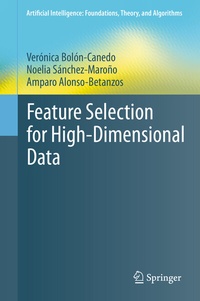
Feature Selection for High-Dimensional Data
Description

This book offers a coherent and comprehensive approach to feature subset selection in the scope of classification problems, explaining the foundations, real application problems and the challenges of feature selection for high-dimensional data.
The authors first focus on the analysis and synthesis of feature selection algorithms, presenting a comprehensive review of basic concepts and experimental results of the most well-known algorithms.
They then address different real scenarios with high-dimensional data, showing the use of feature selection algorithms in different contexts with different requirements and information: microarray data, intrusion detection, tear film lipid layer classification and cost-based features. The book then delves into the scenario of big dimension, paying attention to important problems under high-dimensional spaces, such as scalability, distributed processing and real-time processing, scenarios that open up new and interesting challenges for researchers.
The book is useful for practitioners, researchers and graduate students in the areas of machine learning and data mining.
More details
Other editions
Additional editions
Persons
Dr. Verónica Bolón-Canedo received her PhD in Computer Science from the University of A Coruña, where she is currently a postdoctoral researcher. Her research interests include data mining, feature selection and machine learning.
Dr. Noelia Sánchez-Maroño received her PhD in 2005 from the University of A Coruña, where she is currently a lecturer. Her research interests include agent-based modeling, machine learning and feature selection.
Prof. Amparo Alonso-Betanzos received her PhD in 1988 from the University of Santiago de Compostela, she is a Chair Professor in the Dept. of Computer Science at the University of A Coruña (Spain) and coordinator of the Laboratory for Research and Development in Artificial Intelligence. Her areas of expertise are machine learning, feature selection, knowledge-based systems, and their applications to fields such as predictive maintenance in engineering or predicting gene expression in bioinformatics.
