

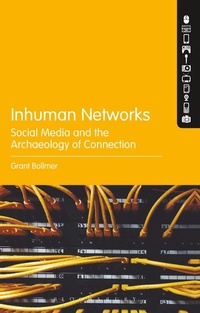
Inhuman Networks
Social Media and the Archaeology of Connection
1st Edition
Published on 11. August 2016
304 pages
978-1-5013-1616-6 (ISBN)
Description

Social media's connectivity is often thought to be a manifestation of human nature buried until now, revealed only through the diverse technologies of the participatory internet. Rather than embrace this view, Inhuman Networks: Social Media and the Archaeology of Connection argues that the human nature revealed by social media imagines network technology and data as models for behavior online. Covering a wide range of historical and interdisciplinary subjects, Grant Bollmer examines the emergence of "the network" as a model for relation in the 1700s and 1800s and follows it through marginal, often forgotten articulations of technology, biology, economics, and the social. From this history, Bollmer examines contemporary controversies surrounding social media, extending out to the influence of network models on issues of critical theory, politics, popular science, and neoliberalism. By moving through the past and present of network media, Inhuman Networks demonstrates how contemporary network culture unintentionally repeats debates over the limits of Western modernity to provide an idealized future where "the human" is interchangeable with abstract, flowing data connected through well-managed, distributed networks.
Reviews / Votes
Part an archaeology of connectivity, part critical analysis of contemporary culture, Inhuman Networks offers an inspiring take for media studies. Grant Bollmer's rich, multi-layered book shows that social media does not just mediate but performs a subtle yet effective moral code: the networks prescribe senses of the self, community, value and direction. The so-called human exists only if it routes. * Jussi Parikka, Winchester School of Art, UK author of Digital Contagions (2007) and Insect Media (2010) * Bollmer's Inhuman Networks represents the best of the cultural studies tradition of taking the object seriously, learning everything one can about it, putting it into historical and cultural contexts, and then rigorously critiquing it. Combining media archaeology and genealogy, Bollmer crafts critiques of the admonition to connect or be considered inhuman. However, he also challenges misguided calls for total refusal of connection, instead insisting we humans re-engage with practices of collectivity and commonality. * Robert W. Gehl, Associate Professor of Communication, University of Utah, USA, and author of Reverse Engineering Social Media * Bollmer's Inhuman Networks issues a bold and welcome critique of social media's culture of connectivity. This accessible, provocative analysis of the "network" concept is shaped by network theorists predating the network society: anatomists deciphering the flow of bodily fluids, railroad conglomerates arguing about rail gauge, defenders of branch banking, and conspiracy theorists. Bollmer deftly shows how the conjunction of these early modern discourses of the network combine with contemporary digital technologies to forge "nodal citizenship," a reduction of the human to an information node in a broader technological network. A must-read for anyone interested in communication, media studies, cultural theory, and political economy. * Damien Smith Pfister, Department of Communication, University of Maryland, USA and author of Networked Media, Networked Rhetorics * Inhuman Networks masterfully exposes the stunted understandings and logical fallacies undergirding widespread economic and cultural assertions that unless we are connected through social media we are less than human. Bollmer convincingly argues that enlightenment understandings of "human nature" are being supplanted by neoliberal and normative narratives of networked communications as the way to finally achieve full humanity. Yet this is a disempowered form of "humanity" constituted through capital and data alone and ultimately less important than the inhuman(e) routers through which individuals "connect" in empowered and irrelevant ways. * Ken Hillis, Professor of Media and Technology Studies University of North Carolina at Chapel Hill USA * As social media becomes more pervasive in many people's lives globally, the complex entanglement of the human and inhuman across practices, cultures, flows and networks are yet to being fully understood. Grant Bollmer's Inhuman Networks: Social Media and the Archaeology of Connection offers a thorough and thought-provoking discussion of how we might re-imagine social media beyond a human-centric model bolstered by problematic metaphors around connection. From metaphors such as "networks" to "contagion", Bollmer takes us on a fascinating journey in and around the messy relationality between technology, desire and humans. This book puts the complex human and beyond-human dimensions of social media in context historically and conceptually in ways that are both poetic and inspiring. * Larissa Hjorth, RMIT Distinguished Professor School of Media and Communication, RMIT University, Australia *More details
Edition
1. Auflage
Language
English
Place of publication
New York
United States
Publishing group
Bloomsbury Publishing PLC (Digital)
Target group
Professional and scholarly
Illustrations
20 bw illus
ISBN-13
978-1-5013-1616-6 (9781501316166)
Copyright in bibliographic data and cover images is held by Nielsen Book Services Limited or by the publishers or by their respective licensors: all rights reserved.
Schweitzer Classification
Other editions
Additional editions
Book
02/2018
Bloomsbury Academic USA
€63.32
Shipment within 15-20 days
Person
Grant Bollmer is Assistant Professor of Media Studies at North Carolina State University, where he teaches in the Department of Communication and the PhD Program in Communication, Rhetoric, and Digital Media, and an Honorary Associate of the Department of Media and Communications at The University of Sydney.
Content
1. Introduction: Connectivity, Flow, Citizenship
Part One: Network Archaeologies
2. Biology: Vital Technologies, Anatomical Networks
3. Society: Railroads, Red Scares, and Racism
4. Economy: Banking on Connection
Part Two: Nodal Citizens
5. Death: Living Forever as Automated Data
6. Labor: Giving Life to (Mobile) Fixed Capital
7. Truth: The Politics of Performing the Total Self
Part Three: Beyond Social Media, or, a World Without People
8. Contagion: The Inevitable Failure of Connectivity
9. (Political) Theory: How to Disempower Friends and Pathologize People
Bibliography
Index
Part One: Network Archaeologies
2. Biology: Vital Technologies, Anatomical Networks
3. Society: Railroads, Red Scares, and Racism
4. Economy: Banking on Connection
Part Two: Nodal Citizens
5. Death: Living Forever as Automated Data
6. Labor: Giving Life to (Mobile) Fixed Capital
7. Truth: The Politics of Performing the Total Self
Part Three: Beyond Social Media, or, a World Without People
8. Contagion: The Inevitable Failure of Connectivity
9. (Political) Theory: How to Disempower Friends and Pathologize People
Bibliography
Index
