

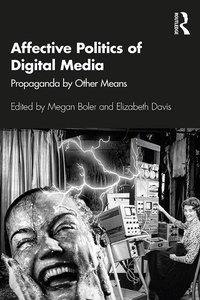
Affective Politics of Digital Media
Propaganda by Other Means
1st Edition
Published on 2. September 2020
378 pages
978-1-000-16907-2 (ISBN)
Description

This interdisciplinary, international collection examines how sophisticated digital practices and technologies exploit and capitalize on emotions, with particular focus on how social media are used to exacerbate social conflicts surrounding racism, misogyny, and nationalism.
Radically expanding the study of media and political communications, this book bridges humanities and social sciences to explore affective information economies, and how emotions are being weaponized within mediatized political landscapes. The chapters cover a wide range of topics: how clickbait, "fake news," and right-wing actors deploy and weaponize emotion; new theoretical directions for understanding affect, algorithms, and public spheres; and how the wedding of big data and behavioral science enables new frontiers of propaganda, as seen in the Cambridge Analytica and Facebook scandal. The collection includes original interviews with luminary media scholars and journalists.
The book features contributions from established and emerging scholars of communications, media studies, affect theory, journalism, policy studies, gender studies, and critical race studies to address questions of concern to scholars, journalists, and students in these fields and beyond.
Radically expanding the study of media and political communications, this book bridges humanities and social sciences to explore affective information economies, and how emotions are being weaponized within mediatized political landscapes. The chapters cover a wide range of topics: how clickbait, "fake news," and right-wing actors deploy and weaponize emotion; new theoretical directions for understanding affect, algorithms, and public spheres; and how the wedding of big data and behavioral science enables new frontiers of propaganda, as seen in the Cambridge Analytica and Facebook scandal. The collection includes original interviews with luminary media scholars and journalists.
The book features contributions from established and emerging scholars of communications, media studies, affect theory, journalism, policy studies, gender studies, and critical race studies to address questions of concern to scholars, journalists, and students in these fields and beyond.
Reviews / Votes
"This is an invaluable guidebook to the affective landscape of our political moment, packed with contributions from original and groundbreaking thinkers. It counters the pace and tone of online propaganda with a crucial critical intervention, contributing to our understanding of the fate of understanding itself-and the consequences for political life."Mark Andrejevic, Professor of Communications & Media Studies, Monash University
"This collection presents the state of the art for investigating affective politics. Importantly, it outlines the risks posed to our democratic institutions if we don't ensure the technical and legal fixes required to delimit social media firms capitalizing on emotional appeals and cognitive biases."
Philip N. Howard, Director, Oxford Internet Institute and Professor, Oxford University, author of Lie Machines (2020) "This is an invaluable guidebook to the affective landscape of our political moment, packed with contributions from original and groundbreaking thinkers. It counters the pace and tone of online propaganda with a crucial critical intervention, contributing to our understanding of the fate of understanding itself-and the consequences for political life."
Mark Andrejevic, Professor of Communications & Media Studies, Monash University
"This collection presents the state of the art for investigating affective politics. Importantly, it outlines the risks posed to our democratic institutions if we don't ensure the technical and legal fixes required to delimit social media firms capitalizing on emotional appeals and cognitive biases."
Philip N. Howard, Director, Oxford Internet Institute and Professor, Oxford University, author of Lie Machines (2020)
"Affective Politics of Digital Media is a body of work that demonstrates just how central affective dynamics are to the political realities generated in an increasingly mediatized world...any chapter of this book stands as a useful entry point for scholars interested in the affective politics of digital media, with each offering a unique perspective and potential avenue for further exploration. It is therefore an important collection for anybody working in the fields of technology, media, journalism, political communications, and policy, and for those seeking to become attuned to the affective dynamics of digital media more broadly."
Rachel Billington, New Media and Society 24(6)
More details
Edition
1. Auflage
Language
English
Place of publication
London
United Kingdom
Publishing group
Taylor & Francis Ltd
Target group
College/higher education
Illustrations
1 Tables, black and white; 2 Line drawings, black and white; 4 Halftones, black and white; 6 Illustrations, black and white
ISBN-13
978-1-000-16907-2 (9781000169072)
Copyright in bibliographic data and cover images is held by Nielsen Book Services Limited or by the publishers or by their respective licensors: all rights reserved.
Schweitzer Classification
Other editions
Additional editions
Book
09/2020
1st Edition
Routledge
€207.30
Shipment within 15-20 days
Book
09/2020
1st Edition
Routledge
€62.20
Shipment within 15-20 days
Persons
Megan Boler is Professor in the Social Justice Education Department at the Ontario Institute for Studies in Education, University of Toronto. Her research focuses on philosophy and politics of emotion; critical studies of affect, social media, and propaganda; and digital media practices within social movements. Her books include Feeling Power: Emotions and Education (1999), Democratic Dialogue in Education (2004), Digital Media and Democracy (2008), and DIY Citizenship (Ratto and Boler, 2014).
Elizabeth Davis is a PhD candidate in the Social Justice Education Department at the Ontario Institute for Studies in Education, University of Toronto. Her research focuses on histories and structures of feeling drawing on materialist, feminist, critical race, disability, media, and cultural studies approaches. Her articles can be found in Theory & Event, Emotion, Space and Society, and The Senses and Society.
Elizabeth Davis is a PhD candidate in the Social Justice Education Department at the Ontario Institute for Studies in Education, University of Toronto. Her research focuses on histories and structures of feeling drawing on materialist, feminist, critical race, disability, media, and cultural studies approaches. Her articles can be found in Theory & Event, Emotion, Space and Society, and The Senses and Society.
Content
Introduction: Propaganda by Other Means Part I: Theorizing Media and Affect 1. Affect, Media, Movement: Interview with Susanna Paasonen and Zizi Papacharissi 2. Reverberation, Affect, and Digital Politics of Responsibility 3. "Fuck Your Feelings": The Affective Weaponization of Facts and Reason 4. Blockchain, Affect, and Digital Teleologies 5. Becoming Kind: A Political Affect for Post-Truth Times 6. Beyond Behaviorism and Black Boxes: The Future of Media Theory Interview with Wendy Chun, Warren Sack, and Sarah Sharma Part II: Affective Media, Social Media, and Journalism: New Relationships 7. Pioneering Countercultural Conservatism: Limbaugh, Drudge, and Breitbart 8. Breitbart's Attacks on Mainstream Media: Victories, Victimhood, and Vilification 9. Algorithmic Enclaves: Affective Politics and Algorithms in the Neoliberal Social Media Landscape 10. Hashtagging the Quebec Mosque Shooting: Twitter Discourses of Resistance, Mourning, and Islamophobia 11. Hindu Nationalism, News Channels, and "Post-Truth" Twitter: A Case Study of "Love Jihad" 12. Computational Propaganda and the News: Journalists' Perceptions of the Effects of Digital Manipulation on Reporting Part III: Exploitation of Emotions in Digital Media: Propaganda and Profit 13. Empathic Media, Emotional AI, and the Optimization of Disinformation 14. The Heart's Content: The Emotional Turn at Upworthy 15. Empires of Feeling: Social Media and Emotive Politics 16. Nudging Interventions in Regulating the Digital Gangsters in an Era of Friction-Free Surveillance Capitalism 17. Digital Propaganda and Emotional Micro-Targeting: Interview with Jonathan Albright, Carole Cadwalladr, Paolo Gerbaudo, and Tamsin Shaw
