

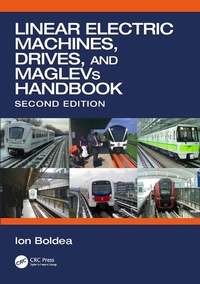
Linear Electric Machines, Drives, and MAGLEVs Handbook
2nd Edition
Published on 31. July 2023
736 pages
978-1-000-90611-0 (ISBN)
Description

Linear motion is richly present in various industries, from direct electric propulsion in urban and interurban people movers on wheels or on magnetic "cushions" (MAGLEVs) to indoor transport of goods (conveyors, etc.), through plunger solenoids (to open hotel doors and as electromagnetic power switches), to compressor drives by linear oscillatory permanent magnet (PM) motors, smart phones integrated microphone and loudspeakers, and controlled vehicles' suspension, etc. Besides the traditional rotary motor drives with mechanical transmissions, which mean friction limitations (weather dependent) in traction (heavy vehicles), more losses, positioning errors (backlash) in the process, and higher maintenance costs to handle them, linear motion in industry by direct electromagnetic forces is free of friction limitations for traction, free of mechanical transmission, and thus more efficient, with less maintenance cost and fewer positioning errors (backlash). This explains why they are used in so many applications already since the dramatic advancement of power electronics and digital control in the last four decades.
Modeling, performance, design, control, and testing of linear electric machines (LEMs) show notable differences with respect to rotary electric motor drives, which warrant a dedicated treatment of these aspects.
The Second Edition (First Edition: 2013) concentrates on the above technical aspects of various types of LEMs in close relationship with specific applications via numerical examples of modeling, design, control, and testing, with ample representative results from literature, industry and some of the author's contributions, such as:
Technical field and circuit modeling of linear induction motors in flat configurations for low and high speeds (with and without dynamic end effects) and in tubular configurations short travel design, control and testing
Linear synchronous motor (LSM) drives in dc-excited, homopolar, reluctance and superconducting excitation configurations for urban and interurban high-speed vehicles propulsion and integrated propulsion and levitation (in MAGLEVs) modeling, design and control with full-scale numerical examples, with emphasis on lower KWh/passenger/Km at high speeds
Flat and tubular linear permanent magnet (PM) synchronous motors (L-PMSMs), mainly destined to industrial indoor transport for automation at high efficiency in clean rooms
Linear "flux-modulation" motors- new breed, suitable for very low-speed applications due to higher thrust density
Plunger solenoids in various applications including new valve PM actuators with millisecond response time
Linear resonant PM oscillatory motors design, control and testing mainly destined to compressors for higher efficiency in compact drives
Attraction and repulsive force suspension (levitation) systems for MAGLEVs
Active and passive guideway MAGLEVs in urban and superhigh-speed interurban transport at lower Kwh per passenger/km (in lighter vehicles without wheels)
The numerous numerical design and control examples (with practical specifications) throughout the 23 chapters of the book allow the reader deep and fast access to a practical but thorough unitary (good for comparisons) methodology in designing and controlling LEMs for various applications.
Modeling, performance, design, control, and testing of linear electric machines (LEMs) show notable differences with respect to rotary electric motor drives, which warrant a dedicated treatment of these aspects.
The Second Edition (First Edition: 2013) concentrates on the above technical aspects of various types of LEMs in close relationship with specific applications via numerical examples of modeling, design, control, and testing, with ample representative results from literature, industry and some of the author's contributions, such as:
Technical field and circuit modeling of linear induction motors in flat configurations for low and high speeds (with and without dynamic end effects) and in tubular configurations short travel design, control and testing
Linear synchronous motor (LSM) drives in dc-excited, homopolar, reluctance and superconducting excitation configurations for urban and interurban high-speed vehicles propulsion and integrated propulsion and levitation (in MAGLEVs) modeling, design and control with full-scale numerical examples, with emphasis on lower KWh/passenger/Km at high speeds
Flat and tubular linear permanent magnet (PM) synchronous motors (L-PMSMs), mainly destined to industrial indoor transport for automation at high efficiency in clean rooms
Linear "flux-modulation" motors- new breed, suitable for very low-speed applications due to higher thrust density
Plunger solenoids in various applications including new valve PM actuators with millisecond response time
Linear resonant PM oscillatory motors design, control and testing mainly destined to compressors for higher efficiency in compact drives
Attraction and repulsive force suspension (levitation) systems for MAGLEVs
Active and passive guideway MAGLEVs in urban and superhigh-speed interurban transport at lower Kwh per passenger/km (in lighter vehicles without wheels)
The numerous numerical design and control examples (with practical specifications) throughout the 23 chapters of the book allow the reader deep and fast access to a practical but thorough unitary (good for comparisons) methodology in designing and controlling LEMs for various applications.
Reviews / Votes
Linear electromagnetic machines (LEMs) exploit electromagnetic phenomena to convert electrical energy to linear motion mechanical energy reversibly. They were invented well before the 1960s, when they became interesting for industrial applications thanks to the widely spreading use of power electronic circuits for controlling linear position, speed, and force. The LEM improvements, in terms of both steady and dynamic performance, during the last decades motivate the new edition of this handbook, which includes 23 chapters having the attributes of tutorials and monographs. This second edition upgrades the former one by including a new chapter, which is dedicated to flux modulation linear permanent magnet (PM) motors and magnetic screws, and some new paragraphs related to subjects that have become hot in the field in the last ten years. It covers solution classifications to practical topologies, to modeling, design, and control, and provides numerous case studies, examples, and sample results based on an up-to-date survey of the field.-Giovanni Spagnuolo, University of Salerno, Italy
More details
Edition
2nd edition
Language
English
Place of publication
London
United Kingdom
Publishing group
Taylor & Francis Ltd
Target group
Professional and scholarly
Illustrations
41 Tables, black and white; 540 Line drawings, black and white; 20 Halftones, black and white; 560 Illustrations, black and white
ISBN-13
978-1-000-90611-0 (9781000906110)
Copyright in bibliographic data and cover images is held by Nielsen Book Services Limited or by the publishers or by their respective licensors: all rights reserved.
Schweitzer Classification
Other editions
Additional editions
Book
12/2024
2nd Edition
CRC Press
€126.50
Shipment within 10-20 days
Book
07/2023
2nd Edition
CRC Press
€246.10
Shipment within 10-20 days
Person
Prof. Ion Boldea studied and published extensively on "rotary and liners electric machines, drives and MAGLEVs design ,control and testing for energy saving and increased productivity in various industries: from renewable energy, through e-transport, robotics, industrial drives, home appliances and info-gadjets since 1976( ISI H-index 41(4173 citations),Scopus H-index 49(8202 citations),Google Academic H-index 61(6246 citations); he wrote more than 20 Monographs and textbooks in USA and U.K on the wide spectrum subjects above ( 6000 citations in World.cat), held IEEE DLs since 2008, intensive Courses in USA, EU,S. Korea, Brasil, China , tutorials at IEEE Conferences, Technical Consulting annual contracts, hosted IEEE Trans. special issues and spent more than 5 years in many visits since 1973 as visiting scholar in USA.He supervised successfully 24 Ph. D. students.
Main expertise : in design and advanced encoder and encoderless control of ac electric motor/generators for applications : in home appliances,intelligent buildings,robotics, industrial processes, variable speed generators -standard and new- in power systems penetrated by renewable energy and in electric transport(cars, trucks, buses trolley buses, underground METRO, regional and high speed trains, MAGLEVs ); from critical analysis of existing solutions with improvement proposals to potentially- patentable solutions conception, design and control ,with lab prototyping and testing having as support :250+m*m labs and 11 people group(a Research Center for electric energy conversion, processing and storage with advanced digital control for various industries )at University Politehnica Timisoara ,Romania (www.upt.ro")
He received "IEEE 2015 Nikola Tesla Award" and "2021 EPE-ECCE Outstanding Achievement Award".
He also cochaired IEEE tech sponsored biannual International Conference OPTIM(now OPTIM-ACEMP) since 1994 and is the founding (since the year 2000)and current Editor in Chief of www.jee.ro, one of the first Internet-only technical Journals. His interests span from Philosophy, Ethics to Gardening mountain hiking and tennis.
Main expertise : in design and advanced encoder and encoderless control of ac electric motor/generators for applications : in home appliances,intelligent buildings,robotics, industrial processes, variable speed generators -standard and new- in power systems penetrated by renewable energy and in electric transport(cars, trucks, buses trolley buses, underground METRO, regional and high speed trains, MAGLEVs ); from critical analysis of existing solutions with improvement proposals to potentially- patentable solutions conception, design and control ,with lab prototyping and testing having as support :250+m*m labs and 11 people group(a Research Center for electric energy conversion, processing and storage with advanced digital control for various industries )at University Politehnica Timisoara ,Romania (www.upt.ro")
He received "IEEE 2015 Nikola Tesla Award" and "2021 EPE-ECCE Outstanding Achievement Award".
He also cochaired IEEE tech sponsored biannual International Conference OPTIM(now OPTIM-ACEMP) since 1994 and is the founding (since the year 2000)and current Editor in Chief of www.jee.ro, one of the first Internet-only technical Journals. His interests span from Philosophy, Ethics to Gardening mountain hiking and tennis.
Content
1. Fields, Forces, and Materials for LEMs. 2. Classifications and Applications of LEMs. 3. Linear Induction Motors: Topologies, Fields, Forces, and Powers Including Edge, End, and Skin Effects. 4. Linear Induction Motors: Circuit Theories, Transients, and Control. 5. Design of Flat and Tubular Low-Speed LIMs. 6. Transportation (Medium- and High-Speed) SLIM Design. 7. DC-Excited Linear Synchronous Motors (DCE-LSM) Steady State, Design, Transients, and Control. 8. Superconducting Magnet Linear Synchronous Motors. 9. Homopolar Linear Synchronous Motors (H-LSM): Modeling, Design, and Control. 10. Linear Reluctance Synchronous Motors:Modeling, Performance Design, and Control. 11. Linear Switched Reluctance Motors (L-SRM): Modeling, Design, and Control. 12. Flat Linear Permanent Magnet Synchronous Motors. 13. Tubular Linear Permanent Magnet Synchronous Motors. 14. Multi-Pole Coil Three-or Two-Phase Linear PM Reluctance Motors. 15. Flux - Modulation Linear PM Motors and Magnetic Screws. 16. Plunger Solenoids and Their Control. 17. Linear Single- Phase PM Brushless Motors. 18. Resonant Linear Oscillatory Single-Phase PM Motors/Generators. 19. Multiaxis Linear PM Motor Drives. 20. Attraction Force (Electromagnetic) Levitation Systems. 21. Repulsive Force Levitation Systems. 22. Active Guideway MAGLEVs. 23. Passive Guideway MAGLEVs.
