

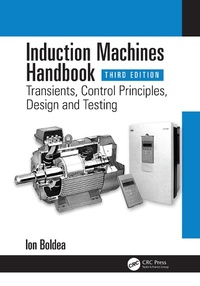
Induction Machines Handbook
Transients, Control Principles, Design and Testing
3rd Edition
Published on 19. May 2020
456 pages
978-1-000-05680-8 (ISBN)
Description

Induction Machines Handbook: Transients, Control Principles, Design and Testing presents a practical up-to-date treatment of intricate issues with induction machines (IM) required for design and testing in both rather constant- and variable-speed (with power electronics) drives. It contains ready-to-use industrial design and testing knowledge, with numerous case studies to facilitate a thorough assimilation of new knowledge.
Individual Chapters 1 through 14 discuss in detail the following:
Three- and multiphase IM transients
Single-phase source IM transients
Super-high-frequency models and behavior of IM
Motor specifications and design principles
IM design below 100 kW and constant V1 and f1
IM design above 100 kW and constant V1 and f1
IM design principles for variable speed
Optimization design
Single-phase IM design
Three-phase IM generators
Single-phase IM generators
Linear induction motors
Testing of three-phase IMs
Single-phase IM testing
Fully revised and amply updated to add the new knowledge of the last decade, this third edition includes special sections on
Multiphase IM models for transients
Doubly fed IMs models for transients
Cage-rotor synchronized reluctance motors
Cage-rotor PM synchronous motor
Transient operation of self-excited induction generator
Brushless doubly fed induction motor/generators
Doubly fed induction generators with D.C. output
Linear induction motor control with end effect
Recent trends in IM testing with power electronics
Cage-PM rotor line-start IM testing
Linear induction motor (LIM) testing
This up-to-date book discusses in detail the transients, control principles, and design and testing of various IMs for line-start and variable-speed applications in various topologies, with numerous case studies. It will be of direct assistance to academia and industry in conceiving, designing, fabricating, and testing IMs (for the future) of various industries, from home appliances, through robotics, e-transport, and renewable energy conversion.
Individual Chapters 1 through 14 discuss in detail the following:
Three- and multiphase IM transients
Single-phase source IM transients
Super-high-frequency models and behavior of IM
Motor specifications and design principles
IM design below 100 kW and constant V1 and f1
IM design above 100 kW and constant V1 and f1
IM design principles for variable speed
Optimization design
Single-phase IM design
Three-phase IM generators
Single-phase IM generators
Linear induction motors
Testing of three-phase IMs
Single-phase IM testing
Fully revised and amply updated to add the new knowledge of the last decade, this third edition includes special sections on
Multiphase IM models for transients
Doubly fed IMs models for transients
Cage-rotor synchronized reluctance motors
Cage-rotor PM synchronous motor
Transient operation of self-excited induction generator
Brushless doubly fed induction motor/generators
Doubly fed induction generators with D.C. output
Linear induction motor control with end effect
Recent trends in IM testing with power electronics
Cage-PM rotor line-start IM testing
Linear induction motor (LIM) testing
This up-to-date book discusses in detail the transients, control principles, and design and testing of various IMs for line-start and variable-speed applications in various topologies, with numerous case studies. It will be of direct assistance to academia and industry in conceiving, designing, fabricating, and testing IMs (for the future) of various industries, from home appliances, through robotics, e-transport, and renewable energy conversion.
More details
Series
Edition
3rd edition
Language
English
Place of publication
London
United Kingdom
Publishing group
Taylor & Francis Ltd
Illustrations
22 Tables, black and white; 342 Illustrations, black and white
File size
15,70 MB
ISBN-13
978-1-000-05680-8 (9781000056808)
Copyright in bibliographic data and cover images is held by Nielsen Book Services Limited or by the publishers or by their respective licensors: all rights reserved.
Schweitzer Classification
Other editions
Additional editions
Book
11/2024
3rd Edition
CRC Press
€63.00
Shipment within 10-20 days
Book
06/2020
3rd Edition
CRC Press
€230.60
Shipment within 15-20 days
Person
Ion Boldea, IEEE Life Fellow and Professor Emeritus at University Politehnica Timisoara, Romania, has taught, researched, and extensively published papers and books (monographs and textbooks) for more than 45 years related to rotary and linear electric motor/generator variable-speed drives, and maglevs. He was a visiting professor in the US and UK for more than 5 years between 1973 and the present.
He was granted four IEEE Best Paper Awards, has been a member of IEEE IAS, IE MEC, and IDC since 1992, was the guest editor of numerous special sections in IEEE Trans, vol. IE, IA, delivered keynote addresses at several IEEE-sponsored International Conferences, participated in IEEE Conference tutorials, and has been an IEEE IAS distinguished lecturer since 2008 (with lectures in the US, Brazil, South Korea, Denmark, Italy, etc.). He has conducted periodic intensive graduate courses for academia and industry in the US and Denmark for the last 20 years.
He was a general chair of ten biannual IEEE-sponsored OPTIM International Conferences (www.info-optim.ro) and is the founding and current chief editor, since 2000, of the internet-based Journal of Electrical Engineering (www.jee.ro).
As a full member of the Romanian Academy, he received the 2015 IEEE Nikola Tesla Award for his contributions to the development of rotary and linear electric motor/generator drives and maglevs modeling, design, testing, and control in industrial applications.
He was granted four IEEE Best Paper Awards, has been a member of IEEE IAS, IE MEC, and IDC since 1992, was the guest editor of numerous special sections in IEEE Trans, vol. IE, IA, delivered keynote addresses at several IEEE-sponsored International Conferences, participated in IEEE Conference tutorials, and has been an IEEE IAS distinguished lecturer since 2008 (with lectures in the US, Brazil, South Korea, Denmark, Italy, etc.). He has conducted periodic intensive graduate courses for academia and industry in the US and Denmark for the last 20 years.
He was a general chair of ten biannual IEEE-sponsored OPTIM International Conferences (www.info-optim.ro) and is the founding and current chief editor, since 2000, of the internet-based Journal of Electrical Engineering (www.jee.ro).
As a full member of the Romanian Academy, he received the 2015 IEEE Nikola Tesla Award for his contributions to the development of rotary and linear electric motor/generator drives and maglevs modeling, design, testing, and control in industrial applications.
Content
1. Induction Machine Transients 2. Single-Phase IM Transients 3. Super-High-Frequency Models and Behaviour of IMs 4. Motor Specifications and Design Principles 5. IM Design below 100 KW and Constant V and f (Size Your Own IM) 6. Induction Motor Design above 100 KW and Constant V and f (Size Your Own IM) 7. Induction Machine Design for Variable Speed 8. Optimization Design Issues 9. Single-Phase IM Design 10. Three-Phase Induction Generators 11. Single-Phase Induction Generators 12. Linear Induction Motors 13. Testing of Three-Phase IMs 14. Single-Phase IM Testing
