

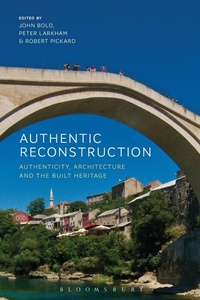
Authentic Reconstruction
Authenticity, Architecture and the Built Heritage
1st Edition
Published on 14. December 2017
352 pages
978-1-4742-8404-2 (ISBN)
Description

Notions of authenticity lie at the heart of many questions about heritage and identity in the built environment. These questions are most pertinent when buildings have been destroyed in disaster or war, and the built fabric is being reconstructed to reinstate traditional or historic appearances in place of what was lost.
Authentic Reconstruction examines this idea of reconstruction, using it as a prompt to examine a range of deeper issues on heritage and the built environment. From post-WWII reconstruction programmes through to the rebuilding of historic cultural landscapes lost in natural disasters, this collection of essays by heritage specialists provides a wide range of case-studies and discussions. Each presents responses to crises and lessons learned, in order to extrapolate general guidelines for future actions by politicians, architects and planners in reconstructing buildings.
The book also looks beyond disaster and war, noting how authenticity bears on political intentions and image building, exploring how reconstruction is used to tell a political or historical story, so conditioning the ways in which the built environment is perceived and appreciated by its users. This is not just about the buildings as bricks and mortar, but about perceptions of identity and the social and historical values which buildings and spaces embody for a richly diverse population.
This book will be valuable to all who are concerned with heritage as practitioners or consumers, particularly those concerned with reconstruction and the creation of authentic places and experiences: architects, architectural historians, town planners, preservationists, conservationists, and those involved in heritage management and material culture.
Authentic Reconstruction examines this idea of reconstruction, using it as a prompt to examine a range of deeper issues on heritage and the built environment. From post-WWII reconstruction programmes through to the rebuilding of historic cultural landscapes lost in natural disasters, this collection of essays by heritage specialists provides a wide range of case-studies and discussions. Each presents responses to crises and lessons learned, in order to extrapolate general guidelines for future actions by politicians, architects and planners in reconstructing buildings.
The book also looks beyond disaster and war, noting how authenticity bears on political intentions and image building, exploring how reconstruction is used to tell a political or historical story, so conditioning the ways in which the built environment is perceived and appreciated by its users. This is not just about the buildings as bricks and mortar, but about perceptions of identity and the social and historical values which buildings and spaces embody for a richly diverse population.
This book will be valuable to all who are concerned with heritage as practitioners or consumers, particularly those concerned with reconstruction and the creation of authentic places and experiences: architects, architectural historians, town planners, preservationists, conservationists, and those involved in heritage management and material culture.
More details
Edition
1. Auflage
Language
English
Place of publication
London
United Kingdom
Publishing group
Bloomsbury Publishing PLC
Target group
Professional and scholarly
Illustrations
50 BW illus
ISBN-13
978-1-4742-8404-2 (9781474284042)
Copyright in bibliographic data and cover images is held by Nielsen Book Services Limited or by the publishers or by their respective licensors: all rights reserved.
Schweitzer Classification
Other editions
Additional editions
John Bold | Peter Larkham | Robert Pickard
Authentic Reconstruction
Authenticity, Architecture and the Built Heritage
Book
02/2020
Bloomsbury Visual Arts
€59.60
Shipment within 15-20 days
John Bold | Peter Larkham | Robert Pickard
Authentic Reconstruction
Authenticity, Architecture and the Built Heritage
Book
12/2017
Bloomsbury Academic
€141.13
Shipment within 15-20 days
Persons
John Bold is former Reader in Architecture at the University of Westminster, UK and a consultant to the Council of Europe on cultural heritage.
Peter Larkham is Professor of Planning at Birmingham School of the Built Environment, Birmingham City University, UK.
Robert Pickard is Emeritus Professor in Heritage Conservation at Northumbria University, UK, and a consultant to the Council of Europe on cultural heritage.
Peter Larkham is Professor of Planning at Birmingham School of the Built Environment, Birmingham City University, UK.
Robert Pickard is Emeritus Professor in Heritage Conservation at Northumbria University, UK, and a consultant to the Council of Europe on cultural heritage.
Content
Acknowledgements
Notes on contributors
Introduction: Reconstruction: the built heritage following war or natural disaster - John Bold
Part 1: Reconstruction in traditional style after conflict
1.1: Traditional Building in Germany after the Second World War - Eva von Engelberg-Dockal and Hans-Rudolf Meier
1.2: Reconstruction of historic monuments in Poland after the Second World War: the case of Warsaw - Ingrid Appelbom Karsten
1.3: Post-conflict urban reconstruction of bazaars in Gjakova and Peja, Kosovo - Bujar Demjaha
Part 2: Reconstruction in contemporary style after conflict
2.1: Originality and authenticity in the post-war reconstruction of Britain - Peter J. Larkham and David Adams
2.2: Dutch reconstructed monuments in review - Marieke Kuipers
2.3: The reconstruction of France in the twentieth century following two world wars: a political or technical challenge? - Danièle Voldman
2.4: Reconstruction in South-East Europe and Georgia - an architect's perspective: scale, materials and appearances - David Johnson
Part 3: Reconstruction after natural or accidental disaster
3.1: Post-disaster reconstruction in the United States: a review of the role of authenticity in historic preservation policies and practices - Gail Sansbury
3.2: Reconstruction after fire - Robert Pickard
3.3: The path of reconstruction of the city of Aquila after the earthquake of 2009 - Alberto Lemme
3.4: The town reassembled: authenticity and transformation in Kiruna, Sweden - Jennie Sjöholm
Part 4: Political dimensions and image building
4.1: Historic buildings preservation and public opinion in England - Martin Cherry
4.2: Politicised reconstruction: the project 'Skopje 2014' - Julija Trichkovska
4.3: The future of post-civil war reconstruction: lessons from Spain - Olivia Muñoz-Rojas
Conclusions, guidelines and looking forward - John Bold, Robert Pickard and Peter J. Larkham
Notes on contributors
Introduction: Reconstruction: the built heritage following war or natural disaster - John Bold
Part 1: Reconstruction in traditional style after conflict
1.1: Traditional Building in Germany after the Second World War - Eva von Engelberg-Dockal and Hans-Rudolf Meier
1.2: Reconstruction of historic monuments in Poland after the Second World War: the case of Warsaw - Ingrid Appelbom Karsten
1.3: Post-conflict urban reconstruction of bazaars in Gjakova and Peja, Kosovo - Bujar Demjaha
Part 2: Reconstruction in contemporary style after conflict
2.1: Originality and authenticity in the post-war reconstruction of Britain - Peter J. Larkham and David Adams
2.2: Dutch reconstructed monuments in review - Marieke Kuipers
2.3: The reconstruction of France in the twentieth century following two world wars: a political or technical challenge? - Danièle Voldman
2.4: Reconstruction in South-East Europe and Georgia - an architect's perspective: scale, materials and appearances - David Johnson
Part 3: Reconstruction after natural or accidental disaster
3.1: Post-disaster reconstruction in the United States: a review of the role of authenticity in historic preservation policies and practices - Gail Sansbury
3.2: Reconstruction after fire - Robert Pickard
3.3: The path of reconstruction of the city of Aquila after the earthquake of 2009 - Alberto Lemme
3.4: The town reassembled: authenticity and transformation in Kiruna, Sweden - Jennie Sjöholm
Part 4: Political dimensions and image building
4.1: Historic buildings preservation and public opinion in England - Martin Cherry
4.2: Politicised reconstruction: the project 'Skopje 2014' - Julija Trichkovska
4.3: The future of post-civil war reconstruction: lessons from Spain - Olivia Muñoz-Rojas
Conclusions, guidelines and looking forward - John Bold, Robert Pickard and Peter J. Larkham
