

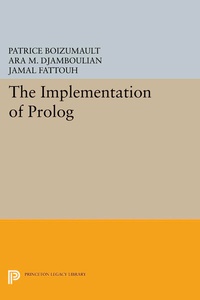
The Implementation of Prolog
1st Edition
Published on 10. March 2015
314 pages
978-1-4008-6344-0 (ISBN)
Description

A semantically well-defined programming language widely used in artificial intelligence, Prolog has greatly influenced other programming languages since its introduction in the late 1970s. A user may find Prolog deceptively easy, however, and there are a number of different implementations. In this book Patrice Boizumault draws from his extensive experience in Prolog implementation to describe for students of all levels the concepts, difficulties, and design limits of a Prolog system.
Boizumault introduces the specific problems posed by the implementation of Prolog, studies and compares different solutions--notably those of the schools of Marseilles and Edinburgh--and concludes with three examples of implementation. Major points of interest include identifying the important differences in implementing unification and resolution; presenting three features of Prolog II--infinite trees, dif, and freeze--that introduce constraints; thoroughly describing Warren's Abstract Machine (WAM); and detailing a Lisp imple-mentation of Prolog.
Originally published in 1993.
The Princeton Legacy Library uses the latest print-on-demand technology to again make available previously out-of-print books from the distinguished backlist of Princeton University Press. These editions preserve the original texts of these important books while presenting them in durable paperback and hardcover editions. The goal of the Princeton Legacy Library is to vastly increase access to the rich scholarly heritage found in the thousands of books published by Princeton University Press since its founding in 1905.
Boizumault introduces the specific problems posed by the implementation of Prolog, studies and compares different solutions--notably those of the schools of Marseilles and Edinburgh--and concludes with three examples of implementation. Major points of interest include identifying the important differences in implementing unification and resolution; presenting three features of Prolog II--infinite trees, dif, and freeze--that introduce constraints; thoroughly describing Warren's Abstract Machine (WAM); and detailing a Lisp imple-mentation of Prolog.
Originally published in 1993.
The Princeton Legacy Library uses the latest print-on-demand technology to again make available previously out-of-print books from the distinguished backlist of Princeton University Press. These editions preserve the original texts of these important books while presenting them in durable paperback and hardcover editions. The goal of the Princeton Legacy Library is to vastly increase access to the rich scholarly heritage found in the thousands of books published by Princeton University Press since its founding in 1905.
More details
Other editions
Additional editions
Patrice Boizumault
The Implementation of Prolog
Book
04/2016
Princeton University Press
€127.80
Article not available at the moment
Patrice Boizumault
The Implementation of Prolog
Book
07/2014
Princeton University Press
€51.60
Article not available at the moment

Patrice Boizumault
The Implementation of Prolog
Book
10/1993
Princeton University Press
€99.04
Article exhausted; check different version
Persons
Content
Foreword
Acknowledgments
Introduction
Pt. I Fundamental Principles of the Language
Ch. 1 Unification
Ch. 2 Resolution and Prolog Control
Ch. 3 Improving Prolog Control
Pt. II Principles and Techniques of Implementation
Ch. 4 Control and Stack(s) Management
Ch. 5 Representation of Terms
Ch. 6 Deterministic Call Returns
Ch. 7 Last-Call Optimization
Ch. 8 Clause Indexing
Ch. 9 Compilation of Prolog
Ch. 10 The dif and freeze Predicates of Prolog-II
Pt. III Implementations
Ch. 11 Mini-CProlog
Ch. 12 Mini-WAM
Ch. 13 Mini-Prolog-II
Ch. 14 Built-In Predicates
Conclusion
Appendix A: Mini-CProlog
Appendix B: Mini-WAM
Appendix C: Mini-Prolog-II
Appendix D: Common Part
Bibliography
Index
Acknowledgments
Introduction
Pt. I Fundamental Principles of the Language
Ch. 1 Unification
Ch. 2 Resolution and Prolog Control
Ch. 3 Improving Prolog Control
Pt. II Principles and Techniques of Implementation
Ch. 4 Control and Stack(s) Management
Ch. 5 Representation of Terms
Ch. 6 Deterministic Call Returns
Ch. 7 Last-Call Optimization
Ch. 8 Clause Indexing
Ch. 9 Compilation of Prolog
Ch. 10 The dif and freeze Predicates of Prolog-II
Pt. III Implementations
Ch. 11 Mini-CProlog
Ch. 12 Mini-WAM
Ch. 13 Mini-Prolog-II
Ch. 14 Built-In Predicates
Conclusion
Appendix A: Mini-CProlog
Appendix B: Mini-WAM
Appendix C: Mini-Prolog-II
Appendix D: Common Part
Bibliography
Index
