

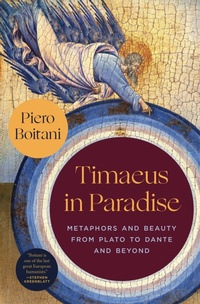
Timaeus in Paradise
Metaphors and Beauty from Plato to Dante and Beyond
1st Edition
Published on 25. November 2025
304 pages
978-0-691-27726-4 (ISBN)
Description

Tracing the influence and impact of Plato's Timaeus-and its major themes, creation and beauty-through the centuries
More than two thousand years after it was written, Plato's Timaeus continues to fascinate and intrigue its readers. In Timaeus in Paradise, Piero Boitani traces the abiding legacy of the Timaeus, mapping an intellectual journey that begins with Plato and extends to Dante and beyond. In a series of short, lyrical chapters, Boitani sketches a lineage that includes Proclus, Boethius, the Hebrew and Christian Bibles, John Scotus Eriugena and Thomas Aquinas. Focusing on Plato's metaphorical language-which Dante considered comparable to that of the Bible-and the beauty of its images, Boitani shows that these images penetrate deep into European culture, inspiring the anonymous author of the treatise on the Sublime as well as the mystical writings of Pseudo-Dionysius the Areopagite.
Plato's account of the creation of the cosmos in the Timaeus supplants Hesiod's myths and Parmenides's theories-and was described by Johannes Kepler as the best gloss ever on the first chapter of Genesis. Boitani finds its echoes everywhere, from the sculptures of Chartres Cathedral and the frescoes of the Anagni Crypt to the paintings of Raphael and Michelangelo. He connects the beauty defined in the Timaeus to the beauties of the Hebrew Bible and to the lilies of the field invoked by Jesus in the Sermon on the Mount. Bringing together philosophy, theology, mysticism, poetry, sculpture and painting, Boitani charts Europe's intellectual history-a history of ideas and images-by capturing the enduring reverberations of Plato's summa. Illustrations accompanying the text cover more than two thousand years of iconography.
More than two thousand years after it was written, Plato's Timaeus continues to fascinate and intrigue its readers. In Timaeus in Paradise, Piero Boitani traces the abiding legacy of the Timaeus, mapping an intellectual journey that begins with Plato and extends to Dante and beyond. In a series of short, lyrical chapters, Boitani sketches a lineage that includes Proclus, Boethius, the Hebrew and Christian Bibles, John Scotus Eriugena and Thomas Aquinas. Focusing on Plato's metaphorical language-which Dante considered comparable to that of the Bible-and the beauty of its images, Boitani shows that these images penetrate deep into European culture, inspiring the anonymous author of the treatise on the Sublime as well as the mystical writings of Pseudo-Dionysius the Areopagite.
Plato's account of the creation of the cosmos in the Timaeus supplants Hesiod's myths and Parmenides's theories-and was described by Johannes Kepler as the best gloss ever on the first chapter of Genesis. Boitani finds its echoes everywhere, from the sculptures of Chartres Cathedral and the frescoes of the Anagni Crypt to the paintings of Raphael and Michelangelo. He connects the beauty defined in the Timaeus to the beauties of the Hebrew Bible and to the lilies of the field invoked by Jesus in the Sermon on the Mount. Bringing together philosophy, theology, mysticism, poetry, sculpture and painting, Boitani charts Europe's intellectual history-a history of ideas and images-by capturing the enduring reverberations of Plato's summa. Illustrations accompanying the text cover more than two thousand years of iconography.
More details
Language
English
Place of publication
Princeton, NJ
United States
Publishing group
De Gruyter
Target group
Professional and scholarly
Edition type
Digital original
Product notice
Reflowable
Illustrations
32 color illus.
File size
50,36 MB
ISBN-13
978-0-691-27726-4 (9780691277264)
Schweitzer Classification
Other editions
Additional editions
Book
approx. 11/2025
Princeton University Press
€47.50
Not yet published
Person
Piero Boitani is Professor Emeritus of Comparative Literature at the Sapienza University of Rome. A Fellow of the British Academy, of the Accademia dei Lincei and of the Medieval Academy of America, he received the Balzan Prize for Comparative Literature in 2016. General Editor of the Greek and Latin Writers series of the Fondazione Lorenzo Valla, he is the author of Anagnorisis: Scenes and Themes of Recognition and Revelation in Western Literature, Il grande racconto dei classici, Plato's Poem and other books of criticism and poetry.
Content
- Cover
- Contents
- List of Illustrations
- Preface
- Note on Translations
- 1. One, Two, Three
- 2. Emulator of Homer
- 3. Pythagorean and Socratic
- 4. Parens, fabricator, artifex: Demogorgon and Phaethon
- 5. Descendants and Intermediaries
- 6. Rachel's Beauty
- 7. The Lilies of the Field
- 8. 'Mira profunditas'
- 9. Compunction and Transfiguration
- 10. 'O qui perpetua mundum ratione gubernas'
- 11. Beauty
- 12. Metaphorá
- 13. Integumenta
- Esthétique du Timée
- 14. The Three Days
- 15. Towards the altitudo terribilis
- 16. The Names of God
- 17. Decor, altitudo, gloria
- 18. Philomythía and Poetry
- 19. 'I love those who love me'
- 20. 'What Timaeus argues about the souls'
- 21. 'The hall-mark of genius'
- 22. 'We must lose ourselves'
- 23. 'Those things that cannot die and those that can'
- 24. 'To new loves Love Eternal opened out'
- 25. 'That deep mind'
- 26. 'Amor quo caelum regitur'
- 27. 'He laughed, self-mockingly'
- 28. 'This reason moved Augustine'
- 29. 'Fountain of light, seedbed of life'
- 30. 'Beings and accidents and modes of life'
- 31. The Moon Smiles Among the Eternal Nymphs
- 32. 'Splendour of God!'
- 33. 'The beauty I saw'
- 34. Neptune and Lethargy
- 35. The Last Simile: The Geometer
- 36. Epilogue: Descent from Heaven, Ascent to Art and Science
- Color Plates
- 37. Afterword: The Unmoved Mover Begins to Move: Literary and Visual Renderings of the Christian Bible
- Appendix: The Timaeus
- Sigla
- Abbreviations
- Notes
- Further Reading
- Illustration Credits
- Index of Names
