

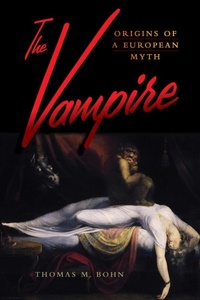
The Vampire
Origins of a European Myth
1st Edition
Published on 1. September 2019
304 pages
978-1-78920-293-9 (ISBN)
Description

Even before Bram Stoker immortalized Transylvania as the homeland of his fictional Count Dracula, the figure of the vampire was inextricably tied to Eastern Europe in the popular imagination.
Drawing on a wealth of previously neglected sources, this book offers a fascinating account of how vampires-whose various incarnations originally emerged from folk traditions from all over the world-became so strongly identified with Eastern Europe. It demonstrates that the modern conception of the vampire was born in the crucible of the Enlightenment, embodying a mysterious, Eastern otherness that stood opposed to Western rationality.
From the Prologue:
From Original Sin to Eternal Life
For a broad contemporary public, the vampire has become a star, a media sensation from Hollywood. Bestselling authors such as Bram Stoker, Anne Rice and Stephenie Meyer continue to fire the imaginations of young and old alike, and bloodsuckers have achieved immortality through films like Dracula, Interview with a Vampireand Twilight. It is no wonder that, in the teenage bedrooms of our globalized world, vampires even steal the show from Harry Potter. They have long since been assigned individual personalities and treated with sympathy. They may possess superhuman powers, but they are also burdened by their immortality and have to learn to come to terms with their craving for blood. Whereas the Southeast European vampire, discovered in the 1730s, underwent an Americanization and domestication in the media landscape of the twentieth century, the creole zombies that first became known through the cheap novels and horror films of the 1920s still continue to serve as brainless horror figures. Do bloodsuckers really exist and should we really be afraid of the dead? These are the questions that I seek to tackle, following the wishes of my daughter, who was ten when I started this project.
Drawing on a wealth of previously neglected sources, this book offers a fascinating account of how vampires-whose various incarnations originally emerged from folk traditions from all over the world-became so strongly identified with Eastern Europe. It demonstrates that the modern conception of the vampire was born in the crucible of the Enlightenment, embodying a mysterious, Eastern otherness that stood opposed to Western rationality.
From the Prologue:
From Original Sin to Eternal Life
For a broad contemporary public, the vampire has become a star, a media sensation from Hollywood. Bestselling authors such as Bram Stoker, Anne Rice and Stephenie Meyer continue to fire the imaginations of young and old alike, and bloodsuckers have achieved immortality through films like Dracula, Interview with a Vampireand Twilight. It is no wonder that, in the teenage bedrooms of our globalized world, vampires even steal the show from Harry Potter. They have long since been assigned individual personalities and treated with sympathy. They may possess superhuman powers, but they are also burdened by their immortality and have to learn to come to terms with their craving for blood. Whereas the Southeast European vampire, discovered in the 1730s, underwent an Americanization and domestication in the media landscape of the twentieth century, the creole zombies that first became known through the cheap novels and horror films of the 1920s still continue to serve as brainless horror figures. Do bloodsuckers really exist and should we really be afraid of the dead? These are the questions that I seek to tackle, following the wishes of my daughter, who was ten when I started this project.
Reviews / Votes
"Thomas M. Bohn's book on the 'historical' vampire is the rare epitome of a knowledgeable, critical and non-speculative monograph on the subject matter; it is not popular non-fiction, but still a very readable piece of academic writing... a splendid study." * Journal of Vampire Studies"One of the major contributions of Bohn's study is his meticulous historiography of vampirism in eastern Europe...Weaving together historical analysis with the process of Christianization, The Vampire: Origins of a European Myth offers an illuminating contribution to scholarship on the vampire figure." * Slavic Review
"Bohn's broad and diligently compiled study ranges from the legends of medieval Iceland, through early modern Silesia and Poland, and up to the modern-day Balkans... The author has tackled an important issue of pan-European relevance." * Sehepunkte
More details
Edition
1. Auflage
Language
English
Place of publication
Oxford
United Kingdom
Target group
Professional and scholarly
Illustrations
Bibliography; Index; 24 Illustrations
ISBN-13
978-1-78920-293-9 (9781789202939)
DOI
10.3167/9781789202922
Copyright in bibliographic data and cover images is held by Nielsen Book Services Limited or by the publishers or by their respective licensors: all rights reserved.
Schweitzer Classification
Other editions
Additional editions
Book
04/2022
Berghahn Books
€42.00
Shipment within 3-4 weeks
Book
09/2019
1st Edition
Berghahn Books
€147.40
Shipment within 3-4 weeks
Person
Thomas M. Bohn is Professor of Russian and Soviet History at Justus Liebig University Giessen.
Content
List of Illustrations
Prologue: From Original Sin to Eternal Life
Introduction: The Vampire as an Imperial Category
Chapter 1. Vampirism in the West
Chapter 2. Vampirism in the East
Chapter 3. Vampirism in the Headlines
Chapter 4. Vampirism in Popular Belief
Chapter 5. Vampirism in the Modern Period
Conclusion: The Vampire as Local Scapegoat
Bibliography
Index
Prologue: From Original Sin to Eternal Life
Introduction: The Vampire as an Imperial Category
Chapter 1. Vampirism in the West
Chapter 2. Vampirism in the East
Chapter 3. Vampirism in the Headlines
Chapter 4. Vampirism in Popular Belief
Chapter 5. Vampirism in the Modern Period
Conclusion: The Vampire as Local Scapegoat
Bibliography
Index
