

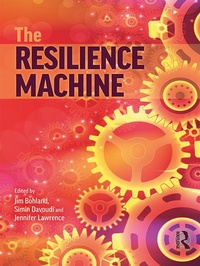
The Resilience Machine
1st Edition
Published on 10. October 2018
234 pages
978-1-351-21117-8 (ISBN)
Description

We live in a time where environmental pressures, social inequities and political derision are the backdrop of everyday life, and where resilience has become a routine prescription for coping with the conditions of modern existence. Drawing an analogy to Harvey Molotch's urban growth machine, this book explores different narratives of resilience and their policy and practice manifestations for cities, citizens and communities. It expands on the metaphor of the machine to show how resilience can be better understood as an assemblage.
Bringing together authors from multiple disciplines and different parts of the world, the book unmasks the often invisible effects of resilience strategies by examining ways in which neoliberal mentalities are fed through the rhetoric of resilience practices, policies and development projects. The contributing essays provide provocative accounts of several areas of inquiry, including biopolitics and smart bodies, resilient cities and communities, urban planning and disaster management, justice and vulnerability, and resistance to resilience. Holding out hope for critical potentials in 'resilience,' The Resilience Machine proposes to move beyond mechanisms of adaptation and into imagining what resilient life could look like in a more just, equitable and democratic world.
The Resilience Machine is a current, vital addition to resilience, community and urban scholarship.
Bringing together authors from multiple disciplines and different parts of the world, the book unmasks the often invisible effects of resilience strategies by examining ways in which neoliberal mentalities are fed through the rhetoric of resilience practices, policies and development projects. The contributing essays provide provocative accounts of several areas of inquiry, including biopolitics and smart bodies, resilient cities and communities, urban planning and disaster management, justice and vulnerability, and resistance to resilience. Holding out hope for critical potentials in 'resilience,' The Resilience Machine proposes to move beyond mechanisms of adaptation and into imagining what resilient life could look like in a more just, equitable and democratic world.
The Resilience Machine is a current, vital addition to resilience, community and urban scholarship.
Reviews / Votes
"A brilliant, empirically rich and theoretically inventive collection, which opens up new perspectives on resilience as a way of governing life itself. Organised around a novel conceptualisation of resilience as a 'machine,' the collection offers a politically incisive examination of the strategies, motivations, and logics that surround different enactments of resilience." -Ben Anderson, Professor of Human Geography, Durham University, UK"The Resilience Machine provides a unique, timely and indispensable critique of resilience narratives, policies and practices and how these have been shaped by dominant political and economic systems. While providing a much-needed critique of resilience practices which further promote neoliberal priorities, this book and its contributors also demonstrate how critical resilience thinking has the potential to produce desirable socio-spatial and environmental outcomes, providing a potential pathway for transformative and positive change. Bohland, Davoudi and Lawrence have assembled a volume that will have wide multidisciplinary appeal for students and researchers with interests in urban studies, disaster management, planning, community development and sustainability." - Mark Scott, Professor of Planning, University College Dublin, Ireland
More details
Edition
1. Auflage
Language
English
Place of publication
London
United Kingdom
Publishing group
Taylor & Francis Ltd
Target group
College/higher education
Professional and scholarly
Illustrations
3 Tables, black and white; 25 Halftones, black and white
File size
4,59 MB
ISBN-13
978-1-351-21117-8 (9781351211178)
Copyright in bibliographic data and cover images is held by Nielsen Book Services Limited or by the publishers or by their respective licensors: all rights reserved.
Schweitzer Classification
Other editions
Additional editions
Jim Bohland | Simin Davoudi | Jennifer Lawrence
The Resilience Machine
Book
10/2018
1st Edition
Routledge
€206.30
Shipment within 15-20 days
Jim Bohland | Simin Davoudi | Jennifer Lawrence
The Resilience Machine
Book
10/2018
1st Edition
Routledge
€76.40
Shipment within 15-20 days
Persons
James Bohland is Research Team Leader on the social and political dimensions of resilience at the Global Forum for Urban and Regional Resilience, and is a Professor Emeritus in the School of Public and International Affairs at Virginia Tech. He is the former vice president and executive director of Virginia Tech's National Capital Region Operations and former director of School of Public and International Affairs.
Simin Davoudi is Professor of Environmental Policy and Planning and Director of Global Urban Research Unit at Newcastle University. She has held visiting professorships at universities in the USA, the Netherlands, Sweden, Australia and Finland. Her research centres on politics of urban planning, securitisation of nature, resilience and governmentality of unknowns. Selected books include: The Routledge Companion to Environmental Planning and Sustainability (2019), Justice and Fairness in the City (2016), Reconsidering Localism (2015) and Conceptions of Space and Place (2009).
Jennifer Lawrence is a post-doctoral research associate with the Global Forum on Resilience, Virginia Tech. Her research explores the assemblage of extractive governance, by drawing out tensions between chronic and acute socio-environmental disasters. Her scholarship is conducted from a problem-centred, theory-driven methodology and highlights the intersection of economic systems, resource extraction and socio-environmental (in)justice. She is also the editor of Biopolitical Disaster (2017).
Simin Davoudi is Professor of Environmental Policy and Planning and Director of Global Urban Research Unit at Newcastle University. She has held visiting professorships at universities in the USA, the Netherlands, Sweden, Australia and Finland. Her research centres on politics of urban planning, securitisation of nature, resilience and governmentality of unknowns. Selected books include: The Routledge Companion to Environmental Planning and Sustainability (2019), Justice and Fairness in the City (2016), Reconsidering Localism (2015) and Conceptions of Space and Place (2009).
Jennifer Lawrence is a post-doctoral research associate with the Global Forum on Resilience, Virginia Tech. Her research explores the assemblage of extractive governance, by drawing out tensions between chronic and acute socio-environmental disasters. Her scholarship is conducted from a problem-centred, theory-driven methodology and highlights the intersection of economic systems, resource extraction and socio-environmental (in)justice. She is also the editor of Biopolitical Disaster (2017).
Content
Introduction Chapter 1. Anatomy of the Resilience Machine Chapter 2. Securing the Imagination: The Politics of the Resilient Self Chapter 3. Designing 'Smart' Bodies: Molecular Manipulation as a Resilience-Building Strategy Chapter 4. Organising Community Resilience Chapter 5. Rejecting and Recreating Resilience After Disaster Chapter 6. The Resonance and Possibilities of Community Resilience Chapter 7. Adaptation Machines, or the Biopolitics of Adaptation Chapter 8. The Resilient City: Where Do We Go from Here? Chapter 9. Towards a Critical Political Geography of Resilience Machines in Urban Planning Chapter 10. Resilience and Justice: Planning for New York City Chapter 11. Seeking the Good (Enough) City Chapter 12. Dismantling the Resilience Machine as a Restoration Engine
