

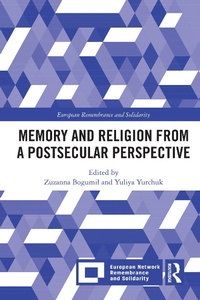
Memory and Religion from a Postsecular Perspective
1st Edition
Published on 27. February 2022
448 pages
978-1-000-54330-8 (ISBN)
Description

The book argues that religion is a system of significant meanings that have an impact on other systems and spheres of social life, including cultural memory.
The editors call for a postsecular turn in memory studies which would provide a more reflective and meaningful approach to the constant interplay between the religious and the secular. This opens up new perspectives on the intersection of memory and religion and helps memory scholars become more aware of the religious roots of the language they are using in their studies of memory. By drawing on examples from different parts of the world, the contributors to this volume explain how the interactions between the religious and the secular produce new memory forms and content in the heterogenous societies of the present-day world. These analyzed cases demonstrate that religion has a significant impact on cultural memory, family memory and the contemporary politics of history in secularized societies. At the same time, politics, grassroots movements and different secular agents and processes have so much influence on the formation of memory by religious actors that even religious, ecclesiastic and confessional memories are affected by the secular.
This volume is ideal for students and scholars of memory studies, religious studies and history.
The editors call for a postsecular turn in memory studies which would provide a more reflective and meaningful approach to the constant interplay between the religious and the secular. This opens up new perspectives on the intersection of memory and religion and helps memory scholars become more aware of the religious roots of the language they are using in their studies of memory. By drawing on examples from different parts of the world, the contributors to this volume explain how the interactions between the religious and the secular produce new memory forms and content in the heterogenous societies of the present-day world. These analyzed cases demonstrate that religion has a significant impact on cultural memory, family memory and the contemporary politics of history in secularized societies. At the same time, politics, grassroots movements and different secular agents and processes have so much influence on the formation of memory by religious actors that even religious, ecclesiastic and confessional memories are affected by the secular.
This volume is ideal for students and scholars of memory studies, religious studies and history.
Reviews / Votes
'Up until this volume, no scholarly study has been dedicated to exploring the intersection of memory and religion. To this end, Memory and Religion in Postsecular Persepctive offers new vistas on how political and social change comes into being by reinterpreting well known theories.'Cathrine Wanner, Pennsylvania State University, USA
'The book states fundamental questions of relations and boundaries between sacred and profane, religious and secular, political uses of religious narratives and media, the features and contexts of memory processes within the sphere of religion in its institutional and vernacular, lived forms. Elaborating such important issues needs intellectual courage and sensitivity allowing the in-depth and refreshing analyses, that we can find in the book.'
Malgorzata Zawila, Jagiellonian University, Poland
More details
Series
Edition
1. Auflage
Language
English
Place of publication
London
United Kingdom
Publishing group
Taylor & Francis Ltd
Target group
College/higher education
Product notice
Reflowable
Illustrations
1 Tables, black and white; 1 Line drawings, black and white; 27 Halftones, black and white; 28 Illustrations, black and white
ISBN-13
978-1-000-54330-8 (9781000543308)
Copyright in bibliographic data and cover images is held by Nielsen Book Services Limited or by the publishers or by their respective licensors: all rights reserved.
Schweitzer Classification
Other editions
Additional editions
Zuzanna Bogumil | Yuliya Yurchuk
Memory and Religion from a Postsecular Perspective
Book
09/2023
1st Edition
Routledge
€64.70
Shipment within 10-20 days
Zuzanna Bogumil | Yuliya Yurchuk
Memory and Religion from a Postsecular Perspective
Book
03/2022
1st Edition
Routledge
€207.80
Shipment within 10-20 days
Persons
Zuzanna Bogumil, PhD, works at the Institute of Archaeology and Ethnology at the Polish Academy of Sciences. Her published works include Gulag Memories: The Rediscovery and Commemoration of Russia's Repressive Past (2018) and a co-authored study titled Milieux de memoire in Late Modernity: Local Communities, Religion, and Historical Politics (2019).
Yuliya Yurchuk, PhD, teaches history at Umea University, Sweden. She specializes in memory, the history of religion and Eastern Europe. She is the author of the book Reordering of Meaningful Worlds: Memory of the Organization of Ukrainian Nationalists and the Ukrainian Insurgent Army in Post-Soviet Ukraine (2014).
Yuliya Yurchuk, PhD, teaches history at Umea University, Sweden. She specializes in memory, the history of religion and Eastern Europe. She is the author of the book Reordering of Meaningful Worlds: Memory of the Organization of Ukrainian Nationalists and the Ukrainian Insurgent Army in Post-Soviet Ukraine (2014).
Content
1. Introduction: Memory and Religion from a Postsecular Perspective Part 1: Memory and Religion: Theoretical Considerations 2. Religion and Collective Memory of the Last Century: General Reflections and Russian Vicissitudes 3. Sacred Religio-Secular Symbols, National Myths and Collective Memory Part 2: Postsecularity and Politics of Memory 4. The Armenian Genocide: Extermination, Memory, Sacralization 5. Building a Patrimonial Church: How the Orthodox Churches in Ukraine Use the Past 6. 'God is in Truth, Not in Power!': The Re-militarization of the Cult of St Alexander Nevsky in Contemporary Russian Cultural Memory 7. The Martyrdom of Jozef Tiso: The Entanglements of the Sacred and Secular in Post-War Catholic Memories 8. Remembering and Enforced Forgetting: The Dynamics of Remembering Cardinal Jozsef Mindszenty in the Cold War Decades Part 3: Post-Conflict Memories 9. Evocation and the June Fourth Tiananmen Candlelight Vigil: A Ritual-Theological Hermeneutics 10. Religious Echoes of the Donbas Conflict: The Discourses of the Christian, Muslim and Jewish Communities in Ukraine 11. Official Quests, Vernacular Answers: The Macedonian Orthodox Church - Ohrid Archbishopric (MOC-OA) as a Memory Actor in the Post-Conflict Republic of North Macedonia (2001-19) 12. Negotiating the Sacred at Non-Sites of Memory. The Religious Imaginary of Post-Genocidal Society Part 4: Media and Postsecular Memory 13. The Crimean Tatars' Memory of Deportation and Islam 14. The Soviet Past in Contemporary Orthodox Hymnography and Iconography 15. Whose Church is It? The Nonreligious Use of Religious Architecture in Eastern Germany Part 5: Transnational and Vernacular Memories 16. The Political Use of the Cult of St Tryphon of Pechenga and Its Potential as a Bridge-Builder in the Arctic 17. 'Vernacular' and 'Official' Memories: Looking Beyond the Annual Hasidic Pilgrimages to Uman 18. Memory as a Religious Mission? Religion and Nation in Local Commemoration Practices in Contemporary Poland 19. Critical Juxtaposition in the Postwar Japanese Mnemoscape: Saint Maksymilian Kolbe of Auschwitz and the Atomic Bomb Victims of Nagasaki Afterword. From 'Religion as a Chain of Memory' to Memory from a Postsecular Perspective
