

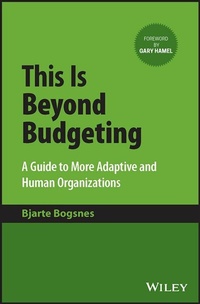
This Is Beyond Budgeting
Description

More details
Other editions
Additional editions
Person
Content
Acknowledgments
[Insert Text Break Here]
Introduction
1 Initial Reflections
2 The Problem
3 Beyond Budgeting
4 Separate and Improve
5 Beyond Budgeting for Whom?
6 Agile Transformation
7 Handelsbanken
8 Implementation
9 What's in It for the Bottom Line?
10 What's in It for Me?
Epilogue
[Insert Text Break Here]
Index
Introduction
My Beyond Budgeting Journey
"I may not have gone where I intended to go, but I think I ended up where I needed to be," Douglas Adams once wrote. This is the story of my life.
I graduated from business studies in the early 1980s, after a short flirt with a military career. My first management job after joining Norwegian Statoil (now Equinor, one of Scandinavia's largest companies) was as head of the corporate budget department. I have led more budgeting rounds than I want to remember in that and in many later finance roles. Looking back, I have done some quite stupid things in my career. But it also means that I know what I am talking about. I have been there and done that. I know most of the tricks in the budget game, including some quite nasty ones.
There was nothing back then indicating that I would become a vocal opponent of this management concept and the philosophy behind it. I have now been one for almost 30 years. I am still embarrassed about an interview I gave to the in-house company magazine, praising the brilliance of budgeting. I hope there are no more copies around!
It all started in the mid-1990s at Borealis, at the time Europe's largest petrochemicals company. The company was partly owned by Statoil and headquartered in Copenhagen. I headed up the corporate finance team. We were all challenged to think of new, different, and better ways of doing our work and of running the company. Our proposal to kick out the budget felt scary. We had not heard of anyone else doing this. We got a "yes," provided we could find an alternative. Beyond Budgeting was not yet born, so we went looking for possible solutions.
After a lot of searching (no Google back then!), many discussions, and some dead ends, we finally cracked it. "Why do we budget?" was the simple question we needed to ask. The answer, which I will return to later, provided us with all we needed. Borealis became one of the inspirations for Jeremy Hope (RIP) and Robin Fraser, the founders of the Beyond Budgeting Roundtable. I later became the chairman of this international network of organizations and individuals interested in Beyond Budgeting.
After heading up finance, I moved to a similar role in human resources before returning to Statoil. I am probably one of very few having worked in both these functions. Those HR years had a big influence on my Beyond Budgeting journey. I will revert to why the two need to work much more closely together.
In my new role as corporate controller for Statoil's international business I could not resist challenging my colleagues on the budget management we were running. In 2004 we went together to the executive committee with a proposal that now had become more ambitious than just kicking out the budget. It was about a new way of leading and managing. The model we proposed, Ambition to Action, has been at the core of the company's performance process ever since. I left my controller role to work full time on Ambition to Action, both on further development and internal training.
The Borealis and Statoil/Equinor cases triggered a lot of external interest. I have been speaking at hundreds of conferences over the years. At Equinor, I also started to run external workshops and do small-scale consulting, with kind permission from my employer. I then made a difficult decision. I left Equinor and started Bogsnes Advisory. I love being able to devote so much more time to Beyond Budgeting, while being a free bird choosing just the work that makes me tick. I seldom have been busier or have had more fun!
Equinor is a great company. I miss my colleagues, and I hope and believe they will take Ambition to Action even further.
I come from a family of teachers. My father, my mother, and my sister all made a difference in so many people's life. My finance education took me in a different direction, but I now feel I am back in the fold. I ended up where I needed to be.
I also married a teacher!
Why This Book?
Some of you might know that I already authored two books. Implementing Beyond Budgeting was published in 2008 and later in a significantly revised second edition in 2016. These books are about Beyond Budgeting, great cases, and my own journey and implementation experiences.
So why another book?
The previous books have done well, with readers all over the world. These include executives and senior managers. I know because of nice feedback from many of them. Still, they represent a minority of my readers, for the simple reason that they are terribly busy people. There are so many great books out there. Reading them all is a luxury few can squeeze into hectic schedules. If you are one of them, this is on purpose a short book, something that could be read on a flight, for instance, one of the few occasions left without meetings and phone calls.
My own insights and experiences keep evolving. I have now worked with even more great organizations and have written several articles that this book also draws on. So much has happened since the last book; I just have to share it!
The pressure on executive teams today is immense. They keep being challenged by stakeholders about the need for change and radical transformation. The pressure is not just about becoming greener and more sustainable. It is also about becoming more dynamic and adaptive. There is a jungle of models and thousands of books claiming to have the answer. No wonder many feel overwhelmed and confused.
Many respond by embarking on an agile transformation journey. Most discover that agile wasn't designed as a way to run an organization. Its original purpose was to improve how software was developed and how teams worked, which it did, very successfully. But when scaling agile, its "holes" become visible.
Beyond Budgeting fills these holes because it was intended and designed as an agile way of managing an organization. Many companies on transformation journeys are therefore reaching out to us. I hope this book can help even more executive teams understand that there can be no true agile transformation without Beyond Budgeting.
The same goes for Lean, which was born in manufacturing. Lean has also many similarities with Beyond Budgeting, such as trusting those closest to the situation to make the right decisions. But when scaling to enterprise Lean, holes appear also here. Again, Beyond Budgeting can fill these.
The COVID-19 pandemic was an eye-opener for many about the shortcomings of traditional and budget-based management. Seldom have so many budgets become irrelevant so fast. We have faced turmoil before, but the pandemic was different. Earlier times, for instance, the 2008 financial crisis, challenged only one of the assumptions behind traditional management: that the future is predictable and plannable. So many working from home during the pandemic challenged also the second assumption: that people can't be trusted. But they could! A few anecdotal examples of the opposite carry no credible evidence.
I am writing these words as a horrible war is raging in Ukraine, global supply chains are broken, and inflation is raging. No one expected this to happen, and no one has a clue about what will happen next. Once again, organizations all over the world must rapidly change their plans.
All these developments over many years have created a surge in interest for Beyond Budgeting, also among the major consulting firms. Almost all have reached out for a cooperation in some form or shape because their clients are getting interested.
We come from different places, and we might have different agendas. Still, we need these firms on board. They have channels and muscles we don't have. Some of them have been clear about their intention of offering Beyond Budgeting to their clients in any case.
We are not naive, but we have decided to join forces to help them understand what Beyond Budgeting really is about and to avoid implementations being reduced to rolling forecasting exercises or just a more dynamic resource allocation. We have unfortunately seen a few examples. We would rather help these firms and their clients get it right than stand by and watch them fail. Hopefully, this book can help both in reaching a deeper and better understanding of Beyond Budgeting.
By the way, if you wonder who "we" are, check out the Epilogue.
If you are new to Beyond Budgeting and this book triggers your interest, my previous books have more of everything, including extensive case stories about Borealis, Equinor, and others. There are also other books to learn from. Beyond Budgeting, written by Jeremy Hope and Robin Fraser in 2003, is a classic. I also recommend Steve Morlidge's great books on a range of Beyond Budgeting topics. Check also out The Viable Map Workbook published by the Beyond Budgeting Institute. More about the Viable Map and the book in Chapter 8.
I am sure you are curious about what you need to do differently when going Beyond Budgeting. Don't worry; you will get it. There is no rocket science. But changing what we do helps little unless we also change how we think. This is the hardest part and should be your most important reason for reading this book.
If you already read any of my books, you may recognize some messages and stories. The purpose of this one is to condense these and make them more accessible for busy people, while also sharing new experiences and insights. I sincerely hope those who need to read it find the time. For those already...
