

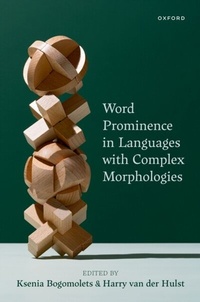
Word Prominence in Languages with Complex Morphologies
1st Edition
Published on 30. March 2023
704 pages
978-0-19-257704-7 (ISBN)
Description

This volume focuses on the theoretical and analytical challenges that languages with complex morphologies pose for the theory and typology of word-level prosodic phenomena. The morphological complexity and phonological length that are characteristic of words in these languages make them a particularly fruitful ground for investigating the effects of both phonological and morphological factors in the assignment of prominence. The first three chapters in the volume explore general theoretical issues pertaining to word prominence in synthetic languages, including the issue of 'wordhood' and the empirical, theoretical, and methodological issues with delineating word-level prominence and the higher-level prosodic phenomena in these languages. These are followed by a series of case studies on stress, accent, and tone in a geographically and genetically diverse set of languages with highly synthetic morphologies including languages of the Americas, Europe and Asia, and Australia. The volume adopts an interdisciplinary perspective, combining phonetic, phonological, and morphosyntactic insights. It will be of interest not only to phonologists and morphologists, but to all those interested in the typological and theoretical issues relating to polysynthetic languages.
More details
Other editions
Additional editions
Ksenia Bogomolets | Harry van der Hulst
Word Prominence in Languages with Complex Morphologies
Book
03/2023
Oxford University Press
€175.50
Shipment within 15-20 days
Persons
Ksenia Bogomolets is Professional Teaching Fellow at the University of Auckland, New Zealand. She specializes in phonology and morphology, with a particular focus on the phonology of stress in polysynthetic languages. She is especially interested in theoretical issues pertaining to morpho-phonology of Algonquian languages, but she has also investigated stress and its interactions with morphology in unrelated highly synthetic languages such as Nez Perce, Ichishkiin Sinwit, and Choguita Rarámuri. On the empirical side, she has a keen interest in documentation of understudied and endangered languages.
Harry van der Hulst is Professor of Linguistics at the University of Connecticut. His research interests include stress, syllabic structure, segmental structure, sign language, gesture, language evolution, and phonological acquisition, and he is both Editor-in-Chief of The Linguistic Review and co-editor of Mouton de Gruyter's series 'Studies in Generative Grammar'. His many books include Asymmetries in Vowel Harmony(OUP, 2018), Radical CV Phonology: A Theory of Segmental and Syllabic Structure (Edinburgh University Press, 2020), and The Oxford History of Phonology (co-edited with B. Elan Dresher; OUP, 2022).
Content
- List of abbreviations
- The contributors
- Part I: Theoretical issues in word prominence
- 1: Ksenia Bogomolets and Harry van der Hulst: Word prominence and polysynthetic languages
- 2: Alana Johns: Polysynthetic words
- 3: Matthew K. Gordon: Word stress and intonational prominence in highly synthetic languages
- Part II: Word prominence in North American languages
- 4: Keren Rice: Domains of prominence in polysynthetic languages of North America
- 5: Anja Arnhold, Emily Elfner, and Richard Compton: Inuktitut and the concept of word-level prominence
- 6: James A. Crippen, Rose-Marie Déchaine, and Emily Elfner: Tlingit (anti-) prominence
- 7: Ksenia Bogomolets: Accent and tone in Arapaho
- 8: Eugene Buckley: M-words, P-words, and accent phrases in Kashaya
- 9: Matthew K. Gordon and Jack B. Martin: Prominence in Muskogean languages
- Part III: Word prominence in South American languages
- 10: Benjamin Molineaux: A reassessment of word prominence in Mapudungun: Phonological vs morphological activation
- 11: Elena I. Mihas and Olga Maxwell: Satipo Ashaninka word- and phrase-level prominence
- 12: Nicholas Rolle: Polysynthesis, stress uniformity, and the opposite-to-anchor stress system in Ese Ejja
- Part IV: Word prominence in Australian languages
- 13: John Mansfield: The prosodic structure of Australian polysynthetic verbs: Bininj Gun-Wok, Murrinpatha, and Ngalakgan
- Part V: Word prominence in languages of Europe and Asia
- 14: Johanna Mattissen: Phonological and morphological wordhood in Nivkh
- 15: Matthew K. Gordon and Ayla B. Applebaum: Prominence in Circassian
- 16: Öner Özçelik: Prosody in Turkish
- 17: Kristine A. Hildebrandt and Gregory D. S. Anderson: Word prominence in languages of Southern Asia
- 18: Harry van der Hulst: A unified account of phonological and morphological accent
- References
- Index
