

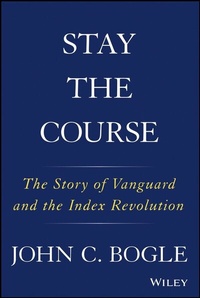
Stay the Course
Description

Stay the Course is the story the Vanguard Group as told by its founder, legendary investor John C. Bogle. This engrossing book traces the history of Vanguard--the largest mutual fund organization on earth.
Offering the world's first index mutual fund in 1976, John Bogle led Vanguard from a $1.4 billion firm with a staff of 28 to a global company of 16,000 employees and with more than $5 trillion in assets under management. An engaging blend of company history, investment perspective, and personal memoir, this book provides a fascinating look into the mind of an extraordinary man and the company he created.
John Bogle continues to be an inspiring and trusted figure to millions of individual investors the world over. His creative innovation, personal integrity, and stubborn determination infuse every aspect of the company he founded. This accessible and engaging book will help you:
* Explore the history of some of Vanguard's most important mutual funds, including First Index Investment Trust, Wellington Fund, and Windsor Fund
* Understand how the Vanguard Group gave rise to the Index Revolution and transformed the lives of millions of individual investors
* Gain insight on John Bogle's views on values such as perseverance, caring, commitment, integrity, and fairness
* Investigate a wide range of investing topics through the lens of one of the most prominent figures in the history of modern finance
The Vanguard Group and John Bogle are inextricably linked--it would be impossible to tell one story without the other. Stay the Course: The Story of Vanguard and the Index Revolution weaves these stories together taking you on a journey through the history of one revolutionary company and one remarkable man. Investors, wealth managers, financial advisors, business leaders, and those who enjoy a good story, will find this book as informative and unique as its author.
More details
Other editions
Additional editions
Content
Foreword
Burton G. Malkiel
It is an honor for me to write the foreword to this important history of the unique and extraordinary financial institution that is Vanguard. Many institutions that call themselves "mutual" are mutual in name only. The Vanguard that Jack Bogle created is truly mutual in practice. Owned by those who have entrusted their money to it, Vanguard is run with only its shareowners in mind. Any "profits" are returned to its owners in the form of reduced fees. New investment instruments are created only if they promise to provide real benefits for investors.
I served on the Vanguard board for 28 years. I can attest that every policy that came before the board was resolved by applying a simple criterion: Was the policy good or bad for the individual shareholder? It is small wonder that Jack Bogle has been called "the best friend the individual investor has ever had." Perhaps my favorite testimonial to Jack was written by a group of acolytes, the Bogleheads, devoted to propagating Bogle's investment ideas: "While some mutual fund founders chose to make billions, [Jack created Vanguard] to make a difference."
And what a difference it was. In an industry known for imposing high fees, Vanguard's were invariably the lowest. Moreover, the complex was run with the objective of distributing any economies of scale back to the shareowners and inexorably lowering the fees over time. Jack's own research made clear that fees were the most important determinant of investment performance. If you want to own a mutual fund with top quartile performance, you are most likely to do so if you buy a fund with bottom quartile fees. As Jack so presciently remarked, "This is a business where you get what you don't pay for."
But lowering fees was only part of the reason for Vanguard's commercial success in now having over $5 trillion under management. Vanguard was also enormously innovative in bringing countless new financial instruments to market to better serve investors with different objectives and in different circumstances.
Vanguard was the first to offer tax-exempt bond funds with three distinct maturities: short, intermediate, and long. It then extended the idea to taxable bonds. It created the first total bond market index fund and then the first balanced index fund, holding both total bonds and total equities. In its drive to continuously lower costs, it created the "Admiral" series of funds. It even initiated the now-popular method of factor investing by bringing to market the first "value" fund in 1992.
But eclipsing any of these innovations, by far the most important was the creation by Vanguard of the first index fund available to the investing public. In my judgment, the index fund is the most important financial innovation that has been created for the individual investor.
Financial innovation is frequently disparaged. It is often associated with financial engineering and complex derivative instruments that were not well understood by their creators and certainly misconstrued by rating agencies and investors. The fallout from this misadventure was not confined to the hapless investors and global financial institutions that suffered punishing losses. The existence of complex mortgage-backed securities helped fuel an enormous housing bubble. When the bubble deflated, a sharp recession followed, and the repercussions practically brought down the entire world financial system. One can understand the animus toward this sort of financial technology, and it is not surprising that many observers have suggested that the only worthwhile financial innovation over the past century has been the ATM machine.
We can readily accept that not all financial innovations have benefited society and that some have actually been toxic. But it would be a serious mistake to brand all new financial instruments as having little or no benefit. For me, the index fund is unquestionably the most important financial innovation of our time, and it has unambiguously been of enormous benefit to the individual investor saving and investing to achieve a secure retirement.
Index funds that simply buy and hold all of the stocks in a broad-based stock market index guarantee that their investors will earn the rate of return generated by the market. Because they involve little turnover, they minimize trading costs and are extremely tax efficient. Index mutual funds and exchange-traded funds can be purchased at expense ratios close to zero, and thus for the first time enable the individual investor to earn the full return generated by the market.
According to Standard & Poor's research, over 90% of actively managed funds underperformed their benchmark indexes over the 15-year period ending in 2017. The average active fund underperformed its equivalent index by a full one percentage point per year. Index funds don't provide average performance: they give the investor top decile returns. The index fund has provided the ideal instrument to invest savings and receive the highest returns available.
When Jack Bogle created "The First Index Investment Trust" (the original name of today's Vanguard 500 Index Fund), it was greeted with derision by the professional investment community. It was variously called "Bogle's folly" or "doomed to failure" and even "un-American." Not even Jack would have predicted that it and its sister Total Stock Market Fund would become the two largest mutual funds in the world. But he did know that his innovation would give the ordinary investor a fair shake, and that managing the Vanguard organization exclusively for the benefit of those who entrusted their money to it would fundamentally change the ability of millions of people to achieve financial security.
Think of a person of modest means who made an initial $500 investment in the Vanguard 500 Index Fund at the start of the fund's life at the end of 1977 and then added $100 of savings each month thereafter. The following table presents the results through the end of 2017. With the most modest of investments, the individual would end up with a $0.75 million nest egg. With $150 per month of savings, the individual would be a millionaire. Small wonder that the index fund has been called the "best friend an investor could have," and that Jack has been called "the greatest investor advocate ever to grace the fund industry."
In 2016 investors pulled $340 billion out of actively managed mutual funds while investing over $500 billion in index funds. The same trends continued in 2017 and 2018. Today over 45% of investment funds are indexed. A sea change was occurring in the fund industry. Active managers could no longer claim superior investment results, so they fought back by inventing new criticisms of indexing. Indexing is now alleged to pose a grave danger both to the stock market and to the general economy.
One of the most respected research houses on Wall Street, Sanford C. Bernstein, published a 47-page report in 2016 with the provocative title "The Silent Road to Serfdom: Why Passive Investment Is Worse Than Marxism." The report suggested that a capitalist market system in which investors invest passively in index funds is even worse than a centrally planned economy, where government directs all capital investment. Indexing is alleged to cause money to pour into a set of investments independent of considerations such as profitability and growth opportunities. It is active managers who ensure that new information is properly reflected in stock prices.
Could it be possible that if everyone invested only in index funds, indexing could grow so large that stocks could become massively mispriced? If everybody indexed, who would ensure that stock prices reflect all the information available about the prospects for different companies? Who would trade from stock to stock to ensure that the market is reasonably efficient? The paradox of index investing is that the stock market needs some active traders who analyze and act on new information so that stocks are efficiently priced and sufficiently liquid for investors to be able to buy and sell. Active traders play a critical role in determining security prices and how capital is allocated.
Active managers are incentivized to perform this function by charging substantial management fees. They will continue to market their services with the claim that they have above-average insights that enable them to beat the market even though, unlike in Garrison Keillor's mythical Lake Wobegon, they cannot all achieve above-average market returns. And even if the proportion of active managers shrinks to as little as 10 or 5% of the total, there would still be more than enough of them to make prices reflect information. We have far too much active management today, not too little.
But as a thought experiment, suppose everybody did index and individual stocks did not reflect new information? Suppose a drug company develops a new cancer drug that promises to double the company's sales and earnings, but the price of their shares does not increase to reflect the news. In our capitalist system it is inconceivable that some trader or hedge fund would not emerge to bid up the price of the stock and profit from the mispricing. In a free-market system we can expect that advantageous arbitrage...
