

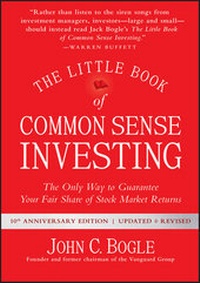
The Little Book of Common Sense Investing
Description

The Little Book of Common Sense Investing is the classic guide to getting smart about the market. Legendary mutual fund pioneer John C. Bogle reveals his key to getting more out of investing: low-cost index funds. Bogle describes the simplest and most effective investment strategy for building wealth over the long term: buy and hold, at very low cost, a mutual fund that tracks a broad stock market Index such as the S&P 500.
While the stock market has tumbled and then soared since the first edition of Little Book of Common Sense was published in April 2007, Bogle's investment principles have endured and served investors well. This tenth anniversary edition includes updated data and new information but maintains the same long-term perspective as in its predecessor.
Bogle has also added two new chapters designed to provide further guidance to investors: one on asset allocation, the other on retirement investing.
A portfolio focused on index funds is the only investment that effectively guarantees your fair share of stock market returns. This strategy is favored by Warren Buffett, who said this about Bogle: "If a statue is ever erected to honor the person who has done the most for American investors, the hands-down choice should be Jack Bogle. For decades, Jack has urged investors to invest in ultra-low-cost index funds. . . . Today, however, he has the satisfaction of knowing that he helped millions of investors realize far better returns on their savings than they otherwise would have earned. He is a hero to them and to me."
Bogle shows you how to make index investing work for you and help you achieve your financial goals, and finds support from some of the world's best financial minds: not only Warren Buffett, but Benjamin Graham, Paul Samuelson, Burton Malkiel, Yale's David Swensen, Cliff Asness of AQR, and many others.
This new edition of The Little Book of Common Sense Investing offers you the same solid strategy as its predecessor for building your financial future.
* Build a broadly diversified, low-cost portfolio without the risks of individual stocks, manager selection, or sector rotation.
* Forget the fads and marketing hype, and focus on what works in the real world.
* Understand that stock returns are generated by three sources (dividend yield, earnings growth, and change in market valuation) in order to establish rational expectations for stock returns over the coming decade.
* Recognize that in the long run, business reality trumps market expectations.
* Learn how to harness the magic of compounding returns while avoiding the tyranny of compounding costs.
While index investing allows you to sit back and let the market do the work for you, too many investors trade frantically, turning a winner's game into a loser's game. The Little Book of Common Sense Investing is a solid guidebook to your financial future.
More details
Other editions
Additional editions
Person
Content
Chapter One A Parable 1
Chapter Two Rational Exuberance 9
Chapter Three Cast Your Lot with Business 25
Chapter Four How Most Investors Turn a Winner's Game into a Loser's Game 39
Chapter Five Focus on the Lowest-Cost Funds 53
Chapter Six Dividends Are the Investor's (Best?) Friend 65
Chapter Seven The Grand Illusion 73
Chapter Eight Taxes Are Costs, Too 85
Chapter Nine When the Good Times No Longer Roll 93
Chapter Ten Selecting Long-Term Winners 111
Chapter Eleven "Reversion to the Mean" 127
Chapter Twelve Seeking Advice to Select Funds? 139
Chapter Thirteen Profit from the Majesty of Simplicity and Parsimony 153
Chapter Fourteen Bond Funds 167
Chapter Fifteen The Exchange-Traded Fund (ETF) 179
Chapter Sixteen Index Funds That Promise to Beat the Market 195
Chapter Seventeen What Would Benjamin Graham Have Thought about Indexing? 209
Chapter Eighteen Asset Allocation I: Stocks and Bonds 223
Chapter Nineteen Asset Allocation II 237
Chapter Twenty Investment Advice That Meets the Test of Time 259
Acknowledgments 269
Introduction to the 10th Anniversary Edition
Don't Allow a Winner's Game to Become a Loser's Game.
SUCCESSFUL INVESTING IS ALL about common sense. As Warren Buffett, the Oracle of Omaha, has said, it is simple, but it is not easy. Simple arithmetic suggests, and history confirms, that the winning strategy for investing in stocks is to own all of the nation's publicly held businesses at very low cost. By doing so you are guaranteed to capture almost the entire return that these businesses generate in the form of dividends and earnings growth.
The best way to implement this strategy is indeed simple: Buy a fund that holds this all-market portfolio, and hold it forever. Such a fund is called an index fund. The index fund is simply a basket (portfolio) that holds many, many eggs (stocks) designed to mimic the overall performance of the U.S. stock market (or any financial market or market sector).1 The traditional index fund (TIF), by definition, basically represents the entire stock market basket, not just a few scattered eggs. It eliminates the risk of picking individual stocks, the risk of emphasizing certain market sectors, and the risk of manager selection. Only stock market risk remains. (That risk is quite large enough, thank you!) Index funds make up for their lack of short-term excitement by their truly exciting long-term productivity. The TIF is designed to be held for a lifetime.
The index fund eliminates the risks of individual stocks, market sectors, and manager selection. Only stock market risk remains.
This is much more than a book about index funds. It is a book that is determined to change the very way that you think about investing. It is a book about why long-term investing serves you far better than short-term speculation; about the value of diversification; about the powerful role of investment costs; about the perils of relying on a fund's past performance and ignoring the principle of reversion (or regression) to the mean (RTM) in investing; and about how financial markets work.
When you understand how our financial markets actually work, you will see that the index fund is indeed the only investment that essentially guarantees that you will capture your fair share of the returns that business earns. Thanks to the miracle of compounding, the accumulations of wealth that are generated by those returns over the years have been little short of fantastic.
The traditional index fund (TIF).
I'm speaking here about the traditional index fund. The TIF is broadly diversified, holding all (or almost all) of its share of the $26 trillion capitalization of the U.S. stock market in early 2017. It operates with minimal expenses and with no advisory fees, with tiny portfolio turnover, and with high tax efficiency. That traditional index fund-the first one tracked the returns of the Standard & Poor's 500 Index-simply owns shares of the dominant firms in corporate America, buying an interest in each stock in the stock market in proportion to its market capitalization, and then holding it forever.
The magic of compounding investment returns. The tyranny of compounding investment costs.
Please don't underestimate the power of compounding the generous returns earned by our businesses. Let's assume that the stocks of our corporations earn a return of 7 percent per year. Compounded at that rate over a decade, each $1.00 initially invested grows to $2.00; over two decades, to $4.00; over three decades, to $7.50; over four decades, to $15.00, and over five decades, to $30.00.2
The magic of compounding is little short of a miracle. Simply put, thanks to the growth, productivity, resourcefulness, and innovation of our corporations, capitalism creates wealth, a positive-sum game for its owners. Investing in equities for the long term has been a winner's game.
The returns earned by business are ultimately translated into the returns earned by the stock market. I have no way of knowing what share of these market returns you have earned in the past. But academic studies suggest that if you are a typical investor in individual stocks, your returns have probably lagged the market by around two percentage points per year.
Applying that figure to the annual return of 9.1 percent earned over the past 25 years by the Standard & Poor's 500 Stock Index, your annual return has likely been in the range of 7 percent. Result: investors as a group have been served only about three-quarters of the market pie. In addition, as explained in Chapter 7, if you are a typical investor in mutual funds, you've done even worse.
A zero-sum game?
If you don't believe that return represents what most investors experience, please think for a moment about "the relentless rules of humble arithmetic" (Chapter 4). These iron rules define the game. As investors, all of us as a group earn the stock market's return.
As a group-I hope you're sitting down for this astonishing revelation-we investors are average. For each percentage point of extra return above the market that one of us earns, another of our fellow investors suffers a return shortfall of precisely the same dimension. Before the deduction of the costs of investing, beating the stock market is a zero-sum game.
A loser's game.
As investors seek to outpace their peers, winners' gains inevitably equal losers' losses. With all that feverish trading activity, the only sure winner in the costly competition for outperformance is the person who sits in the middle of our financial system. As Warren Buffett recently wrote, "When trillions of dollars are managed by Wall Streeters charging high fees, it will usually be the managers who reap outsize profits, not the clients."
In the casino, the house always wins. In horse racing, the track always wins. In the Powerball lottery, the state always wins. Investing is no different. In the game of investing, the financial croupiers always win, and investors as a group lose. After the deduction of the costs of investing, beating the stock market is a loser's game.
Less to Wall Street croupiers means more to Main Street investors.
Successful investing, then, is about minimizing the share of the returns earned by our corporations that is consumed by Wall Street, and maximizing the share of returns that is delivered to Main Street. (That's you, dear reader.)
Your chances of earning your fair share of the market's returns are greatly enhanced if you minimize your trading in stocks. One academic study showed that during the strong bull market of 1990-1996 the most active one-fifth of all stock traders turned their portfolios over at the rate of more than 21 percent per month. While they earned the annual market return of 17.9 percent during that bull market period, they incurred trading costs of about 6.5 percent, leaving them with an annual return of but 11.4 percent, only two-thirds of the market return.
Mutual fund investors, too, have inflated ideas of their own omniscience. They pick funds based on the recent performance superiority-or even the long-term superiority-of a fund manager, and often hire advisers to help them achieve the same goal (Warren Buffett's "Helpers," described in the next chapter). But as I explain in Chapter 12, the advisers do it with even less success.
Oblivious of the toll taken by costs, too many fund investors willingly pay heavy sales loads and incur excessive fund fees and expenses, and are unknowingly subjected to the substantial but undisclosed transaction costs incurred by funds as a result of their hyperactive portfolio turnover. Fund investors are confident that they can consistently select superior fund managers. They are wrong.
Mutual fund investors are confident that they can easily select superior fund managers. They are wrong.
Contrarily, for those who invest and then drop out of the game and never pay a single unnecessary cost, the odds in favor of success are awesome. Why? Simply because they own shares of businesses, and businesses as a group earn substantial returns on their capital, pay out dividends to their owners, and reinvest what's left for their future growth.
Yes, many individual companies fail. Firms with flawed ideas and rigid strategies and weak managements ultimately fall victim to the creative destruction that is the hallmark of competitive capitalism, only to be succeeded by other firms.3 But in the aggregate, businesses have grown with the long-term growth of our vibrant economy. Since 1929, for example, our nation's gross domestic product (GDP) has grown at a nominal annual rate of 6.2 percent; annual pretax profits of our nation's corporations have grown at a rate of 6.3 percent. The correlation between the growth of GDP and the growth of corporate profits is 0.98. (1.0 is perfect.) I assume that this long-term relationship will prevail in the years ahead.
Get out of the casino and stay out!
This book intends to show you why you should stop contributing to the croupiers of the financial markets. Why? Because during the past decade they have raked in something like...
