

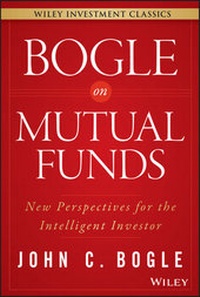
Bogle On Mutual Funds
Description

Reviews / Votes
"No investor can be called "intelligent" who doesn't understand the principles Bogle articulates in this book. The investor may still decide to try his hand at outperforming the market, but he should know what he's up against." - Investing.comMore details
Other editions
Additional editions
Person
Content
Preface
The purpose of this book is to guide investors in developing and implementing an intelligent investment program through mutual funds. It does not attempt to tell you how to attain wealth without risk, nor does it attempt to tell you how to select the next "number one" equity fund. Both of these tasks are, in a word, impossible, and I fear this book would lack all credibility if I did not acknowledge that fact at the outset.
Rather, what I hope to provide is a sensible framework for establishing a long-term investment program that will meet your financial needs. Such a program must take into account: (1) your investment attitudes, whether conservative or venturesome; (2) your position in the life cycle of investing, as you move from the accumulation of assets during your earning years to the enjoyment of income during your retirement years; and (3) the behavior of the securities markets over the long run, from which much (but not too much) should be learned.
This book deals solely with mutual funds. It does not deal with the analysis and evaluation of individual stocks and bonds. In my view, attempting to build a lifetime investment program around the selection of a handful of individual securities is, for all but the most exceptional investors, a fool's errand. To be sure, by owning individual equities, some active investors will inevitably enjoy spectacular results. But others perforce will lose much of their capital. Earning extraordinary returns from the ownership of individual stocks is a high-risk, long-shot bet for most investors. Specific stock bets should be made, if at all, in small portions, and more for the excitement of the game than for the profit. Serious money belongs elsewhere; it belongs in a widely diversified investment program. For nearly all investors, mutual funds are the most efficient method of achieving this diversification.
This book covers not only equity funds but bond funds and money market funds as well. Together, these two new (post-1970) segments of the mutual fund industry are larger than the equity fund base that had dominated the industry since the inception of the first U.S. mutual fund back in 1924. Of the industry's current total assets of $1.6 trillion, equity-oriented (common stock and balanced) funds comprise $517 billion, bond funds $510 billion, and money market funds $555 billion. Diversification in bonds and in short-term instruments is every bit as important as in equities: a portfolio comprising, say, 100 fixed-income obligations vastly reduces the risk of any single default, without any reduction whatsoever in return.
While mutual funds are an ideal vehicle to mitigate substantially the risk of holding specific stocks and bonds, market risk still remains. The central task of a lifetime investment strategy is to allocate financial resources so as to balance the different market risks among the three basic classes of liquid assets: (1) common stocks, which carry the greatest short-term price volatility and uncertainty, but-based on the underlying fundamentals of corporate earnings, dividends, and dividend growth-promise the highest expected returns over the long term; (2) bonds, which normally provide lower returns than stocks and, depending on the length of maturity, carry significant risk of principal fluctuation but remarkable stability of income; and (3) money market reserves, which usually engender minimal risk to capital and thus the lowest rewards but, given their short-term nature, create an inevitable risk of income volatility. An intelligent approach to allocating your assets among these three investment classes is a key theme of this book.
Risk and return are normally considered the central elements of asset allocation, and this book will not abandon the careful evaluation of these two fundamentals. However, I will add a third critical element, cost. The cost of an investment program is the third leg of what I would define as the eternal triangle of investing. In the mutual fund field, taking into account the impact of sales charges (if any), operating expenses, and advisory fees, annual costs may run from less than 0.3% to more than 3.0% of the value of your investment. If pre-tax, pre-inflation annual returns on a balanced portfolio of financial assets (i.e., stocks, bonds, and reserves) are assumed to run in the range of +10%, after-tax, inflation-adjusted annual returns will cluster around +4%. In such an environment, the difference between expenses of 0.3% and 3.0% commands, on the face of it, a powerful influence on returns. Other factors held equal, if the real after-tax return is +4% annually, the low-expense fund will earn a net return of +3.7%, nearly four times the net return of +1.0% for the high-expense fund. Maintaining minimal investment costs, then, is also an important theme of the book.
CAVEAT EMPTOR
The Latin phrase caveat emptor, literally translated, means "let the buyer beware." In ancient Rome, this warning was often posted in the marketplace to remind prospective buyers to carefully examine what they were purchasing before the sale was completed, so that in case of later disappointment they could not blame the seller. The same type of warning should alert today's mutual fund investors to possible disappointment in their investment selections. So I use caveat emptor boxes like this one throughout the book to highlight subjects that demand special caution on the part of the intelligent investor. In a few cases, I also use this format to direct your attention to what I hope will be interesting anecdotes and historical perspectives.
There is, of course, a point at which you must act on general principles and implement your asset allocation decision. You will usually want to choose among fund families that offer scores of mutual funds with different investment objectives and performance characteristics. Then you will have to select and monitor those equity, bond, and money market funds that best meet your specific requirements. Your choices among bond and money market funds will involve a limited number of critical judgments. Your choices among stock funds will usually require many more considerations, although, if you should elect to participate in the entire U.S. stock market through an index fund, the critical issues will be few. Helping you to make wise choices among individual mutual funds is yet another key theme.
While I assiduously avoid any specific reference to the mutual funds in The Vanguard Group, it will be obvious that much of the philosophy that I express in this book is a reflection of the Vanguard philosophy. For this parallelism, I make no apology. It is not because Vanguard has particular goals that I emphasize their importance in this book; rather, it is because I regard these goals as critically important that Vanguard adopted them in the first place. Only because I believed, for example, that low cost made a difference did we set out in 1974 to become the world's lowest-cost provider of financial services. Only because I believed that passive investing-holding all stocks in the market as distinct from actively managing a portfolio of selected stocks-should become an investment option did we form in 1976 the mutual fund industry's first market index fund. Only because I believed that millions of investors could make their own decisions without the advice-and cost-of an intermediary securities broker did we convert to a no-load (no sales commission) distribution system in 1977. I hope that you will consider the reaffirmation of these (and other) Vanguard principles throughout this book, not as a conflict of interest on my part, but as an exercise in integrity.
I have come to be known as the iconoclast of the mutual fund industry. Among industry participants, I am surely its sharpest critic. It is not that I consider this to be a bad industry; rather, it is an industry that can be so much better than it is. Somewhere along the road, the industry has lost its way. In my view, too many fund complexes have put the business need for asset gathering, the better to enhance the profits earned by fund managers, ahead of the fiduciary duty to provide efficient asset management at the lowest reasonable price, the better to enhance the returns earned by fund shareholders.
That said, let me affirm my positive belief in this industry: mutual funds, in general, have done a good job for their shareholders. Specifically, the industry is to be commended for four particular accomplishments.
- Mutual funds have provided an essential diversification that has greatly reduced the risk of owning individual stocks and bonds.
- Mutual funds have provided investment services-account information, transaction ease, efficient recordkeeping, and so on-that make them an extraordinarily convenient means of investing.
- Mutual funds have been created in a remarkable variety of types and objectives, and they are in a position to meet even the most particular needs of investors.
- Mutual funds have provided professional investment management that has, broadly speaking, delivered returns reflecting those earned in the market segments in which they participate.
These are not trivial accomplishments. Indeed, they provide the basic rationale for the growth of mutual fund industry assets from $94 billion at the beginning of 1980 to $1.6 trillion as 1993 began.
The central aim of this book is to make you a more...
