

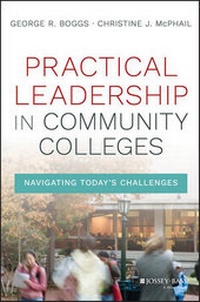
Practical Leadership in Community Colleges
Description

More details
Other editions
Additional editions
Persons
Content
PREFACE
There are few careers that can compare to those in community colleges. The institutions truly make a difference in the lives of people and in the well-being of communities. The rewards are visible at graduation ceremonies, performances, athletic events, and exhibits, where students-who would not otherwise have had a chance to pursue higher education or vocational training-demonstrate and are recognized for achieving goals they and their families might only have dreamed to accomplish. The benefits provided by the colleges extend to the community by providing trained employees to local businesses and through the economic impact they have. Because of the demographics of their students, community colleges can help to close achievement gaps and keep our nation secure and competitive.
For community colleges to realize their maximum impact, strong, stable, courageous, and effective leadership is essential. Leadership-at all levels of the institution-makes a significant difference in how well the institution serves its students and its communities. However, leadership in community colleges has become increasingly complex. The colleges are being pushed to increase the success rates of their students-including the most at-risk students in higher education-and to close achievement gaps in an environment of declining public support and calls for increased accountability for outcomes. The very mission of the institutions is being changed by both internal and external forces. Governance of the institutions has become more challenging because of both internal strife and external political influence. In the wake of natural disasters and human-made tragedies, college leaders are dealing with increased concerns for campus safety and security and responding to an increase in government mandates and reporting requirements.
The purpose of this book is to assist educators, leaders, and aspiring leaders to anticipate and to manage emerging issues and to assist trustees in their oversight of institutions that are faced with significant challenges. Although the recommendations are based in theory, the focus is on practical responses to issues. The authors hope to encourage discussions of issues at cabinet meetings, in committee and task force meetings, and in leadership development programs so that leaders are better prepared to deal with the leadership issues they will be faced with.
How This Book Is Structured
In chapter 1, we discuss the origin of issues and the importance of anticipating them and of their effective management. A model for issue management is presented.
In chapter 2, we discuss how the community colleges' open-door policies provide access to and opportunity for education through programs and services that serve as the foundation for life-changing perspectives for individuals and responsiveness to community needs. We highlight some of the mission-related issues that community college leaders will have to navigate as they focus on maintaining the open door and responding to student needs, internal and external policies, and mandates.
Contemporary accountability efforts like those we articulate in chapter 3 indicate that community colleges are undergoing major transformation in terms of what it means to be accountable. The discussion in this chapter focuses on the importance of transparency and how today's community college leaders are expected to build environments that demonstrate through quantifiable results how responsive they are to internal and external stakeholders.
The financing of community colleges continues to be a major issue of concern for community college educators. In chapter 4, we discuss a wide range of changes in the community college sector that affect funding for community colleges. Contemporary community college leaders will be expected to manage the institutions in the midst of growing demands from internal and external stakeholders, increased governmental policies and mandates, and shifting relationships with business communities that look to community colleges for the training of skilled workers.
In chapter 5, we discuss how the increasingly diverse student populations have presented new and different leadership challenges for community college educators. Diversity, equity, and inclusion (DEI) issues emerge inside and outside the classroom. The discussion highlights how some of these DEI challenges are influencing and enhancing learning outcomes for underrepresented students, faculty engagement, and overall institutional improvements.
In the community college setting, a variety of groups have a stake in the business of the college. The discussion in chapter 6 demonstrates that governance problems are not always easy for community college leaders to solve and that communications and media relations strategies often determine the seriousness of an issue. Community college leaders must strive to support governance systems that ensure stakeholders have appropriate opportunities to engage in decision making at the institution. We make the point that communication and media relations strategies are important tools for leaders.
In chapter 7, we discuss the importance of community colleges' ability to respond to the changing external and internal environments. We highlight recent changes and point out some factors that may serve as barriers to organizational change. We remind community college leaders that the college's capacity to respond to change is essential for the current and future welfare of the institution.
Chapter 8 deals with safety and security issues. Leaders need to ensure that campus emergency preparedness plans are up to date, employees and students receive necessary training, and mandated reports are filed on time. All too often, college leaders need to respond to problems created by natural disasters, accidents, or violence against students and employees. More recently, leaders are finding they have to respond to concerns about athletic injuries and problems with cybersecurity.
At the end of each chapter, we present issues to consider. Case studies or scenarios are also provided throughout the text. Our hope is that these issues and case studies will inspire in-depth discussions at presidents' and chancellors' cabinet meetings, in committee meetings, and in leadership development classrooms. There are no "cookie cutter" answers for addressing these issues or responding to cases, but thinking deeply about them will prepare leadership teams for the inevitable difficult issues they will face as they lead these dynamic institutions that are so important to our society.
The common thread throughout the discussion in all of the chapters is that the issues community college leaders currently face-and will have to address in the future-will be different and more complex than those faced by community college leaders in the past. However, too many community college leaders tell us they lack the preparation to address these issues in an effective manner. This book provides both incumbent and aspiring leaders with new ideas and proactive approaches to the task of issue management in community colleges. It will help administrators, faculty, and boards of trustees be better prepared to address today's and tomorrow's challenges.
How to Use This Book
Why does a community college educator need a copy of Practical Leadership in Community Colleges: Navigating Today's Challenges? For a number of reasons, many leaders may not have time or the desire to think about their own personal growth and renewal-or even the professional development of their leadership teams. We have come to believe that continual personal growth for community college educators is a necessity rather than an option for today or a resolution for the future. This is not necessarily a book designed for reading top to bottom. Rather, it is a resource of timely information that can be used on a continual basis. The issues are all related to challenges that community college leaders have responsibility for addressing at their institutions. It is designed to be a resource tool for community college leaders and prospective leaders to learn how to manage important issues and to help their institutions in the transformation process.
HOW ADMINISTRATORS CAN USE THE BOOK
- Focused discussions (around the issues) with leadership teams
- Grow-Your-Own college leadership institutes or academies
- Simulations and scenario leadership development programs
- Resource and reference tool for project development
- Functional or topical modules (e.g., designed to be inserted into existing college professional growth activities)
HOW FACULTY CAN USE THE BOOK
- Issue discussions and debates with colleagues and/or students
- Contemporary issues papers for professional associations
- Resource and reference tool for classroom discussion
HOW GOVERNING BOARDS CAN USE THE BOOK
- Orientation to the issues confronting community colleges
- Board retreats/leadership summits or workshops
- Functional or topical modules (e.g., designed to be inserted into continuing board training efforts)
HOW LEADERSHIP DEVELOPMENT TRAINERS CAN USE THE BOOK
- Career and executive coaching
- Leadership institutes
- Focus groups and workshops
- Stand-alone workshops (e.g., required capstone workshops; voluntary extracurricular...
