

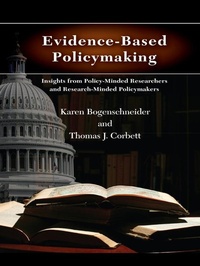
Evidence-Based Policymaking
Insights from Policy-Minded Researchers and Research-Minded Policymakers
Published on 11. January 2011
364 pages
978-1-135-14979-6 (ISBN)
Description

This book is for those who believe that good government should be based on hard evidence, and that research and policy ought to go hand-in-hand. Unfortunately, no such bond exists. Rather, there is a substantial gap, some say chasm, between the production of knowledge and its utilization. Despite much contrary evidence, the authors propose there is a way of doing public policy in a more reflective manner, and that a hunger for evidence and objectivity does exist.
?
The book is pragmatic, drawing on advice from some of the best and brightest informants from both the research and policy communities. In their own voices, researchers provide incisive analysis about how to bridge the research/policy divide, and policymakers provide insights about why they use research, what kind is most useful, where they seek it, and how they screen its quality. The book breaks through stereotypes about what policymakers are like, and provides an insiders' view of how the policy process really works. Readers will learn what knowledge, skills, approaches, and attitudes are needed to take research findings from the laboratory to lawmaking bodies, and how to evaluate one's success in doing so.
?
The book's balance between theory and practice will appeal to students in graduate and upper-level undergraduate courses in family studies and family policy, educational policy, law, political science, public administration, public health, social work, and sociology. This book will also be of interest to researchers who want to bring their ideas into policy debate and to those who work with policymakers to advance an evidence-based policy agenda.
?
The book is pragmatic, drawing on advice from some of the best and brightest informants from both the research and policy communities. In their own voices, researchers provide incisive analysis about how to bridge the research/policy divide, and policymakers provide insights about why they use research, what kind is most useful, where they seek it, and how they screen its quality. The book breaks through stereotypes about what policymakers are like, and provides an insiders' view of how the policy process really works. Readers will learn what knowledge, skills, approaches, and attitudes are needed to take research findings from the laboratory to lawmaking bodies, and how to evaluate one's success in doing so.
?
The book's balance between theory and practice will appeal to students in graduate and upper-level undergraduate courses in family studies and family policy, educational policy, law, political science, public administration, public health, social work, and sociology. This book will also be of interest to researchers who want to bring their ideas into policy debate and to those who work with policymakers to advance an evidence-based policy agenda.
Reviews / Votes
"This book is an engaging, fieldwork-based how-to guide appropriate for all contemporary psychologists finding themselves involved with policy, consultations, restructuring and service development." - Sarah McDonald in The Psychologist"In this volume, Bogenschneider and Corbett expertly address the multitude of pitfalls by using their own considerable breadth of experience in bridging the gap between research and policy to suggest ways to overcome barriers to collaboration. The most important chapter in the book, 'Generating Evidence on Disseminating Evidence to Policymakers,' deserves to be required reading in applied-research graduate programs because it articulates the cultural differences between knowledge producers and policy makers. This book provides a valuable collection of tools with which to speed up the collaborative process while honestly addressing the many messy and complicated elements involved." - Marlene M. Eisenberg and Michael B. Blank, in PsycCRITIQUES
"Crossing the chasm between research and policymaking requires navigating partisan debates fueled by ideological purity amidst unseen imperatives. But rational governance is better governance. Finally, a book shows us how to get there from here." - Gail C. Christopher, D.N., Vice President, W.K. Kellogg Foundation, USA
"Bogenschneider and Corbett brilliantly fill a big gap in our understanding of evidence. This volume would make a fine addition to any and every serious master's or upper-level undergraduate policy course where the role of evidence in the policy process is discussed." - Timothy M. Smeeding, Professor, and Director, Institute for Research on Poverty, UW-Madison, USA
"Karen Bogenschneider and Tom Corbett have spent most of their careers working to bridge the gap between policymakers and policy researchers. This new book is a monument to their wisdom and their commitment to this endeavor." - Sara McLanahan, Professor and Endowed Chair, Princeton University, USA
"Bogenschneider's and Corbett's expertise goes beyond understanding theory. They know how public policy works. When I need advice about ways to strengthen the relationship between higher education and public officials, I go to Karen and Tom first. This book makes a real contribution to those who want to learn about public policy." - Mary Fairchild, National Conference of State Legislatures, USA
"This book should be read by all who hope research can affect policy in the real world. The authors' unique experience provides insights that move the field of evidence-based policy significantly forward." - Matthew Stagner, Ph.D., Chapin Hall at the University of Chicago, USA
More details
Language
English
Place of publication
London
United Kingdom
Publishing group
Taylor & Francis Ltd
Target group
College/higher education
Illustrations
14 s/w Tabellen
14 Tables, black and white
File size
4,34 MB
ISBN-13
978-1-135-14979-6 (9781135149796)
Copyright in bibliographic data and cover images is held by Nielsen Book Services Limited or by the publishers or by their respective licensors: all rights reserved.
Schweitzer Classification
Other editions
Additional editions
Karen Bogenschneider | Thomas Corbett
Evidence-Based Policymaking
Insights from Policy-Minded Researchers and Research-Minded Policymakers
Book
04/2010
1st Edition
Routledge
€79.40
Shipment within 15-20 days
Karen Bogenschneider | Thomas Corbett
Evidence-Based Policymaking
Insights from Policy-Minded Researchers and Research-Minded Policymakers
Book
04/2010
1st Edition
Routledge
€232.50
Shipment within 15-20 days
Persons
Dr. Karen Bogenschneider is a Rothermel Bascom Professor of Human Ecology at the University of Wisconsin-Madison and a Family Policy Specialist at the University of Wisconsin-Extension. Since its inception in 1993, Professor Bogenschneider has served as director of the Wisconsin Family Impact Seminars--a series of presentations, briefing reports, and discussion sessions for state policymakers. Since 1999, she has directed the Policy Institute for Family Impact Seminars, which is currently providing technical assistance to 28 sites across the country conducting or planning to conduct Family Impact Seminars in their state capitals. Dr. Bogenschneider's book, Family Policy Matters: How Policymaking Affects Families and What Professionals Can Do, is in its second edition. She was invited to write the family policy decade review for the Journal of Marriage and Family in 2000 and 2010 (along with Tom Corbett). Dr. Bogenschneider is a fellow of the National Council on Family Relations and has received numerous awards for her scholarship and outreach programs.
Dr. Thomas J. Corbett served as Associate Director of the Institute for Research on Poverty for several years until his retirement and remains an active affiliate. He has long studied social assistance systems that affect the well-being of disadvantaged families and has explored methods for assessing program effectiveness including service on a National Academy of Sciences expert panel examining methods for evaluating contemporary welfare reform. He co-edited a book with Mary Clare Lennon titled Policy Into Action and has worked on poverty-related policy issues at all levels of government, including a year as Senior Policy Advisor at the U.S. Department of Health and Human Services where he worked on national welfare reform.
Dr. Thomas J. Corbett served as Associate Director of the Institute for Research on Poverty for several years until his retirement and remains an active affiliate. He has long studied social assistance systems that affect the well-being of disadvantaged families and has explored methods for assessing program effectiveness including service on a National Academy of Sciences expert panel examining methods for evaluating contemporary welfare reform. He co-edited a book with Mary Clare Lennon titled Policy Into Action and has worked on poverty-related policy issues at all levels of government, including a year as Senior Policy Advisor at the U.S. Department of Health and Human Services where he worked on national welfare reform.
Content
1. Exploring the Disconnect Between Research and Policy 2. Do Policymakers Want Evidence? Insights from Research-Minded Policymakers 3. When Researchers Delivered Evidence to Policymakers 4. Who are These Knowledge Producers and Knowledge Consumers Anyway? 5. Why Research is Underutilized in Policymaking: Community Dissonance Theory 6. Breaking Through Stereotypes of Policymakers 7. What Knowledge Producers Should Know About the Policymaking Process 8. Barriers to and Rewards of Cross-Cultural Communication 9. Communicating With Policymakers: Insights from Policy-Minded Researchers 10. Approaching Policymakers: Moving Beyond "What" to "How" 11. Generating Evidence on Disseminating Evidence to Policymakers 12. Where Do We Go from Here? Appendix: Methodological Notes. References
