

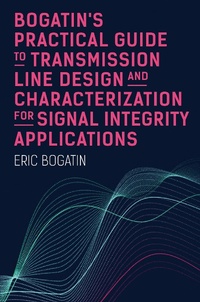
Bogatin's Practical Guide to Transmission Line Design and Characterization for Signal Integrity Applications
Published on 31. May 2020
604 pages
978-1-63081-692-6 (ISBN)
Description

This multimedia eBook establishes a solid foundation in the essential principles of how signals interact with transmission lines, how the physical design of interconnects affects transmission line properties, and how to interpret single-ended and differential time domain reflection (TDR) measurements to extract important figures of merits and avoid common mistakes. This book presents an intuitive understanding of transmission lines. Instructional videos are provided in every chapter that cover important aspects of the interconnect design and characterization process. This video eBook helps establish foundations for designing and characterizing the electrical properties of interconnects to explain in a simplified way how signals propagate and interact with interconnects and how the physical design of transmission structures will impact performance.Never be intimidated by impedance or differential pairs again.
More details
Other editions
Additional editions
Eric Bogatin
Practical Transmission Line Design and Measurement, Part 1: Lossless Single-Ended Transmission Lines
Book
05/2020
Artech House Publishers
€97.27
No shipping information available
Content
- Practical Guide to Transmission Line Design and Characterization for Signal Integrity Applications
- Table of Contents
- Chapter 1 What Are Transmission Lines and Why You Should Care
- 1.1 Do We Really Need Another Transmissi
- 1.2 All Interconnects Are Transmission L
- 1.3 The Importance of Measurement or Cha
- 1.4 When Are Interconnects Not Transpare
- 1.5 Why the RF World is Different from t
- 1.6 Review Questions
- Chapter 2 Essential Principles of Signal on Interconnects
- 2.1 All Interconnects are Transmission Lines
- 2.2 Signals Are Dynamic
- 2.3 A Simple Free Tool to Illustrate the Propagation of a Signal
- 2.4 Time Delay and Wiring Delay
- 2.5 Signals See an Instantaneous Impedance
- 2.6 Instantaneous Impedance and Characteristic Impedance
- 2.7 What Happened to the Inductance of the Transmission Line?
- 2.8 What is Special about 50 Ohms?
- 2.9 The Paradox of Current Flow into a Transmission Line
- 2.10 Displacement Current as a New Type of Current
- 2.11 Return Current in a Transmission Line
- 2.12 Where Does the Return Current Flow?
- 2.13 Review Questions
- Chapter 3 Categorizing Transmission Lines
- 3.1 Distinguishing Metrics
- 3.2 Uniform or Nonuniform Transmission Lines
- 3.3 Single-Ended or Differential
- 3.4 Uncoupled or Coupled
- 3.5 Lossless and Lossy Transmission Lines
- 3.6 Balanced or Unbalanced
- 3.7 Review Questions
- Chapter 4 Five Impedances of a Transmission Line
- 4.1 The Instantaneous Impedance
- 4.2 Characteristic Impedance
- 4.3 The Surge or Wave Impedance
- 4.4 The Input Impedance in the Time Domain
- 4.5 Drawing Circuits with Resistors and Transmission Lines
- 4.6 Input Impedance in the Frequency Domain
- 4.7 A Few Special Cases for the Input Impedance in the Frequency Domain
- 4.8 Which is Better, the Frequency or the Time Domain Impedance?
- 4.9 Review Questions
- Chapter 5 Why We Care About Impedance: Reflections
- 5.1 Reflections Keep the Universe from Blowing Up
- 5.2 The Reflection and Transmission Coefficient
- 5.3 Using the Reflection Coefficient and Transmission Coefficient
- 5.4 An Important Distinction Between the Signal and the Voltage
- 5.5 Important Termination Special Case: A 50-Ohm Resistive Load
- 5.6 Important Termination Special Case:
- 5.7 Important Termination Case: A Short
- 5.8 Resolving the Paradox: Where Did 2V
- 5.9 Another Paradox: The Signal Launched into the Transmission Line
- 5.10 Review Questions
- Chapter 6 Analyzing Reflections with the Bounce Diagram
- 6.1 A Typical TX-RX Circuit
- 6.2 The Bounce Diagram: An Example
- 6.3 Simulating the Dynamic Nature of Reflections
- 6.4 Special Case: Short at the Far End
- 6.5 Circuits with an Interface between Two Tranmission Lines
- 6.6 Try These Examples of Transmission Line Circuits
- 6.7 Review Questions
- Chapter 7 Practical Applications of Transmission Line Properties: What Every Scope User Needs to Know about Transmission Line s
- 7.1 A Commonly Misinterpreted Effect
- 7.2 The Wrong Root Causes of Rise Time Increase with Cable Length
- 7.3 Modeling Any Transient Source with Three Figures of Merit
- 7.4 Analyzing the Long Rise Time in Terms of Transmission Lines
- 7.5 The Third Figure of Merit for all Sources: Intrinsic Rise Time
- 7.6 When the Source Impedance is 50 Ohms
- 7.7 When the Thevenin Source Resistance is Much Lower than 50 Ohms
- 7.8 When to Use 50 Ohms or 1-Mohm Input to Scope
- 7.9 Review Questions
- Chapter 8 Electrical Models of Transmission Lines
- 8.1 Measured Electrical Behaviors of Transmission Lines
- 8.2 Equivalent Electric Circuit Models of Transmission Lines
- 8.3 Models and the Real World
- 8.4 Real and Ideal Transmission Lines
- 8.5 Introducing a Simple, Open-Source SPICE-Like Simulators: QUCS
- 8.6 The Tline Element and Real Transmission Lines
- 8.7 Total L and C in a Transmission Line
- 8.8 The Limit to a Transmission Line as a Lumped C or L
- 8.9 Capacitance Per Length and Inductance Per Length
- 8.10 Limitations of the n-Section Lumped Circuit Model
- 8.11 Review Questions
- Chapter 9 The TDR Principles
- 9.1 A Simple Example of a TDR Measurement and What It Can Measure
- 9.2 Principles of Operation
- 9.3 From Reflection Coefficient to Impedence
- 9.4 TDR Response with a Short Discontinuity Before the Termination
- 9.5 The TDR Response from Resistors
- 9.6 A Uniform Transmission Line or a Resistor?
- 9.7 Electrically Long and Electrically Short Transmission Lines
- 9.8 Spatial Resolution of a TDR
- 9.9 Masking: Reflections from Two Uniform Transmission Lines
- 9.10 Review Questions
- Chapter 10 Practical TDR Measurements
- 10.1 Always Use a Torque Wrench
- 10.2 Cable Termination Launches
- 10.3 Quality of Cables
- 10.4 Uniform Transmission Lines and Impedance
- 10.5 How Uniform Are Transmission Lines?
- 10.6 Increasing Impedance Down the Line
- 10.7 Discontinuities from Different Ends
- 10.8 TDR Response from a Transmission Line with an Open or Short Far End
- 10.9 TDR Response from a Very Low Impedance Transmission Line
- 10.10 When There is Coupling to a High Q Resonator
- 10.11 Review Questions
- Chapter 11 Measuring Dk with a TDR
- 11.1 The Dk and the Speed of a Signal
- 11.2 Dkeff of Microstrip and Stripline
- 11.3 Measuring Dk, Method 1: Guess the Location of the Ends of the Line
- 11.4 Measuring Dk, Method 2: Two Different Line Lengths
- 11.5 Measuring Dk, Method 3: Special Test Structure with Small Pads
- 11.6 From Effective Dk to Bulk Dk in Micostrop
- 11.7 At What Frequency Does the TDR Measure the Impedance or Dielectric Constant?
- 11.8 Review Questions
- Chapter 12 Calculating the Characteristic Impedance from Geometry and Material Properties
- 12.1 Characteristic Impedance and Geometry
- 12.2 Analytical Exact Examples
- 12.3 Using a 2D Field Solver to Calculate the Characteristic Impedance
- 12.4 Finite Width of the Return Path
- 12.5 Practice Safe Simulation and Rule #9
- 12.6 Review Questions
- Chapter 13 A Microstrip Transmission Line
- 13.1 The Surface Microstrip
- 13.2 A Simple Rule of Thumb
- 13.3 Sensitivity Analysis: First- and Second-Order Factors
- 13.4 A Comparison to Analytical Approximations
- 13.5 Comparison to a Measurements of a Simple Test Board
- 13.6 Second-Order Factors: Solder Mask, Trace Thickness, Etchback, and Adjacent Conductors
- 13.7 Review Questions
- Chapter 14 Stripline Analysis
- 14.1 Simple Stripline Analysis
- 14.2 Comparison to Analytical Approximations
- 14.3 A Design Example for Asymmetric Strpline
- 14.4 When Does the Top Plane Not Matter?
- 14.5 First- and Second-Order Factors
- 14.6 Review Questions
- Chapter 15 Differential Signaling and Differential Impedance
- 15.1 Differential Pairs for Low-Noise Analog Signals
- 15.2 Differential and Common Signals in High Speed Digital Signaling
- 15.3 Differential and Common Impedance with Traces Far Apart
- 15.4 Calculated Differential and Common Impedances with No Coupling
- 15.5 Displacement Current and the Origin of Impedance
- 15.6 Impedance of One Line When Part of a Pair
- 15.7 Case 1: The Second Line is Kept Low
- 15.8 Case 2: The Second Line is Driven with an Opposite Signal
- 15.9 Case 3: The Second Line is Driven with the Same Signal
- 15.10 Odd and Even Modes and Impedance
- 15.11 Important Properties of Odd- and Even-Mode Impedances
- 15.12 Relating Odd-Mode, Even-Mode Impedance, and Differential and Common Impedance
- 15.13 How Not to be Confused about Differential Impedance
- 15.14 Review Questions
- Chapter 16 Differential TDR
- 16.1 Measuring the Odd-Mode Impedance
- 16.2 Differential Impedance for a Tightly Coupled Differential Pair
- 16.3 Changing Coupling with Constant Linewidth
- 16.4 Changing Coupling with Constant Differential Impedance
- 16.5 Impedance Profile of a Very Tightly Coupled Differential Pair
- 16.6 Review Questions
- Chapter 17 Exploring the Properties of Differential Pairs
- 17.1 Engineering a Microstrip with a Constant Differential Impedance
- 17.2 Which is Better: Tightly Coupled or Loosely Coupled Differential Pairs?
- 17.3 Speed of a Differential and Common Signal
- 17.4 Stripline First-Order Factors
- 17.5 Stripline Second-Order Factors
- 17.6 Review Questions
- Chapter 18 Differential Pairs with No Return Paths
- 18.1 The Single-Ended Impedance and Location of the Return Plane
- 18.2 The Common Impedance and Location of the Return Path
- 18.3 Coupling Between the p- and n-Lines and the Return Plane
- 18.4 Differential Impedance of a Differential Pair and Location of the Return Plane
- 18.5 Return Currents in a Differential Pair with the Plane Far Away
- 18.6 TDR Response of a Differential Pair with a Short Gap in the Return Plane
- 18.7 TDR Response of a Differential Pair with a Short Gap in the Return Plane
- 18.8 TDR Response
- 18.9 Review Questions
- Chapter 19 Analyzing Discontinuities and Hacking Interconnects
- 19.1 Electrically Short Interconnects as Discontinuities
- 19.2 Hacking Interconnects
- 19.3 The Simulation Environment: QUCS
- 19.4 QUCS Schematics Available for Download
- 19.5 Simulating a TDR
- 19.6 Models of Discontinuities
- 19.7 An Example of Hacking an Interconnect with a Launch Discontinuity (Schematic File G_LaunchC)
- 19.8 Avoid Mink Holes
- 19.9 Hacking an Interconnect with Multiple Impdances
- 19.10 A Transmission Line with a Small Capacitive Discontinuity
- 19.11 Hacking a Very Low Impedance Interconnect
- 19.12 Extracting Circuit Models for Termination Resistors
- 19.13 Review Questions
- Appendix A: Answers to the Review Questions
- Chapter 1
- Chapter 2
- Chapter 3
- Chapter 4
- Chapter 5
- Chapter 6
- Chapter 7
- Chapter 8
- Chapter 9
- Chapter 10
- Chapter 11
- Chapter 12
- Chapter 13
- Chapter 14
- Chapter 15
- Chapter 16
- Chapter 17
- Chapter 18
- Chapter 19
- References
- About the Author
