

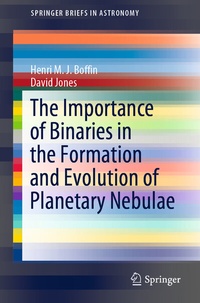
The Importance of Binaries in the Formation and Evolution of Planetary Nebulae
Description

It is now clear that a binary evolutionary pathway is responsible for a significant fraction of all planetary nebulae, with some authors even going so far as to claim that binarity may be a near requirement for the formation of an observable nebula. This has led to the requirement that textbooks most likely need to be rewritten. Building upon the review of Jones and Boffin in Nature Astronomy (2017), this Springer Brief takes a first step in this direction. It offers the first expanded presentation of all the theoretical and observational support for the importance of binarity in the formation of planetary nebulae, initially focusing on common envelope evolution but also covering wider binaries. This book emphasises the wider impact of the field, highlighting the critical role binary central stars of planetary nebulae have in understanding a plethora of astrophysical phenomena, including type Ia supernovae, chemically peculiar stars and circumbinary exoplanets.
Reviews / Votes
"The many things to be learned from this book are somewhat more up to date and thus important for anyone who wants to go forward from 2020 (rather than 1965) studying planetary nebulae and theircentral stars." (Virginia Trimble, The Observatory, Vol. 140 (1276), 2020)
More details
Other editions
Additional editions
Persons
Henri Boffin received his PhD in 1993 for his work on the formation of barium stars and has since studied a variety of problems in relation to binary stars, as well as exoplanets. Most recently, he has shown the importance of binary stars in explaining planetary nebulae, including discovering the binary central star of Fleming 1, and pioneered the use of optical interferometry to study mass transfer in symbiotic stars. He is co-author of more than 100 referred papers and co-editor of 5 books. He was credited the discovery of 11 asteroids. Since 2003 he works at the European Southern Observatory (ESO).
David Jones received his PhD in 2011, from the University of Manchester's Jodrell Bank Centre for Astrophysics, for his work on the morphologies and kinematics of planetary nebulae. He has also worked at the European Southern Observatory's Paranal Observatory, the Universidad de Atacama and the Isaac Newton Group of Telescopes, and is currently based at the Instituto de Astrofísica de Canarias (IAC) on the Spanish island of La Palma. He is the author of more than 50 refereed papers covering topics ranging from near-Earth asteroids to type Ia supernovae. Since 2018, he is a member of the organizing committee of the International Astronomical Union's Planetary Nebulae commission.
