

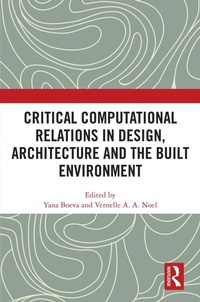
Critical Computational Relations in Design, Architecture and the Built Environment
1st Edition
Published on 16. December 2024
132 pages
978-1-040-30204-0 (ISBN)
Description

This book delves into the power relations between computational practices, technology infrastructures, knowledge, and their reproductions of bias in design at multiple scales. It provides critical perspectives and insights on how computation intersects with architecture, design, the built environment, and society.
Computational practices, tools and methods in design, architecture, and the built environment, frequently offer technocentric solutions to design problems. Portrayed as mere tools that are "neutral" and "optimized", these technological infrastructures mask social, political, and environmental entanglements involved in their creation and expansion as well as the power of software monopolies and technology providers.
The six contributions to this volume provide critical perspectives and insights on how computation intersects with architecture, design, the built environment, and society. The chapters cover diverse topics such as data practices for design simulations, machine learning (ML) and digital humanities methods for digital heritage, a computationally-aided exploration of ideologies of digital architecture, embodied and craft practice for digital fabrication, feminist hacking practices challenging heteronormative values in digital urban design, and post-disciplinary pedagogies for computational design.
The book will be of interest to researchers, students and practitioners in the fields of architecture, built environment, computational design, science and technology studies, and sociology. The chapters in this book were originally published in Digital Creativity.
Computational practices, tools and methods in design, architecture, and the built environment, frequently offer technocentric solutions to design problems. Portrayed as mere tools that are "neutral" and "optimized", these technological infrastructures mask social, political, and environmental entanglements involved in their creation and expansion as well as the power of software monopolies and technology providers.
The six contributions to this volume provide critical perspectives and insights on how computation intersects with architecture, design, the built environment, and society. The chapters cover diverse topics such as data practices for design simulations, machine learning (ML) and digital humanities methods for digital heritage, a computationally-aided exploration of ideologies of digital architecture, embodied and craft practice for digital fabrication, feminist hacking practices challenging heteronormative values in digital urban design, and post-disciplinary pedagogies for computational design.
The book will be of interest to researchers, students and practitioners in the fields of architecture, built environment, computational design, science and technology studies, and sociology. The chapters in this book were originally published in Digital Creativity.
More details
Edition
1. Auflage
Language
English
Place of publication
London
United Kingdom
Publishing group
Taylor & Francis Ltd
Target group
College/higher education
File size
57,47 MB
ISBN-13
978-1-040-30204-0 (9781040302040)
Copyright in bibliographic data and cover images is held by Nielsen Book Services Limited or by the publishers or by their respective licensors: all rights reserved.
Schweitzer Classification
Other editions
Additional editions
Yana Boeva | Vernelle A. A. Noel
Critical Computational Relations in Design, Architecture and the Built Environment
Book
approx. 07/2026
1st Edition
Routledge
€57.50
Not yet published
Yana Boeva | Vernelle A. A. Noel
Critical Computational Relations in Design, Architecture and the Built Environment
Book
12/2024
1st Edition
Routledge
€196.70
Shipment within 10-20 days
Persons
Yana Boeva is Junior Research Group Leader and Postdoctoral Researcher at the Institute for Social Sciences and the Cluster of Excellence "Integrative Computational Design and Construction for Architecture (IntCDC)" at the University of Stuttgart, Germany. Her research interests include the critical studies of computation, digital infrastructure, knowledge and skill requirements in the digital transformation, epistemic cultures and practices of design and engineering, and their sociocultural context. Her latest co-edited book Algorithmic Regimes: Methods, Interactions, and Politics (2024) explores how algorithms have become a central technology for producing, circulating, and evaluating knowledge in multiple societal arenas.
Vernelle A. A. Noel, Ph.D. is Assistant Professor of Computational Design at Carnegie Mellon University , Pittsburgh, USA, and Director of the Situated Computation + Design Lab. She investigates craft traditions, embodied and technological practices, the built environment, and their societal intersections to build new frameworks and methodologies. She builds novel tools and methods to explore social, cultural, and political aspects of computation and emerging technologies for new reconfigurations of practice, pedagogy, and publics. Her work has been supported by the Graham Foundation, the Mozilla Foundation, and ideas2innovation (i2i), among others. She is a recipient of the DigitalFUTURES Young Award for exceptional research and scholarship in the field of critical computational design, and has a TEDx Talk titled, "The Power of Making: Craft, Computation, and Carnival."
Vernelle A. A. Noel, Ph.D. is Assistant Professor of Computational Design at Carnegie Mellon University , Pittsburgh, USA, and Director of the Situated Computation + Design Lab. She investigates craft traditions, embodied and technological practices, the built environment, and their societal intersections to build new frameworks and methodologies. She builds novel tools and methods to explore social, cultural, and political aspects of computation and emerging technologies for new reconfigurations of practice, pedagogy, and publics. Her work has been supported by the Graham Foundation, the Mozilla Foundation, and ideas2innovation (i2i), among others. She is a recipient of the DigitalFUTURES Young Award for exceptional research and scholarship in the field of critical computational design, and has a TEDx Talk titled, "The Power of Making: Craft, Computation, and Carnival."
Content
Introduction: Critical computational relations in design, architecture and the built environment 1. Techno-optimism and optimization in media architecture practice and theory 2. Form data as a resource in architectural analysis: an architectural distant reading of wooden churches from the Carpathian Mountain regions of Eastern Europe 3. Tracing (in)visibilising practices: engaging with simulations for architecture and spatial planning 4. Digital tufting bee: expanding computational design boundaries through collective material practice and social play 5. We build this city on rocks and (feminist) code: hacking corporate computational designs of cities to come 6. Cultivating the critical imagination: post-disciplinary pedagogy in a computational design laboratory
