

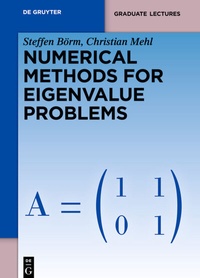
Numerical Methods for Eigenvalue Problems
Description

Eigenvalues and eigenvectors of matrices and linear operators play an important role when solving problems from structural mechanics and electrodynamics, e.g., by describing the resonance frequencies of systems, when investigating the long-term behavior of stochastic processes, e.g., by describing invariant probability measures, and as a tool for solving more general mathematical problems, e.g., by diagonalizing ordinary differential equations or systems from control theory.
This textbook presents a number of the most important numerical methods for finding eigenvalues and eigenvectors of matrices. The authors discuss the central ideas underlying the different algorithms and introduce the theoretical concepts required to analyze their behavior with the goal to present an easily accessible introduction to the field, including rigorous proofs of all important results, but not a complete overview of the vast body of research. Several programming examples allow the reader to experience the behavior of the different algorithms first-hand.
The book addresses students and lecturers of mathematics, physics and engineering who are interested in the fundamental ideas of modern numerical methods and want to learn how to apply and extend these ideas to solve new problems.
Reviews / Votes
"Hinreichend ausführliche und gut verständliche Beweise."
Prof. Dr. Alexander Hornberg, Hochschule Esslingen
More details
Other editions
Additional editions
Persons
Content
2 - 1 Introduction [Seite 9]
2.1 - 1.1 Example: Structural mechanics [Seite 9]
2.2 - 1.2 Example: Stochastic processes [Seite 12]
2.3 - 1.3 Example: Systems of linear differential equations [Seite 13]
3 - 2 Existence and properties of eigenvalues and eigenvectors [Seite 16]
3.1 - 2.1 Eigenvalues and eigenvectors [Seite 16]
3.2 - 2.2 Characteristic polynomials [Seite 20]
3.3 - 2.3 Similarity transformations [Seite 23]
3.4 - 2.4 Some properties of Hilbert spaces [Seite 27]
3.5 - 2.5 Invariant subspaces [Seite 32]
3.6 - 2.6 Schur decomposition [Seite 34]
3.7 - 2.7 Non-unitary transformations [Seite 41]
4 - 3 Jacobi iteration [Seite 47]
4.1 - 3.1 Iterated similarity transformations [Seite 47]
4.2 - 3.2 Two-dimensional Schur decomposition [Seite 48]
4.3 - 3.3 One step of the iteration [Seite 51]
4.4 - 3.4 Error estimates [Seite 55]
4.5 - 3.5 Quadratic convergence [Seite 61]
5 - 4 Power methods [Seite 69]
5.1 - 4.1 Power iteration [Seite 69]
5.2 - 4.2 Rayleigh quotient [Seite 74]
5.3 - 4.3 Residual-based error control [Seite 78]
5.4 - 4.4 Inverse iteration [Seite 81]
5.5 - 4.5 Rayleigh iteration [Seite 85]
5.6 - 4.6 Convergence to invariant subspace [Seite 87]
5.7 - 4.7 Simultaneous iteration [Seite 91]
5.8 - 4.8 Convergence for general matrices [Seite 99]
6 - 5 QR iteration [Seite 108]
6.1 - 5.1 Basic QR step [Seite 108]
6.2 - 5.2 Hessenberg form [Seite 112]
6.3 - 5.3 Shifting [Seite 121]
6.4 - 5.4 Deflation [Seite 124]
6.5 - 5.5 Implicit iteration [Seite 126]
6.6 - 5.6 Multiple-shift strategies [Seite 134]
7 - 6 Bisection methods [Seite 140]
7.1 - 6.1 Sturm chains [Seite 142]
7.2 - 6.2 Gershgorin discs [Seite 149]
8 - 7 Krylov subspace methods for large sparse eigenvalue problems [Seite 153]
8.1 - 7.1 Sparse matrices and projection methods [Seite 153]
8.2 - 7.2 Krylov subspaces [Seite 157]
8.3 - 7.3 Gram-Schmidt process [Seite 160]
8.4 - 7.4 Arnoldi iteration [Seite 167]
8.5 - 7.5 Symmetric Lanczos algorithm [Seite 172]
8.6 - 7.6 Chebyshev polynomials [Seite 173]
8.7 - 7.7 Convergence of Krylov subspace methods [Seite 180]
9 - 8 Generalized and polynomial eigenvalue problems [Seite 190]
9.1 - 8.1 Polynomial eigenvalue problems and linearization [Seite 190]
9.2 - 8.2 Matrix pencils [Seite 193]
9.3 - 8.3 Deflating subspaces and the generalized Schur decomposition [Seite 197]
9.4 - 8.4 Hessenberg-triangular form [Seite 200]
9.5 - 8.5 Deflation [Seite 204]
9.6 - 8.6 The QZ step [Seite 206]
10 - Bibliography [Seite 211]
11 - Index [Seite 214]
