

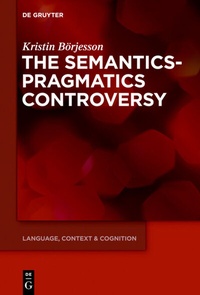
The Semantics-Pragmatics Controversy
Description

Currently, there is a great number of approaches to the semantics-pragmatics distinction on the market. This book is unique in that it offers a comprehensive overview, comparison and critical evaluation of these approaches. Taking as a starting point the notorious difficulty of differentiating so-called literal from non-literal (or figurative) meaning, it covers a wide range of the key current topics in semantics and pragmatics, e.g., the saying/meaning distinction, minimalism vs. contextualism, unarticulated constituents, indexicalism, (generalised) conversational implicatures, speech acts, levels of meaning in interpretation, the role of context in interpretation, the nature of lexical meaning. Notably, rather than taking a solely theoretical perspective, the book integrates psycho- and neurolinguistic perspectives, considering experimental results concerning the (differences in) processing of the various types of meaning covered. In terms of topics covered and perspectives taken, it is equally well suited for undergraduate as well as postgraduate students of linguistics and/or philosophy of language.
Reviews / Votes
"Börjessons Überlegungen über das Neudenken der Dichotomie "wörtliche und nicht wörtliche Bedeutung" liefern auch neue Impulse für die Untersuchung weiterer linguistischer Phänomene. Zu diesen linguistischen Phänomenen gehören die lexikalische Bedeutung eines Wortes, die Metapher, die Metonymie und die Ironie."
Mária Molnár in: Sprachtheorie und germanistische Linguistik 21.7 (2017), 89-92
More details
Other editions
Additional editions
Person
Content
1.1 - 1.1 The Standard Notions and Their Problems [Seite 11]
1.2 - 1.2 Aim of the Book [Seite 17]
1.3 - 1.3 Plan of the book [Seite 18]
2 - 2 Against the Standard Notions of Literal Meaning and Non-literal Meaning [Seite 21]
2.1 - 2.1 Literal Meaning and Context-Independence [Seite 21]
2.1.1 - 2.1.1 Literal Meaning as Compositional Meaning? [Seite 22]
2.1.2 - 2.1.2 Literal Meaning as Context-Independent? [Seite 27]
2.1.3 - 2.1.3 Literal Meaning as Primary to Non-literal Meaning? [Seite 33]
2.2 - 2.2 Non-literal Meaning and Conventionality [Seite 38]
2.2.1 - 2.2.1 Empirical Evidence [Seite 38]
2.2.2 - 2.2.2 Theoretical Considerations [Seite 44]
2.3 - 2.3 Consequences for Lexical Meaning [Seite 52]
2.3.1 - 2.3.1 Problematic Data [Seite 53]
2.3.2 - 2.3.2 Approaches to Meaning in the Lexicon [Seite 59]
2.3.2.1 - 2.3.2.1 The Maximalist Approach [Seite 60]
2.3.2.2 - 2.3.2.2 The Intermediate Approach [Seite 64]
2.3.3 - 2.3.3 Semantic Underspecification in the Lexicon [Seite 71]
2.3.3.1 - 2.3.3.1 The Minimalist Approach [Seite 71]
2.3.3.2 - 2.3.3.2 Ruhl's monosemic approach [Seite 76]
2.3.3.3 - 2.3.3.3 A Cognitive Approach [Seite 77]
2.3.3.4 - 2.3.3.4 Underspecification and Conventionality [Seite 82]
2.3.3.5 - 2.3.3.5 Underspecification and Semantic Relations [Seite 84]
2.3.3.6 - 2.3.3.6 More Underspecification in the Lexicon [Seite 85]
2.3.3.7 - 2.3.3.7 Underspecification of Semantic Composition [Seite 88]
2.4 - 2.4 Empirical Investigations of Aspects of Semantics [Seite 90]
2.4.1 - 2.4.1 Polysemy vs. Underspecification in the Lexicon [Seite 90]
2.4.2 - 2.4.2 Empirical Evidence for Semantic vs. Pragmatic Processing [Seite 96]
2.5 - 2.5 Why the Standard Notions? [Seite 101]
2.6 - 2.6 Summary [Seite 105]
3 - 3 Utterance Meaning and the Literal/Non-literal Distinction [Seite 109]
3.1 - 3.1 Levels of Meaning [Seite 110]
3.1.1 - 3.1.1 Grice's Four Types of Meaning [Seite 110]
3.1.2 - 3.1.2 Bierwisch's Three Levels of Meaning [Seite 115]
3.1.3 - 3.1.3 Summary [Seite 120]
3.2 - 3.2 The Problem of Characterising the Level of Utterance Meaning [Seite 122]
3.2.1 - 3.2.1 Explicit/Implicit Meaning [Seite 124]
3.2.1.1 - 3.2.1.1 Explicatures [Seite 124]
3.2.1.2 - 3.2.1.2 Implicitures [Seite 133]
3.2.2 - 3.2.2 Unarticulated Constituents vs. Hidden Indexicals [Seite 137]
3.2.3 - 3.2.3 Minimal Semantic Content and Full Propositionality [Seite 148]
3.2.4 - 3.2.4 Minimal Proposition vs. Proposition Expressed [Seite 157]
3.3 - 3.3 Summary [Seite 164]
4 - 4 Utterance Meaning and Communicative Sense - Two Levels or One? [Seite 169]
4.1 - 4.1 Problematic Phenomena [Seite 171]
4.1.1 - 4.1.1 Metaphor [Seite 171]
4.1.1.1 - 4.1.1.1 Traditional Characterisation and its Problems [Seite 171]
4.1.1.2 - 4.1.1.2 Metaphor and The Similarity of Various Types of Meaning [Seite 173]
4.1.1.3 - 4.1.1.3 Metaphor and Attributive Categories [Seite 176]
4.1.1.4 - 4.1.1.4 Empirical Results Concerning Metaphor Interpretation [Seite 178]
4.1.1.5 - 4.1.1.5 Formal approaches to metaphor interpretation [Seite 182]
4.1.1.6 - 4.1.1.6 Summary [Seite 189]
4.1.2 - 4.1.2 Irony [Seite 191]
4.1.2.1 - 4.1.2.1 Traditional Characterisation and its Problems [Seite 191]
4.1.2.2 - 4.1.2.2 Irony as echoic interpretive use [Seite 192]
4.1.2.3 - 4.1.2.3 Irony as a Form of Indirect Negation [Seite 195]
4.1.2.4 - 4.1.2.4 Empirical Results Concerning Irony Interpretation [Seite 198]
4.1.2.5 - 4.1.2.5 Summary [Seite 205]
4.1.3 - 4.1.3 Conversational Implicatures [Seite 206]
4.1.3.1 - 4.1.3.1 Generalised vs. Particularised Conversational Implicature - Theoretical Approaches [Seite 206]
4.1.3.2 - 4.1.3.2 (Mostly) Empirical Evidence Concerning GCIs [Seite 217]
4.1.3.3 - 4.1.3.3 Summary [Seite 226]
4.1.4 - 4.1.4 Speech Acts [Seite 227]
4.2 - 4.2 Differentiating What is Said from What is Meant [Seite 232]
4.2.1 - 4.2.1 What is Said/What is Meant and Indirect Speech Reports [Seite 234]
4.2.2 - 4.2.2 Primary vs. Secondary Pragmatic Processes [Seite 239]
4.2.3 - 4.2.3 What is Said/What is Meant and Distinct Knowledge Systems [Seite 244]
4.3 - 4.3 Summary [Seite 252]
5 - 5 Varieties of Meaning, Context and the Semantics/Pragmatics Distinction [Seite 256]
5.1 - 5.1 Towards an Alternative Characterisation of (Non-)Literal Meaning [Seite 256]
5.1.1 - 5.1.1 Literal Meaning and Types of Non-literal Meaning [Seite 258]
5.1.2 - 5.1.2 Literal Meaning as 'Minimal Meaning' [Seite 265]
5.1.3 - 5.1.3 Nature of the Processes Determining (Non)-Literal Meaning [Seite 271]
5.1.4 - 5.1.4 (Non-)Literal Meaning as (Non-)Basic Meaning [Seite 278]
5.2 - 5.2 The Nature of Context in Utterance Interpretation [Seite 285]
5.2.1 - 5.2.1 Context and the Interpretation of Implicit Meaning Aspects [Seite 286]
5.2.1.1 - 5.2.1.1 Free Enrichment and Implicit Meaning Aspects [Seite 286]
5.2.1.2 - 5.2.1.2 Discourse Interpretation and Information from Conceptual Frames [Seite 290]
5.2.1.3 - 5.2.1.3 Free Enrichment and Information from Conceptual Frames [Seite 294]
5.2.1.4 - 5.2.1.4 Consequences [Seite 302]
5.2.2 - 5.2.2 Context, Semantic Interpretation and the Semantics/ Pragmatics Distinction [Seite 303]
5.3 - 5.3 Summary [Seite 314]
6 - 6 Summary [Seite 317]
7 - List of Figures [Seite 321]
8 - Bibliography [Seite 323]
9 - Index [Seite 335]
