Alles über E-Books | Antworten auf Fragen rund um E-Books, Kopierschutz und Dateiformate finden Sie in unserem Info- & Hilfebereich.
Formal methods have been applied successfully to the verification of medium-sized programs in protocol and hardware design. However, their application to more complex systems, resulting from the object-oriented and the more recent component-based software engineering paradigms, requires further development of specification and verification techniques supporting the concepts of reusability and modifiability.
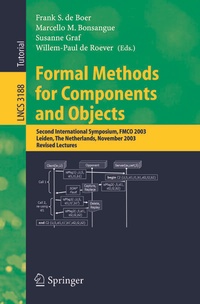
This book presents revised tutorial lectures given by invited speakers at the Second International Symposium on Formal Methods for Components and Objects, FMCO 2003, held in Leiden, The Netherlands, in November 2003. The 17 revised lectures by leading researchers present a comprehensive account of the potential of formal methods applied to large and complex software systems such as component-based systems and object systems. The book makes a unique contribution to bridging the gap between theory and practice in software engineering.
Series
Language
Place of publication
Publishing group
Target group
Professional and scholarly
Illustrations
File size
ISBN-13
978-3-540-30101-1 (9783540301011)
DOI
Schweitzer Classification
Causality and Scheduling Constraints in Heterogeneous Reactive Systems Modeling.- Machine Function Based Control Code Algebras.- Exploiting Abstraction for Specification Reuse. The Java/C# Case Study.- On the Verification of Cooperating Traffic Agents.- How to Cook a Complete Hoare Logic for Your Pet OO Language.- Behavioural Specification for Hierarchical Object Composition.- Consistency Management within Model-Based Object-Oriented Development of Components.- CommUnity on the Move: Architectures for Distribution and Mobility.- TulaFale: A Security Tool for Web Services.- A Checker for Modal Formulae for Processes with Data.- Semantic Essence of AsmL: Extended Abstract.- An MDA Approach to Tame Component Based Software Development.- An Application of Stream Calculus to Signal Flow Graphs.- Synchronous Closing and Flow Analysis for Model Checking Timed Systems.- Priority Systems.- Preserving Properties under Change.- Tools for Generating and Analyzing Attack Graphs.