

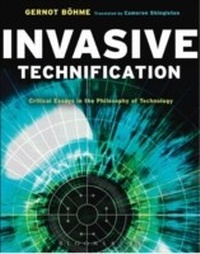
Invasive Technification
Critical Essays in the Philosophy of Technology
1st Edition
Published on 23. August 2012
248 pages
978-1-4411-9465-7 (ISBN)
Description

Technology has extended its reach to the human
body, not just in a literal sense, through implants, transplants and
technological substitutes for biological organs, but in a more figurative sense
too. Technological infrastructure and the institutions of a technified society today
determine what perception is, how we communicate and what forms of human
relationship with the natural world are possible. A fundamental new conception
of technology is urgently needed. Technology can no longer be seen as a means
for efficiently attaining pre-established ends. Rather, it must be seen as a total structure which makes new forms of
human action and human relationship possible, while limiting the possibilities
of others.
In Invasive
Technification, acclaimed German philosopher Gernot Boehme offers a reading
of technology that explores the many dimensions in which technology presents
challenges for modern human beings. It is a book about the preservation of
humanity and humane values under the demanding conditions of a technically
advanced civilisation and makes a major contribution to the contemporary
philosophy of technology.
body, not just in a literal sense, through implants, transplants and
technological substitutes for biological organs, but in a more figurative sense
too. Technological infrastructure and the institutions of a technified society today
determine what perception is, how we communicate and what forms of human
relationship with the natural world are possible. A fundamental new conception
of technology is urgently needed. Technology can no longer be seen as a means
for efficiently attaining pre-established ends. Rather, it must be seen as a total structure which makes new forms of
human action and human relationship possible, while limiting the possibilities
of others.
In Invasive
Technification, acclaimed German philosopher Gernot Boehme offers a reading
of technology that explores the many dimensions in which technology presents
challenges for modern human beings. It is a book about the preservation of
humanity and humane values under the demanding conditions of a technically
advanced civilisation and makes a major contribution to the contemporary
philosophy of technology.
Reviews / Votes
'Boehme is a worthy successor to Ellul and Mumford, one who brings the critique of technology up to date by accounting for the recent explosion of new technologies undreamt of by his illustrious predecessors. He also goes beyond them in basing his analysis on a much more developed philosophical orientation focused on the effect of technology on Nature; and thus he is able to assess its invasive impact on human nature, on what we are as bodies and minds and what we might become under its influence. His book is essential reading for anyone who is interested in this issue, arguably the most important one that humanity has to face.' Summing Up: Recommended. Science/technology and philosophy collections, upper-divisionundergraduates and above. * CHOICE *
More details
Edition
1. Auflage
Language
English
Place of publication
New York
United States
ISBN-13
978-1-4411-9465-7 (9781441194657)
Copyright in bibliographic data and cover images is held by Nielsen Book Services Limited or by the publishers or by their respective licensors: all rights reserved.
Schweitzer Classification
Other editions
Additional editions
Book
10/2012
Continuum Publishing Corporation
€117.50
Shipment within 15-20 days
Book
10/2012
Continuum Publishing Corporation
€55.89
Shipment within 15-20 days
Persons
Gernot Boehme was Professor of Philosophy at Darmstadt's Technische Univeritaet, Germany, between 1977 and 2002. His publications in English include Coping with Science (Westview, 1992) and Ethics in Context (Polity, 2001).
Cameron Shingleton is a translator and lecturer at the Melbourne School of Continental Philosophy, University of Melbourne, Australia.
Cameron Shingleton is a translator and lecturer at the Melbourne School of Continental Philosophy, University of Melbourne, Australia.
Content
Preface
\ 1. Introduction \ 2. Science, Technology, Civilisation \ 3. Understanding
Technology: Use and Entertainment \ 4. The Technification of Human Relations \ 5.
The Technification of Nature \ 6. Critique of Technology \ Appendix: The Last
Man as UEbermensch \ Index
\ 1. Introduction \ 2. Science, Technology, Civilisation \ 3. Understanding
Technology: Use and Entertainment \ 4. The Technification of Human Relations \ 5.
The Technification of Nature \ 6. Critique of Technology \ Appendix: The Last
Man as UEbermensch \ Index
