

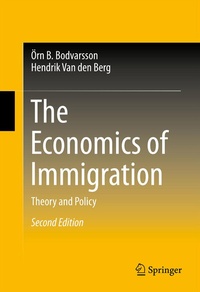
The Economics of Immigration
Theory and Policy
2nd Edition
Published on 17. May 2013
XV, 474 pages
978-1-4614-2116-0 (ISBN)
Description

The Economics of Immigration is written as a both a reference for researchers and as a textbook on the economics of immigration. It is aimed at two audiences: (1) researchers who are interested in learning more about how economists approach the study of human migration flows; and (2) graduate students taking a course on migration or a labor economics course where immigration is one of the subfields studied. The book covers the economic theory of immigration, which explains why people move across borders and details the consequences of such movements for the source and destination economies. The book also describes immigration policy, providing both a history of immigration policy in a variety of countries and using the economic theory of immigration to explain the determinants and consequences of the policies. The timing of this book coincides with the emergence of immigration as a major political and economic issue in the USA, Japan Europe and many developing countries.
More details
Series
Edition
2nd ed. 2013
Language
English
Place of publication
New York
United States
Publishing group
Springer US
Target group
Professional and scholarly
Product notice
Reflowable
Illustrations
XV, 474 p.
File size
4,55 MB
ISBN-13
978-1-4614-2116-0 (9781461421160)
DOI
10.1007/978-1-4614-2116-0
Schweitzer Classification
Other editions
Additional editions
Book
05/2013
2nd Edition
Springer
€160.49
Shipment within 15-20 days
Content
- Intro
- Contents
- Chapter 1: Introduction to Immigration Economics
- 1.1 The Late Twentieth-Century Immigration Explosion
- 1.1.1 The Complexity of Immigration
- 1.1.2 Not Everyone Likes Immigrants
- 1.1.3 Economists´ Perspective
- 1.2 The Determinants of Immigration
- 1.2.1 Many Factors Discourage Immigration
- 1.2.2 Considering the Full Set of Push, Pull, Stay, and Stay Away Factors
- 1.2.3 Shifts in Economic Forces Influence Immigration
- 1.2.4 Immigration Is a Complex Phenomenon
- 1.3 A Brief History of Immigration
- 1.3.1 Early Migrations
- 1.3.2 Recent Immigration
- 1.4 There Are Many Types of Immigrants
- 1.4.1 Not All Immigrants Are Permanent Settlers
- 1.4.2 Forced Immigration
- 1.4.3 Some Immigrants Are Difficult to Classify
- 1.5 The Purpose and Organization of this Book
- References
- Part I: Immigration Theory and Evidence
- Modeling Immigration
- The Basic Labor Market Model of Immigration
- Who Gains and Who Loses with Immigration?
- Building on the Basic Labor Market Model
- Chapter 2: The Determinants of International Migration: Theory
- Chapter Overview
- 2.1 Early Migration Theory
- 2.1.1 Pre-1960 Theory
- 2.1.2 Ravenstein and Zipf
- 2.1.3 The Standard Modern Theory of Migration
- 2.1.3.1 The Migrant as Investor in Human Capital
- 2.1.3.2 The Migrant as Consumer
- 2.1.3.3 The Migrant as Household Producer
- 2.1.4 Further Influences on Migration
- 2.1.4.1 The Role of Past Migration
- 2.1.4.2 Migration as a Life Cycle Decision
- 2.1.4.3 The Expected Income Hypothesis
- 2.2 The Modern Model of Immigration
- 2.2.1 The First Borjas Model
- 2.2.1.1 The General Intuition of the First Model
- 2.2.1.2 The Specification of the Model
- 2.2.1.3 The Predictions of the Model
- 2.2.2 Borjas´ 1991 Model
- 2.2.3 Recent Extensions of the Borjas Model
- 2.2.3.1 The CHW Model
- 2.2.3.2 Migration as a Response to Relative Deprivation
- 2.2.3.3 Migration as Sequential Search and the Option Value of Waiting
- 2.3 The Family or Household as the Decision-Making Unit
- 2.3.1 Conflicting Interests and the Family Migration Decision
- 2.3.2 Mincer´s Model
- 2.3.3 Family Migration as a Portfolio Decision
- 2.4 Summary and Conclusions
- References
- Chapter 3: Why People Immigrate: The Evidence
- Chapter Overview
- 3.1 Regression Models of Immigration
- 3.1.1 Empirical Models of Regional Migration
- 3.1.2 The Gravity Model of International Migration
- 3.1.2.1 The Basic Gravity Model of Migration
- 3.1.2.2 The Augmented Gravity Model
- 3.1.2.3 Generalizing the Gravity Model
- 3.1.3 Some Econometric Problems Related to the Gravity Model
- 3.2 The Choice of Variables in Statistical Models of Immigration
- 3.2.1 Three Examples
- 3.2.2 Representing Income Differences
- 3.2.3 Representing Migration Costs
- 3.2.4 Representing Source Country Development
- 3.2.5 Representing Immigration Restrictions
- 3.2.6 The Empirical Evidence on the Determinants of Migration
- 3.2.7 Evidence on Worldwide Migration
- 3.2.8 Evidence on Migration to Groups of OECD Countries
- 3.2.9 Evidence on US Immigration
- 3.2.10 Immigration to Other Countries
- 3.2.11 Summarizing the Results
- 3.3 Summary and Concluding Remarks
- 3.3.1 The Power of Statistical Models
- 3.3.2 The Way Forward
- References
- Chapter 4: Who Immigrates? Theory and Evidence
- Chapter Overview
- 4.1 Immigrant Selection: The Chiswick vs. Borjas Debate
- 4.1.1 Some Unfortunate Terminology
- 4.1.2 The Chiswick View
- 4.1.3 The Borjas Model
- 4.1.4 A More Detailed Look at the Borjas Model
- 4.1.5 Selection by Observed Characteristics
- 4.2 Extensions of the Borjas Model
- 4.2.1 Variable Migration Costs and Migrant Selection
- 4.2.2 Credit Constraints and Immigrant Selection
- 4.2.3 Family Migration and Selection Bias
- 4.3 The Empirical Evidence on Immigrant Selectivity
- 4.3.1 Borjas´ Empirical Results
- 4.3.2 Further Tests of Borjas´ Model
- 4.3.3 Tests Based on Counterfactual Density Functions
- 4.4 The Asymmetric Information Model
- 4.4.1 Kwok and Leland´s Model
- 4.4.2 Restoring Symmetric Information
- 4.5 The Theory of Immigrant Assimilation
- 4.5.1 The Chiswick Study of Assimilation
- 4.5.2 Potential Bias in Chiswick´s Results
- 4.5.3 Borjas´ Empirical Results
- 4.6 Addressing Borjas´ Critique
- 4.7 Conclusions
- References
- Chapter 5: The Effects of Immigration on the Destination Economy: The Theory
- Chapter Overview
- 5.1 The Macro Effects of Immigration
- 5.1.1 Homogeneous Labor with Fixed Capital
- 5.1.2 Homogeneous Labor with Variable Capital
- 5.1.3 Heterogeneous Labor
- 5.1.4 Heterogeneous Labor with Constant Capital
- 5.1.5 Heterogeneous Labor and Perfectly Elastic Capital Supply
- 5.1.6 How Big Is the US Immigrant Surplus?
- 5.2 Detailing the Distributional Effects of Immigration
- 5.2.1 The Johnson Model (1980)
- 5.2.2 The Altonji and Card Model (1991)
- 5.2.3 The Ottaviano and Peri Model
- 5.2.3.1 Temporary Effects on the Capital-Labor Ratio
- 5.2.3.2 Positive Feedback Effects on Workers in Different Education Cells
- 5.2.3.3 Negative Feedback Effects on Workers That Have the Same Education, But Different Experience
- 5.3 Long-Run Adjustment Processes
- 5.3.1 Internal Migration Responses
- 5.3.2 Multiple Goods
- 5.3.3 Choice of Technology
- 5.3.4 The Demand Effect of Immigration
- 5.4 The Demand Effect of Immigration
- 5.4.1 Say´s Law of Immigration
- 5.4.2 Regional Migration and Local Demand
- 5.4.3 A Few Models of Immigrant Demand Effects
- 5.4.4 Bodvarsson and Van den Berg´s Lexington Model
- 5.4.5 The More General Case
- 5.4.6 Further Models of Immigrant Demand Effects
- 5.5 Concluding Remarks
- References
- Chapter 6: How Immigration Impacts the Destination Economy: The Evidence
- 6.1 Introduction
- 6.2 The Spatial Correlation Method
- 6.2.1 Cross Section Applications
- 6.2.2 Dealing with Simultaneity and Spurious Correlation
- 6.2.3 Recent Applications of the Spatial Correlation Method
- 6.2.4 Applications of the Unexpected Exogenous Supply Shock Method
- 6.2.5 The Mariel Boatlift
- 6.2.6 Russian Immigrants in Israel
- 6.2.7 Assessing the Spatial Correlation Method
- 6.3 The Production Function Method
- 6.3.1 Grossman´s Pioneering Production Study
- 6.3.2 Gang and Rivera-Batiz
- 6.3.3 Assessing the Production Function Method
- 6.4 The Skill Cell Approach
- 6.4.1 Borjas´ Use of National Data Versus Regional Data
- 6.4.2 Ottaviano and Peri´s Extension of Borjas´ Skill Cell Model
- 6.4.3 Other Types of Labor Market Cells
- 6.5 Concluding Remarks
- References
- Chapter 7: Estimating Immigration´s Impact: Accounting for All Adjustments
- 7.1 Introduction
- 7.2 Does Immigration Trigger Internal Migration?
- 7.2.1 Evidence That Immigrants Induce Native Out-Migration
- 7.2.2 Evidence That Immigration Has Little Effect on Native Out-Migration
- 7.3 Migration Biases Estimates of Immigration´s Wage Effect
- 7.4 Does Immigration Change Industry Structure?
- 7.5 Measuring the Demand Effects of Immigration
- 7.5.1 Hercowitz and Yashiv´s Estimates
- 7.5.2 Bodvarsson and Van den Berg´s Lexington, Nebraska, Study
- 7.5.3 Estimating the Demand Effect of the Mariel Boatlift
- 7.5.4 Additional Estimates of the Demand Effects of Immigration
- 7.6 The Costs of Government Services for Immigrants
- 7.6.1 Recent Studies for the USA
- 7.6.2 Are US Immigrants More Costly Today than in the Past?
- 7.6.3 Estimates of Fiscal Costs for Other Countries
- 7.7 Immigration´s External Effects
- 7.7.1 Economies of Scale
- 7.7.2 Are There Negative Externalities Associated with Immigration?
- 7.8 Concluding Remarks
- References
- Chapter 8: Immigration and the Source Country
- 8.1 Remittances and Demand Effects in the Source Country
- 8.1.1 Supply and Demand Effects
- 8.1.2 Immigrants and Remittances
- 8.1.3 A Two-Country View of Remittances
- 8.2 What We Know About Immigrant Remittances
- 8.2.1 The Growth of Immigrant Remittances
- 8.2.2 Remittances as a Percentage of Source Country GDP
- 8.2.3 The Reliability of Remittance Data
- 8.2.4 The Recent Data on the Growth of Immigrant Remittances
- 8.2.5 Policies to Encourage Remittances
- 8.2.6 How Remittances Are Used in the Source Countries
- 8.2.7 Remittances: Tentative Conclusions
- 8.3 The Brain Drain
- 8.3.1 Human Capital of Immigrants
- 8.3.2 The Brain Drain as a Development Issue
- 8.3.3 How Big Is the Brain Drain?
- 8.3.4 Why Human Capital Flees Capital-Scarce Countries
- 8.3.5 Brain Drain and Brain Waste
- 8.4 A Reassessment of the Brain Drain
- 8.4.1 Remittances Again
- 8.4.2 The Brain Drain as an Incentive to Seek Education
- 8.4.3 A Simple Case
- 8.4.4 A More Realistic Case
- 8.5 Conclusions
- References
- Chapter 9: Economic Growth and Immigration
- 9.1 The Early Models of Economic Growth
- 9.1.1 Adam Smith´s Broad View of Growth
- 9.1.2 The Classicals and Diminishing Returns
- 9.1.3 The Role of Immigration in the Classical Model
- 9.1.4 Was the Classical Model a Failure?
- 9.1.5 Forgetting the Classicals and Marx: The Neoclassical School
- 9.1.6 Keynes and the Harrod-Domar Model
- 9.2 The Solow Growth Model
- 9.2.1 A Graphic Representation of the Solow Model
- 9.2.2 Immigration Similarly Has No Long-Run Effects
- 9.2.3 How an Economy Achieves Permanent Growth
- 9.3 Immigration and Technological Progress: A First Examination
- 9.3.1 Immigration and Technological Progress
- 9.3.2 Joseph Schumpeter´s Theory of Creative Destruction
- 9.3.3 The Opportunity Costs of Innovation
- 9.3.4 The Gains from Innovation
- 9.4 Immigration in the Schumpeterian Model: A More General Discussion
- 9.4.1 Immigrants as an Innovative Resource
- 9.4.2 Immigrants, Population Size, and the Returns to Innovation
- 9.4.3 Immigrants and Technology Transfers
- 9.5 Growth Effects of Immigration in the Source Country
- 9.5.1 The Overall Growth Effect of Out-Migration
- 9.5.2 How Remittances Are Used in Source Countries
- 9.5.3 The Brain Drain Again
- 9.6 Summary and Tentative Observations
- Appendix: An Alternative Mathematical Schumpeterian Model
- Innovation and Profit
- The Equilibrium Level of Entrepreneurial Activity
- The Equilibrium Rate of Technological Progress
- References
- Chapter 10: Immigration and Economic Growth: More Fundamental Issues
- 10.1 Technology
- 10.1.1 A Broader Definition of Human Technology
- 10.1.2 The Diversity of Technological Change
- 10.1.3 The S-Curve of Technology Diffusion
- 10.1.4 Technological Change Is Not Always Technological Progress
- 10.1.5 Technological Change Is a Combinatorial Process
- 10.1.6 Technology Is a Nonrival Good
- 10.1.7 Paradigm Shifts
- 10.2 Immigration and the Agglomeration of Economic Activity
- 10.2.1 The Causes of Agglomeration
- 10.2.2 The Agglomeration of Innovative Activity
- 10.2.3 The Changing Patterns of Economic Activity
- 10.3 Immigration and the Social and Natural Environments
- 10.3.1 Nature as a Source of Diminishing Returns
- 10.3.2 The Natural Environment
- 10.3.3 An Ecological Solow Model
- 10.3.4 Adding a Third Sector: Human Society
- 10.3.5 Bourdieu´s Forms of Capital
- 10.3.6 Modeling the Social Sector
- 10.4 Institutions and Social Capital
- 10.4.1 The Study of Institutions
- 10.4.2 Conflicts Between Formal and Informal Institutions
- 10.5 Chapter Conclusions and Some Further Thoughts on the Solow Model
- References
- Part II: Immigration Issues and Cases
- Chapter 11: Temporary Immigration, Involuntary Immigration, and Other Variations on the Standard Model
- Chapter Overview
- 11.1 Return Immigration
- 11.1.1 Return Immigration as a Response to Changing Circumstances
- 11.1.2 Correcting Mistakes in Judgement
- 11.1.3 Source Country Policies to Encourage Immigrants to Return
- 11.2 Temporary Immigration
- 11.2.1 The Multinational Corporation and Temporary Immigration
- 11.2.2 Temporary Immigration as a Destination Country Policy
- 11.2.3 The Diversity of Temporary Immigration
- 11.3 Analyzing Temporary Migration
- 11.3.1 A Simple Model: Culture Clash Versus Higher Income
- 11.3.2 Other Determinants of Temporary Immigration
- 11.3.3 The Role of International Trade
- 11.3.4 Further Issues Related to Temporary Immigration
- 11.3.5 Temporary Immigration as a Form of Labor Market Discrimination
- 11.3.6 Growth Implications of Temporary Immigration
- 11.3.7 Temporary Immigration and the Ageing Problem
- 11.4 Asylum Seekers and Refugees
- 11.4.1 Refugees
- 11.4.2 The UNHCR
- 11.4.3 Asylum Seekers
- 11.5 Involuntary Immigration
- 11.5.1 A Model of International Slavery
- 11.5.2 Other Oppressive Forms of Immigration
- 11.6 Summary and Conclusions
- References
- Chapter 12: Unauthorized Immigration
- 12.1 Introduction
- 12.2 Estimating Unauthorized Immigration
- 12.2.1 The Residual Method
- 12.2.2 Other Methods for Estimating Unauthorized Immigration
- 12.3 What Do the Estimates Tell Us?
- 12.4 Some Characteristics of Unauthorized Immigrants
- 12.5 The Economic Analysis of Unauthorized Immigration
- 12.5.1 The Supply and Demand for Unauthorized Workers
- 12.5.2 Unauthorized Immigration as a Form of Labor Market Discrimination
- 12.5.3 Oppression of Unauthorized Workers
- 12.5.4 Discussion of the Labor Segmentation Hypothesis
- 12.5.5 Temporary Work Visas: Just a Variation on Illegality?
- 12.5.6 Unauthorized Immigration Can Be Deadly
- 12.6 The Fiscal Costs and Benefits of Unauthorized Immigration
- 12.7 Unauthorized Immigration: Policy Options
- 12.7.1 Border Controls
- 12.7.2 Employer Sanctions
- 12.8 Conclusions
- References
- Chapter 13: Hispanic Immigration to the USA
- 13.1 A Brief Description of Recent Hispanic Immigration to the USA
- 13.2 Assimilation
- 13.2.1 Hispanics´ Slow Assimilation
- 13.2.2 Further Reasons Why Hispanic Assimilation Is Slow
- 13.2.3 Is It All Just a Data Problem?
- 13.3 Geographic Diffusion
- 13.3.1 Networks and Herding
- 13.3.2 Toward the South and the Midwest
- 13.3.3 The Dispersal of Manufacturing Jobs and Immigrant Dispersal
- 13.4 Explaining Hispanic Immigration
- 13.4.1 The Welfare Effects on the Source Hispanic Countries
- 13.4.2 The Demand Effects of Hispanic Immigration
- 13.5 Future Hispanic Immigration
- 13.5.1 Will Hispanic Immigration Continue?
- 13.5.2 Temporary Immigration Programs
- 13.6 Conclusions
- References
- Part III: Immigration Policy: Introduction
- The Goals of Immigration Policy
- Classifying Immigration Policies
- References
- Chapter 14: Immigration Policy in the USA
- Chapter Overview
- 14.1 Early Immigration Policy
- 14.1.1 The Borders Were Not Entirely Open
- 14.1.2 Assessing the Early Policies
- 14.2 The Latter Half of the Nineteenth Century
- 14.2.1 Religion and Immigration
- 14.2.2 Growing Opposition to Immigration Spurs New Legislation
- 14.2.3 The Chinese Exclusion Act
- 14.2.4 Controlling the Border
- 14.2.5 Immigration Remained Mostly Open
- 14.2.6 Assessing the Early Policies
- 14.3 The Shift in Policy in the Early Twentieth Century
- 14.3.1 The First General Restrictions of Immigration
- 14.3.2 The Post-World War I Shift in Policy
- 14.3.3 Immigration During the Great Depression
- 14.3.4 Immigration Policy During the War
- 14.4 Post World War II Immigration Policy
- 14.4.1 Policy Immediately After the War
- 14.4.2 A New Immigration Law in 1965
- 14.4.3 The Economic Effects of the 1965 Act
- 14.4.4 The Growth of Unauthorized Immigration
- 14.5 Recent USA Immigration Policy
- 14.5.1 IRCA
- 14.5.2 After IRCA
- 14.5.3 Summarizing Recent US Policy
- 14.6 Post 9/11 Immigration Policy
- 14.6.1 Reform of the Immigration Bureaucracy and Enforcement
- 14.6.2 Employment-Based Permanent Residency
- 14.6.3 Temporary Work Visas
- 14.6.4 Diversity Immigrant Visas
- 14.6.5 Immigration Reform Stalls in 2006 and 2007
- 14.7 Summary and Conclusions
- References
- Chapter 15: Immigration Policy in Canada
- Chapter Overview
- 15.1 Overview of Immigration Policy in Canada
- 15.1.1 Immigration and Population Growth in Canada
- 15.1.2 The Early Years
- 15.1.3 Late Nineteenth Century Immigration
- 15.1.4 Summary of Nineteenth Century Canadian Immigration Policy
- 15.2 Canadian Immigration Policy in the Twentieth Century
- 15.2.1 The First Half of the Twentieth Century
- 15.2.2 After World War II
- 15.2.3 Comparing Immigration Legislation
- 15.3 Canada´s Immigration Policy Today
- 15.3.1 The 2002 Reform
- 15.3.2 The Canadian Point System
- 15.3.3 Should Policy Discriminate in Favor of Highly Educated Immigrants?
- 15.3.4 The Seven Questions in the Early Twenty-First Century
- 15.3.5 Immigrant Performance and Recent Shifts in Policy
- 15.4 Some Final Observations
- References
- Chapter 16: Immigration Policy in Europe
- Chapter Overview
- 16.1 European Migration During the Colonial Era
- 16.1.1 Colonial Regimes and Immigration
- 16.1.2 The Nineteenth Century
- 16.1.3 The Emigration Life Cycle
- 16.1.4 European Emigration After World War I
- 16.2 The Post-World War II Period
- 16.2.1 Guest Workers
- 16.2.2 The Post-Soviet Era
- 16.2.3 Recent EU Immigration Policy
- 16.3 The Interesting Case of Ireland
- 16.4 Recent Immigration Policy in Spain
- 16.5 Can Immigration Solve Europe´s Demographic Burden?
- 16.6 Conclusions
- References
- Chapter 17: Conclusions and Final Observations
- Chapter Overview
- 17.1 Immigration: A Fundamental Economic Phenomenon
- 17.2 We Must Think Outside Our Little Boxes
- 17.3 An Appeal to Holism
- 17.3.1 Defining Holism
- 17.3.2 The Economics of Immigration Must Embrace Holism
- 17.3.3 The Holistic Approach to the Study of Immigration: An Example
- 17.4 Developing International Institutions for an International Phenomenon
- 17.4.1 The Global Commission on International Migration
- 17.4.2 What Is the Optimal Flow of Immigrants?
- 17.4.3 Small Steps Towards Global Governance
- 17.5 Final Comment
- References
- Index
