

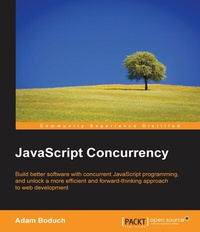
JavaScript Concurrency
Build better software with concurrent JavaScript programming, and unlock a more efficient and forward thinking approach to web development
Published on 13. January 2025
292 pages
978-1-78588-026-1 (ISBN)
Description

Build better software with concurrent JavaScript programming, and unlock a more efficient and forward thinking approach to web development
Key Features
[*]Apply the core principles of concurrency to both browser and server side development
[*]Explore the latest tools and techniques at the forefront of concurrent programming, including JavaScript promises, web workers, and generators
[*]Learn how concurrent and parallel programming can help you tackle the challenges of fast, data heavy web development
Book DescriptionConcurrent programming may sound abstract and complex, but it helps to deliver a better user experience. With single threaded JavaScript, applications lack dynamism. This means that when JavaScript code is running, nothing else can happen. The DOM can't update, which means the UI freezes. In a world where users expect speed and responsiveness - in all senses of the word - this is something no developer can afford. Fortunately, JavaScript has evolved to adopt concurrent capabilities - one of the reasons why it is still at the forefront of modern web development. This book helps you dive into concurrent JavaScript, and demonstrates how to apply its core principles and key techniques and tools to a range of complex development challenges. Built around the three core principles of concurrency - parallelism, synchronization, and conservation - you'll learn everything you need to unlock a more efficient and dynamic JavaScript, to lay the foundations of even better user experiences. Throughout the book you'll learn how to put these principles into action by using a range of development approaches. Covering everything from JavaScript promises, web workers, generators and functional programming techniques, everything you learn will have a real impact on the performance of your applications. You'll also learn how to move between client and server, for a more frictionless and fully realized approach to development. With further guidance on concurrent programming with Node.js, JavaScript Concurrency is committed to making you a better web developer. The best developers know that great design is about more than the UI - with concurrency, you can be confident every your project will be expertly designed to guarantee its dynamism and power. What you will learn
[*]Understand exactly how JavaScript works in a web browser environment, and how these mechanisms power our event-driven JavaScript code
[*]Use promises to turn complex synchronization scenarios into readable and maintainable values
[*]Compute values lazily and avoid unnecessary memory allocations using generators.
[*]Write concurrent code that doesn't feel like concurrent code by abstracting away boilerplate chores
[*]Leverage true hardware parallelism with web workers to get a better performance
[*]Get to grips with the NodeJS model of concurrency and learn why it's good for I/O-intensive web applications
Who this book is forJavaScript Concurrency is written for any JavaScript developer who wants to learn how to write more efficient, powerful, and maintainable applications that utilize the latest developments in the JavaScript language. All aspects of concurrent, asynchronous, and parallel programming are covered from first principles and by the end of the book you'll be able to create a fully-worked application that leverages all the topics covered in the book.
Key Features
[*]Apply the core principles of concurrency to both browser and server side development
[*]Explore the latest tools and techniques at the forefront of concurrent programming, including JavaScript promises, web workers, and generators
[*]Learn how concurrent and parallel programming can help you tackle the challenges of fast, data heavy web development
Book DescriptionConcurrent programming may sound abstract and complex, but it helps to deliver a better user experience. With single threaded JavaScript, applications lack dynamism. This means that when JavaScript code is running, nothing else can happen. The DOM can't update, which means the UI freezes. In a world where users expect speed and responsiveness - in all senses of the word - this is something no developer can afford. Fortunately, JavaScript has evolved to adopt concurrent capabilities - one of the reasons why it is still at the forefront of modern web development. This book helps you dive into concurrent JavaScript, and demonstrates how to apply its core principles and key techniques and tools to a range of complex development challenges. Built around the three core principles of concurrency - parallelism, synchronization, and conservation - you'll learn everything you need to unlock a more efficient and dynamic JavaScript, to lay the foundations of even better user experiences. Throughout the book you'll learn how to put these principles into action by using a range of development approaches. Covering everything from JavaScript promises, web workers, generators and functional programming techniques, everything you learn will have a real impact on the performance of your applications. You'll also learn how to move between client and server, for a more frictionless and fully realized approach to development. With further guidance on concurrent programming with Node.js, JavaScript Concurrency is committed to making you a better web developer. The best developers know that great design is about more than the UI - with concurrency, you can be confident every your project will be expertly designed to guarantee its dynamism and power. What you will learn
[*]Understand exactly how JavaScript works in a web browser environment, and how these mechanisms power our event-driven JavaScript code
[*]Use promises to turn complex synchronization scenarios into readable and maintainable values
[*]Compute values lazily and avoid unnecessary memory allocations using generators.
[*]Write concurrent code that doesn't feel like concurrent code by abstracting away boilerplate chores
[*]Leverage true hardware parallelism with web workers to get a better performance
[*]Get to grips with the NodeJS model of concurrency and learn why it's good for I/O-intensive web applications
Who this book is forJavaScript Concurrency is written for any JavaScript developer who wants to learn how to write more efficient, powerful, and maintainable applications that utilize the latest developments in the JavaScript language. All aspects of concurrent, asynchronous, and parallel programming are covered from first principles and by the end of the book you'll be able to create a fully-worked application that leverages all the topics covered in the book.
All prices
More details
Edition
Digital original
Language
English
Place of publication
Birmingham
United Kingdom
Target group
US School Grade: College Graduate Student
Edition type
Digital original
File size
1,27 MB
ISBN-13
978-1-78588-026-1 (9781785880261)
Copyright in bibliographic data and cover images is held by Nielsen Book Services Limited or by the publishers or by their respective licensors: all rights reserved.
Schweitzer Classification
Other editions
Additional editions
Person
Boduch Adam :
Adam Boduch has been involved in large-scale JavaScript development for nearly 15 years. Before moving to the frontend, he worked on several large-scale cloud computing products using Python and Linux. No stranger to complexity, Adam has practical experience with real-world software systems and the scaling challenges they pose.
Adam Boduch has been involved in large-scale JavaScript development for nearly 15 years. Before moving to the frontend, he worked on several large-scale cloud computing products using Python and Linux. No stranger to complexity, Adam has practical experience with real-world software systems and the scaling challenges they pose.
Content
Table of Contents
Why JavaScript Concurrency?
The JavaScript Execution Model
Synchronizing with Promises
Lazy Evaluation with Generators
Working with Workers
Practical Parallelism
Abstracting Concurrency
Evented IO with NodeJS
Advanced NodeJS Concurrency
Building a Concurrent Application
Why JavaScript Concurrency?
The JavaScript Execution Model
Synchronizing with Promises
Lazy Evaluation with Generators
Working with Workers
Practical Parallelism
Abstracting Concurrency
Evented IO with NodeJS
Advanced NodeJS Concurrency
Building a Concurrent Application

