

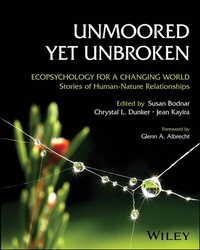
Unmoored Yet Unbroken
Description

Unmoored Yet Unbroken is less a final statement than a generative offering. It gathers voices from around the world-many early in their careers-who are working to articulate what it means to live and practice in an ecologically disoriented age. What emerges is a collective engagement with resilience, not as simple endurance, but as a relational process-a network of care that spans people, cultures, and ecologies, and leads to the deepening transformation of self. An important contribution to the ecopsychology literature."
- PETER H. KAHN, Jr., Professor of Psychology and Environmental and Forest Sciences, University of Washington; author of Technological Nature: Adaptation and the Future of Human Life
A rich tapestry of global narratives that highlights the psychological impact of environmental changes
Unmoored Yet Unbroken explores the intricate relationship between humans and the natural environment. With stories and observations from urban, suburban, rural, and wild environments, this book challenges ethnocentric perspectives and emphasizes our deep interdependence with the natural world. Protecting and stabilizing this relationship is vital for our mental health and essential in the broader fight against climate change.
This book uncovers the psychological challenges arising from our increasing disconnection from the natural world through a blend of diverse personal narratives, clinical insights, and cultural analysis. It addresses the urgent need to understand how environmental changes impact mental health in every community. By deepening our understanding of how climate change influences the human psyche, Unmoored Yet Unbroken offers an essential perspective for scholars, students, activists, and general readers.
. Explore the clinical implications of ecological change and how they differ globally
. Get a well-rounded perspective grounded in clinical evidence, personal stories, interviews, and survey results
. Understand how ecological changes impact marginalized communities in urban and rural settings
This book addresses gaps in existing literature and offers insights into the unique challenges marginalized groups face in environmental changes.
More details
Other editions
Additional editions
Persons
Susan Bodnar, PhD, is a psychologist and educator who created a popular graduate-level course on clinical ecopsychology at Teachers College, Columbia University, where she also teaches child psychopathology. She is the founder of DEWLab.org, dedicated to exploring the human connection with the natural world. She serves on the editorial board of Ecopsychology and is assistant editor for Psychoanalytic Dialogues. Susan maintains a psychotherapy practice in Manhattan, offering traditional, walk-and-talk, and pet-assisted therapy, and is clinical director of the Stamford Wellness Center, a rural start-up clinic in upstate New York.
Chrystal L. Dunker, PhD, is an environmental educator and researcher specializing in human-nature interaction patterns and their role in well-being. She is managing editor of Ecopsychology and an affiliate of the Human Interaction with Nature and Technological Systems Lab (HINTS Lab) at the University of WA - Seattle. Chrystal's love of the outdoors and her joy in sharing the wonders of the more-than-human world fuel her ongoing work-rooted in her dissertation research and years in environmental education-to contribute new insights and scholarship that help advance the field of ecopsychology.
Jean Kayira, PhD, is an Associate Professor in the Department of Environmental Studies at the State University of New York College of Environmental Science and Forestry (SUNY-ESF) in Syracuse. Her work is rooted in a deep commitment to Indigenous knowledge systems, land-based education, and community-led research. With a passion for decolonizing methodologies and food justice, she brings diverse ways of knowing into both her scholarship and teaching. Jean finds joy in learning alongside others and in building relationships that honor place, stories, and lived experiences.
Content
About the Contributors ix
About the Editors xiii
Foreword xv
Preface: Ethnographic Activism: Stories that Evoke Change xvii
Acknowledgments xxi
1 Introduction: Challenging the Inevitability of Climate Change 1
Susan Bodnar, PhD
2 Retracing Umunthu: The Interconnectedness of Home and the Natural World 15
Jean Kayira, PhD
Section 1 Attachment and Loss of Place 23
3 Nature as Caregiver: Our Attachment to Place 25
Linda Buzzell, MA, MFT
4 The Wind Sings: A Life Rooted in Nature and Reciprocity 29
Elizabeth M. Mattice
5 Sacred Land: Nature Connectedness and Identity in Iranian Diaspora 35
Sarina H. Alavi
6 Flames and Fears: The Impact of Wildfire on Children's Mental Health 41
Amber Ray
7 Perspectives on the Changing Environment of South Florida 49
Maya Sikora
8 Resisting Binaries and a Changing Climate: Stories of Trans Ecology 55
Taylor Michl
9 The Fortress of the Gulf: From Sea Trade to Oil Wealth and Environmental Reckoning 65
Fatemah Alkhamis
10 It's All One Song: The Interwoven Threads of Environment, Culture, and Community 77
Danny DeBonis
Section 2 Environmental Impacts and Emotions 81
11 Environmental Impacts and Emotions 83
Panu Pihkala, PhD
12 Disrupted Rhythms: Climate Change and Its Toll on Amazonian Lives 95
Paula Aljovin, MA and Luna Dannon, BA
13 Rising Tides, Burdened Minds: The Psychological Impact of Climate-induced Flooding in Pakistan 105
Ayesha Liaqat
14 Climate Change and Environmental Upheaval: Exploring Community Impacts and Resilience in the Paraíba Valley 111
Katie Garcia
15 The Fifth Season in Nature: How Smog Redefines Lahore's Winters and Community Life 119
Amna Maryam
16 At the Crossroads: Mental Health of Rural Men Facing Economic and Environmental Shifts in the Catskills 127
Carrie Sutton, MA
Section 3 Environment and Mental Health 133
17 The Impact of the Climate Crisis on Mental Health: Journeys Between the Particular and the Collective 135
Judith Anderson, MBChB, MA
18 Beyond Survival: Loss of Place Connection After Tsunami and Earthquake Devastation 145
Koya Asano
19 Between Screens and Streams: Technology's Impact on Our Environmental Connection 151
Niklas K. Nyblom
20 The Impact of Wildfires: Experiencing the 2021 Colorado Marshall Fire 157
Elizabeth Campbell
21 Tides of Erasure: Change and Loss Amid Gentrification of the Hamptons, New York 165
Siena Fabiano
22 Dust Storms in Beijing: Breathing Through Environmental and Psychological Change 177
Zhaohe Chang
23 Honoring the Earth, Healing the Future: Ojibwe Spirituality and Climate Resistance 185
Nevaeh Marshall
Section 4 Community and Interconnectedness 193
24 Reflections on Community and Interconnectedness 195
Ranjan Datta, PhD
25 The Emotions of Climate Change and the Ripple in Community: A Haudenosaunee Perspective 199
Jade Haumann
26 Changing Climate, Severe Weather, and Socioeconomic Disparities in Environmental Experiences 203
Paritosh Joshi
27 Belonging in Nature: LGBTQ+ Community Connections Amid Climate Challenges 209
Sofia Packer
28 Whispers of the Canyon: Climate Change and a Diné Connection to the Land 215
Amber Ballenger
Section 5 Faith, Memory, and Change 221
29 Faith, Memory, and Change: Addressing the Climate Crisis Through a Moral and Spiritual Lens 223
Karenna Gore, JD, MA
30 Uprooted: Changing Climate, Conflict, and Displacement in Sudan 227
Zikra Fashir
31 The Impacts of Pollution, Climate, and Environmental Disaster on Residents of Mobile, Alabama 233
Rian Maxwell-Williams
32 Sacred Rains, Modern Times: Community Perspectives on India's Changing Monsoons 239
Khushi Shah
33 Nature, Queerness, and Self-Returning 249
Irene Fueyo-Gomez
34 The Negro Speaks of Rivers: An Exploration of the Sacred Nature of Rivers in Africana Memory 257
Taylar S. Enlow
35 Echoes of an Ephemeral Relationship: Navigating Memory and Urban Transformation in Albania 263
Neiva Teka
36 Wildfires and the Psychology of Environmental Terror 267
Georgios Dougalis
37 Pathways to Resilience in a Changing World: Anchoring Individual, Community, and Ecological Healing 275
Chrystal Dunker, PhD
Online Resources 285
About the Contributors
Sarina Alavi, MA, is a second-year PhD student in School Psychology at Teachers College, Columbia University, where she also recently earned an MA in Clinical Psychology. Born in Northern Nevada to parents who were forced migrants from Iran, Sarina identifies as Persian-American and was raised in both Northern Nevada and Southern California. Her doctoral research centers on systems-integrated interventions and implementation science, with a focus on culturally considerate practices. Sarina has also previously published and presented on topics including nature connectedness as a protective factor against negative outcomes, such as involvement in firearm violence.
Glenn A. Albrecht, PhD, was a Professor of Sustainability at Murdoch University in Western Australia until his retirement in 2014. He is an honorary fellow at the School of Geosciences at the University of Sydney. Widely published, he is the author of Earth Emotions: New Words for a New World, Cornell University Press, 2019, and a forthcoming book, The Symbiocene: Our Only Future, again with CUP. He is also a grandfather.
Paula Aljovin, MA, is a Peruvian-American researcher based in New York City. She earned her MA in Clinical Psychology from Teachers College, Columbia University, and her BA in Psychology at Pontificia Universidad Católica del Perú. Paula co-designed and led the Mental Health Team of The Vine Trust's Amazon Hope Medical Programme, a Scottish-based organization that delivers free primary health services in remote Amazonian communities through medical ships. She currently works as a Project Coordinator in a community-based intergenerational study of Alzheimer's disease at Columbia University Irving Medical Center.
Fatemah Alkhamis, MA, is a Kuwaiti woman with an MA in Clinical Psychology. She advocates for culturally sensitive mental health practices, environmental sustainability, and decolonial approaches to psychotherapy and psychological science. Her work reflects a deep appreciation for Arab heritage and culture, striving to elevate its significance while fostering connections between culture, community, and the environment.
Judith Anderson, MBChB, MA, is a Jungian psychotherapist and psychiatrist who has been focused on the psychological aspects of climate change since 2005. Part of the founding group of Climate Psychology Alliance in the UK, she was Chair of its Board of Directors from 2020 to 2024. She is passionate about the need for psychotherapists to become climate aware. She recently co-edited Being a Therapist in a Time of Climate Breakdown (2024 Routledge). ORCID iD: 0009-0005-3632-9312.
Koya Asano, MA, is a Clinical Psychology graduate from Teachers College, Columbia University. He is from Japan and received his bachelor's degree from Adelphi University in the United States.
Amber Ballenger is Diné from the Navajo Nation and is part of the Meadow People Clan and Folded Arms People Clan. She is a current graduate student at the State University of New York-College of Environmental Science and Forestry, studying Environmental Science. Through her work and research, she aims to foster deeper connections between children and the natural world, shaping future generations to be stewards of the environment.
Linda Buzzell, MA, MFT, is a psychotherapist who has specialized in ecotherapy since 2000. She and Craig Chalquist edited the Sierra Club Books anthology Ecotherapy: Healing with Nature in Mind (2009), a core text in clinical ecopsychology. She is on the Editorial Board of Ecopsychology, the peer-reviewed journal in the field, and is an Adjunct Faculty at Pacifica Graduate Institute in Santa Barbara, California, where she teaches ecopsychology and ecotherapy.
Lizzy Campbell, MA, graduated with her MA in Clinical Psychology from Teachers College, Columbia University. Lizzy is passionate about equitable access to psychological services, especially among youth, and her research interests include parental impacts on psychological well-being in children. Outside of her academic and professional interests, Lizzy is an avid reader and cat mom who enjoys engaging in outdoor activities, especially hiking, camping, and paddleboarding.
Zhaohe Chang, MA, graduated from Teachers College, Columbia University with a master's degree in clinical psychology. Zhaohe is seeking to pursue a doctoral degree in this field. During his spare time, he likes to play Legos and explore new ecopsychological activities.
Luna Dannon is a Peruvian clinical psychologist and an independent visual artist based in Lima, Perú (@lunadannonarte). She trained in classical drawing and painting at the Barcelona Academy of Art and completed her BA in Psychology at Pontificia Universidad Católica del Perú. Luna co-designed and led the Mental Health Team of The Vine Trust's Amazon Hope Medical Programme. This Scottish-based organization delivers free primary health services in remote Amazonian communities through medical ships. She is currently developing an art exhibition that explores how the Kukama Kukamiria, through their cosmology, preserve their collective memory, which has been plagued by violence and discrimination.
Ranjan Datta, PhD, is serving as Canada Research Chair (CRC) in Community Disaster Research at Mount Royal University, Alberta, Canada. With over 17 years devoted to community-based research, Dr. Datta has made significant contributions across diverse domains, including community disaster research, resilience, and environmental resource management, spanning Indigenous and non-Indigenous communities in Canada, Ghana, Bangladesh, and India. Beyond academia, his engagement in community-led social justice movements reflects his dedication to social and environmental advocacy, exemplifying his commitment to transformative change.
Danny DeBonis, MA, is a clinical psychology graduate from Teachers College, Columbia University, and is a clinical research coordinator at the Columbia University Irving Medical Center.
Georgios Dougalis, MA, is the Lab Manager of the Spelke Lab at Harvard University and a research associate in the Communication Sciences Lab at Columbia University. He is from Greece and holds a bachelor's degree in psychology and philosophy from Durham University and a master's degree in clinical psychology from Columbia University. His research currently examines infants' core cognition and capacities for self- and interactive regulation in various risk contexts, including exposure to environmental toxins.
Taylar Enlow is a graduate student at Union Theological Seminary. Her research focuses on spiritual ecology and Earth ethics within an Africana framework. She is a graduate of Temple University, where she majored in Global Studies with a concentration in Africana cultures and religions.
Siena Fabiano, MA, holds a master's degree in clinical psychology from Columbia University's Teachers College. She grew up in a small coastal village surrounded by the salty air and deep blue waters of Long Island's East End. She is passionate about understanding and researching the significant intersection between the environment, mental health, and well-being, especially in her hometown, which is particularly vulnerable to environmental degradation due to pressures like gentrification and climate change.
Zikra Fashir, is an Ed.M. Mental Health Counseling Student at Teachers College, Columbia University. She is currently working to assist refugees in the Kiryandongo Refugee Settlement in Bweyale, Uganda.
Irene Fueyo-Gomez, MA, is a clinical psychology graduate from Columbia University's Teachers College. She is interested in research that centers on the experiences of queer people to address the high rates of psychopathology and suicidality in this population. She believes in the therapeutic potential of a connection with nature.
Katie Garcia, MA, is an educator and ecological theater advocate exploring the intersections of spirituality, environmental psychology, and creative pedagogy. Her ultimate goal is to empower individuals to reconnect with themselves and others, foster a deeper relationship with nature, and contribute to positive change in the world.
Karena Gore, JD, MA is the founder and executive director of the Center for Earth Ethics (CEE) at Union Theological Seminary. CEE works to change the dominant value system from one based on short-term material gain-no matter the pollution, depletion, and inequity-to one based on the long-term health of the whole community of life. She is the author of Lighting the Way: Nine Women Who Changed Modern America (2005). She graduated from Harvard College, Columbia Law School, and Union Theological Seminary and currently is member of the faculty of Union Theological Seminary and an adjunct at Columbia Climate School.
Jade Haumann is a Seneca Nation Wolf Clan member and is currently a graduate student studying fire ecology through a Haudenosaunee lens at the State University of New York-College of Environmental Science and Forestry. Her work embodies her passion for advocating for Indigenous sovereignty, healing human-land relations, and her love for community. She hopes to inspire others to nurture their passions and let them guide them as they navigate the impacts of climate change.
Paritosh Joshi, MA, is a Job Readiness Trainer at America Works of New York and an Executive Functioning Coach. He has a Master of Arts in Clinical Psychology and a Master of Arts in...
