

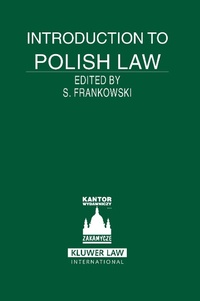
Introduction to Polish Law
Published on 11. November 2005
448 pages
978-90-411-5727-0 (ISBN)
Description

During two decades encompassing three epochal events - the collapse of European communism in 1989, NATO membership in 1999, and accession to the European Union in 2004 - the legal system of Poland has emerged with remarkable maturity and stability. In an exemplary blend of its democratic heritage from the era between the World Wars, proven effective legislation from the communist era, and the vibrant 1997 Constitution, Polish law dramatically reflects new social, economic and political realities.
With eleven lucid chapters written by fifteen academic experts from the Warsaw University School of Law and Administration, each in his or her respective field of law, this deeply informed but succinct and practical volume is the ideal starting point for research whenever a question of Polish law arises. The authors clearly explain the legal concepts, customs and rules surrounding such essential elements as the following:
principles and practices of constitutional law;
administrative law and procedure;
civil procedure;
courts and special judicial bodies;
judicial review;
enforcement of foreign judgments;
family, succession and inheritance matters;
formation and conduct of corporations and partnerships;
contract formation, interpretation and termination;
environmental protection;
harmonizing Polish economic law with EU standards;
competition law and regulatory framework of market processes;
special regulation of energy, telecommunications and financial markets;
copyrights, patents, utility models and industrial designs;
licence agreements;
the labour relationship and types of employment contracts; and
criminal law and procedure.
Each chapter includes its own detailed bibliography.
English-speaking legal practitioners and academics have here an ideal introduction to the basic institutions, principles and rules of Polish law. Encompassing all the major fields of legal practice, Introduction to Polish Law provides an essential understanding of the Polish legal system, so that users can become familiar with law and legal processes in Poland and pursue further research on specific Polish legal matters. Practitioners will find it of great value for both counselling and courtroom use.
With eleven lucid chapters written by fifteen academic experts from the Warsaw University School of Law and Administration, each in his or her respective field of law, this deeply informed but succinct and practical volume is the ideal starting point for research whenever a question of Polish law arises. The authors clearly explain the legal concepts, customs and rules surrounding such essential elements as the following:
principles and practices of constitutional law;
administrative law and procedure;
civil procedure;
courts and special judicial bodies;
judicial review;
enforcement of foreign judgments;
family, succession and inheritance matters;
formation and conduct of corporations and partnerships;
contract formation, interpretation and termination;
environmental protection;
harmonizing Polish economic law with EU standards;
competition law and regulatory framework of market processes;
special regulation of energy, telecommunications and financial markets;
copyrights, patents, utility models and industrial designs;
licence agreements;
the labour relationship and types of employment contracts; and
criminal law and procedure.
Each chapter includes its own detailed bibliography.
English-speaking legal practitioners and academics have here an ideal introduction to the basic institutions, principles and rules of Polish law. Encompassing all the major fields of legal practice, Introduction to Polish Law provides an essential understanding of the Polish legal system, so that users can become familiar with law and legal processes in Poland and pursue further research on specific Polish legal matters. Practitioners will find it of great value for both counselling and courtroom use.
More details
Other editions
Additional editions
Adam Bodnar | Stanislaw Frankowski
Introduction to Polish Law
Book
12/2005
1st Edition
Kluwer Law International
€368.42
Shipment within 10-20 days
Content
- Cover
- Half Title Page
- Editorial Board
- Title Page
- Copyright Page
- Preface
- Table of Contents
- List of Abbreviations
- Introduction
- Chapter 1 Constitutional Law
- I. INTRODUCTION
- II. THE PRINCIPLES OF THE POLITICAL SYSTEM
- A. Sovereignty of the Nation
- B. Independence and Sovereignty of the State
- C. Democratic State Ruled by Law
- D. Separation of Powers
- III. INDIVIDUAL RIGHTS AND FREEDOMS
- A. Dignity of the Person
- B. Freedom and Equality
- IV. THE LEGISLATIVE POWER
- A. Sejm and Senate
- B. The Electoral System
- C. The Term of Office and Composition of the Two Chambers
- D. The Legislative Process
- E. The Control Function
- V. THE EXECUTIVE POWER: THE PRESIDENT OF THE REPUBLIC
- A. The President's Status
- B. Electing the President
- C. Presidential Prerogatives and Powers
- VI. THE EXECUTIVE POWER: THE COUNCIL OF MINISTERS, CENTRAL GOVERNMENT ADMINISTRATION AND LOCAL SELF-GOVERNMENT
- A. The Status of the Council of Ministers
- B. The Council's Formation and Dissolution
- C. The Council's Accountability
- VII. CONCLUDING OBSERVATIONS
- SELECTED BIBLIOGRAPHY
- Chapter 2 Civil Law (Law of Contracts, Property and Obligations)
- I. INTRODUCTION
- A. The Codification of Polish Civil Law
- B. Principal Features of the 1964 Civil Code and the Post-1988 Amendments
- II: GENERAL PROVISIONS OF THE 1964 CODE, INCLUDING THE LAW ON CONTRACTS
- A. The Subject Matter and Sources of Civil Law
- B. Spatial and Temporal Application of Civil Law
- C. Subjects of Civil Law
- D. Legal Personality of Natural Persons
- 1. Legal Capacity
- 2. Capacity to Undertake Legal Actions
- 3. The Individualization of Natural Persons
- 4. Protection of Personal Interests
- E. Legal Personality of Juridical Persons
- 1. The Definition of the Juridical Person
- 2. The Legal Capacity of Juridical Persons
- 3. Capacity to Undertake Legal Actions
- 4. Special Status of the State Treasury
- F. Agency
- G. Legal Events
- 1. Declarations of Intent and Its Forms
- 2. Contract Formation, Interpretation and Termination
- 3. Imperfect Legal Actions
- H. Statutory Time Limits
- I. The Object of Civil Law Relations
- III. LAW OF PROPERTY
- A. Functions, Sources and the Nature of Property
- B. Substance and Scope of Ownership Rights
- C. Acquisition and Loss of Ownership
- 1. Types of Acquisition
- 2. Transfer of Ownership
- 3. Acquisition of Ownership from an Unauthorized Person
- 4. Adverse Possession and the Acquisition Resulting from the Owner's Expression of the Lack of Interest in the Property
- 5. Other Instances of Acquisition
- 6. Relinquishment of Ownership Rights
- D. Co-Ownership
- E. Separate Ownership of Residential and Non-Residential Quarters
- F. Protection of Ownership
- G. Perpetual Usufruct
- H. Limited Property Rights
- 1. Usufruct
- 2. Servitudes
- 3. Limited Property Rights of Members of a Cooperative
- I. Mortgage
- J. Pledge
- K. Possession
- L. Land and Mortgage Registers
- M. Exercise of Rights
- IV. LAW OF OBLIGATIONS
- A. The Basic Characteristics and Sources of the Law of Obligations
- B. The Notion of an Obligation
- C. The Debt and the Debtor's Liability
- D. The Creation of an Obligation
- E. Performance as the Object of an Obligation
- F. Subjects of Obligations
- G. The Freedom of Contract Principle
- H. Consumer Contracts
- I. Baseless Enrichment
- J. Ex Delicto (Tort) Liability
- K. Discharge of Obligations
- L. Non-Performance or Improper Performance of Obligations
- M. Expiration of Obligations
- N. Protection of Creditors in Case of the Debtor's Insolvency
- O. Special Part
- V. CONCLUDING OBSERVATIONS
- SELECTED BIBLIOGRAPHY
- Chapter 3 Family and Succession Law
- PART ONE: FAMILY LAW
- I. THE EVOLUTION OF POLISH FAMILY LAW
- II. BASIC CONCEPTS AND PRINCIPLES OF FAMILY LAW
- III. MARRIAGE
- A. Entering into Marriage
- B. Marriage Impediments
- C. Legal Consequences of Marriage
- D. Termination of Marriage
- E. Annulment of Marriage
- F. Legal Separation
- G. Divorce Grounds
- 1. Positive Divorce Grounds
- 2. Negative Divorce Grounds (Art. 56 §§ 2-3)
- H. Legal Consequences of Divorce
- I. Property Relations Between Spouses
- 1. Marital Property Systems
- 2. Statutory Community Property System
- 3. Liability for Debts
- 4. Management of Community Property
- J. Spousal Support During Marriage
- K. Termination or Partition of Community Property
- IV. THE PARENT-CHILD RELATIONSHIP
- A. Recognizing a Child's Biological Identity
- B. Parental Authority
- V. ADOPTION
- A. Types of Adoption
- B. Termination of Adoption
- C. Adoption by Foreigners
- VI. SUPPORT DUTY
- A. Support Between Direct-Line Relatives
- B. Affinity-Based Support Duty
- C. The Order of Classes of Obligors
- PART TWO: THE LAW OF SUCCESSION
- I. GENERAL PRINCIPLES
- II. TESTAMENTARY SUCCESSION
- A. Testamentary Freedom
- B. Forms of Testament
- C. Substance of a Testament
- D. Validity of Testaments
- III. STATUTORY SUCCESSION (ARTS. 931-938 OF THE CC)
- IV. THE LEGAL STATUS OF HEIRS
- A. Acquisition of Estate
- B. Heir's Unworthiness and Disinheritance
- C. Liability of Heirs for Debts of the Estate
- D. A Forced Share
- E. Non-Severable Nature of the Estate and Its Distribution
- V. CONCLUDING REMARKS
- SELECTED BIBLIOGRAPHY
- Chapter 4 Civil Procedure
- I. INTRODUCTION
- A. The Code of Civil Procedure and Its Historical Background
- B. Modes of Proceedings in Civil Cases
- C. Examination Proceedings
- D. Enforcement Proceedings
- II. FUNDAMENTAL PRINCIPLES OF CIVIL PROCEDURE
- A. The Principle of Substantive Truth
- B. The Principle of the Parties' Autonomy
- C. The Principle of Adversarial Proceedings
- D. The Principle of the Equality of Parties
- E. The Principles of Directness and Orally Conducted Proceedings
- F. The Principle of Free Evaluation of Evidence
- III. THE COMPOSITION AND JURISDICTION OF COURTS
- A. General Rules
- B. The Jurisdictional Issues
- C. The Court Clerk
- IV. PARTIES TO PROCEEDINGS, REPRESENTATIVES AND COSTS OF PROCEEDINGS
- A. Parties to Proceedings
- B. Representatives
- C. Costs of Proceedings
- V. TYPES OF CIVIL SUITS
- A. Introductory Observations
- B. Performance Suits
- C. Determination Suits
- D. Formation Suits
- E. Claims for the Benefit of Third Parties
- F. Counter Suits
- VI. LAW ON EVIDENCE IN CIVIL CASES
- A. The Object of Proof and Evidentiary Measures
- B. Documents
- C. Witnesses
- D. Expert Opinions
- E. Visual Inspections
- F. Hearing of the Parties
- G. Modern Sources of Evidence
- H. Evidentiary Proceedings
- VII. APPELLATE MEASURES
- A. Ordinary Appeal
- B. Interlocutory Appeal
- C. Cassation Complaint
- D. Reopening of Proceedings
- E. Complaint for Declaring a Final Judgment Contrary to Law
- VIII. ENFORCEMENT OF CIVIL JUDGMENTS
- A. Enforcement Bodies
- B. Enforcement Title
- C. Status of Enforcement Officers
- D. Initiation of Enforcement Proceedings and Methods
- E. Division of the Collected Amount
- F. Protection against Enforcement
- G. Costs of Enforcement
- IX. JURISDICTION OF POLISH COURTS AND ENFORCEMENT OF FOREIGN JUDGMENTS IN POLAND
- A. International Civil Procedure
- B. Jurisdiction of Polish Courts
- C. Recognition and Effectiveness of Foreign Judgments
- D. Declaration of Enforceability of a Foreign Judgment
- E. Recognition and Enforcement
- X. CONCLUDING REMARKS
- SELECTED BIBLIOGRAPHY
- Chapter 5 Administrative Law
- I. INTRODUCTION
- A. General Characteristics of Polish Administrative Law
- B. Historical Background
- II. MAIN ISSUES AND DEVELOPMENTAL TRENDS OF CONTEMPORARY ADMINISTRATIVE LAW
- A. Post-Transition Developments
- B. Current Problems and Trends
- 1. Administrative Law in the Market Economy
- 2. Administrative Law and the System of Sources of Law
- 3. Administrative Law and Protection of Rights and Freedoms
- 4. Administrative Law and Its Role in the Transformation Period
- 5. Increased Efficiency and Effectiveness
- 6. Growing Role of Professional Self-Governing Bodies
- 7. Finalization of Public Administration Reforms
- 8. Privatization of Public Tasks
- 9. Growing Significance of Procedural Matters
- 10. Reform of Substantive Administrative Law
- C. Areas in Need of Reform
- 1. Civil Rights and Freedoms
- 2. Economic Activity
- 3. Free Choice of Profession
- 4. Social Rights
- 5. Environmental Protection
- 6. Status of Public Administration Staff
- 7. Management of Public Property
- 8. 'Europeanization' of Administrative Law
- 9. Codification
- III. THE SYSTEM OF PUBLIC ADMINISTRATION
- A. Central Administration
- B. The President of the Republic of Poland
- C. The Council of Ministers
- D. The Prime Minister (Premier)
- E. Ministers
- F. Central Organs (Central Offices)
- G. Local Administration
- H. Governmental Administration
- I. Territorial Self-Government
- IV. FUNCTIONING OF PUBLIC ADMINISTRATION
- A. The Principle of Legality
- B. Legal Forms of Administrative Activities
- C. Administrative Procedures
- D. Oversight of Administration
- V. CONCLUDING REMARKS
- SELECTED BIBLIOGRAPHY
- Chapter 6 Economic Law
- I. INTRODUCTION
- A. Economic Law Within the Polish Legal System
- B. Historical Background
- II. Constitutional Foundations of the Economy
- A. Introduction
- B. The Socially Responsible Economy and the Family Farm
- C. The Principles of Economic Freedom and Equality
- D. Protection of Private Ownership
- III. COMMENCING AND CONDUCTING ECONOMIC ACTIVITY
- A. Harmonizing Polish Economic Law with EU Standards
- B. Basic Principles of Economic Law under the 2004 Act
- C. Conducting Economic Activity by Foreign Business Entities
- D. Requirements for Commencing Economic Activity
- E. Regulatory Framework of Economic Activities
- F. Preferential Treatment of Certain Entities
- G. Eliminating Impediments to Conducting Economic Activity
- IV. REGULATORY FRAMEWORK OF MARKET PROCESSES
- A. Protection of Competition
- B. Special Regulation of Certain Markets
- C. Regulation of Energy Markets
- D. Regulation of Telecommunications
- E. Regulation of the Financial Market
- F. Regulation of the Water Supply and Sewage Management
- V. THE ROLE OF THE STATE AND LOCAL SELF-GOVERNMENT IN THE ECONOMY
- A. The State's Economic Activity
- B. Privatization of State Enterprises
- C. Restitution of Nationalized Property: An Unsolved Problem
- D. Communal Economic Activities
- VI. CONCLUDING REMARKS
- SELECTED BIBLIOGRAPHY
- Chapter 7 Commercial Law
- I. INTRODUCTION
- A. Historical Background
- B. Basic Sources of Commercial Law
- II. COMMERCIAL ACTIVITIES
- A. Sources of Regulations on Commercial Activities and Types of Agreements
- B. Creating a Distinct Category of Commercial Activities
- C. Business Entities
- 1. Definitions of Business Activities and of Business Entities
- 2. The Rights and Obligations of a Business Entity
- 3. Forms of Economic Activity
- 4. Business Activities Conducted by Foreigners and Foreign Business Entities
- 5. Foreign Trade Representative Offices
- 6. Types of Business Entities
- D. The Business Register
- 1. The National Court Register
- 2. Accessibility, Reliability and Accuracy of Data
- 3. Entries
- 4. The Register of Insolvent Debtors
- III. COMPANIES LAW
- A. Historical Background
- B. Structure of the CCC
- C. Partnerships
- D. Registered Partnerships
- 1. The Liability of Partners
- 2. Representation and Management of the Partnership's Business Affairs
- E. Limited Liability Partnerships
- F. Professional Partnerships
- G. Joint-Stock Partnerships
- IV. CAPITAL COMPANIES (CORPORATIONS)
- A. Introduction
- B. Limited Liability Companies
- C. Rights and Obligations of Shareholders
- D. Property Rights
- E. Corporate Rights
- F. Governing Bodies: Management Board, Supervisory Board and Shareholders' Meeting
- G. Joint-Stock Companies
- 1. Introduction
- 2. Shareholders' Rights
- 3. Shares
- 4. Shareholders' Obligations
- H. Supervisory Board and Management Board
- 1. Prohibition on Combining Functions
- 2. Right to Challenge Resolutions
- 3. Meetings of the Boards
- 4. Composition of the Boards
- 5. Elections to the Boards
- 6. Remuneration and Liability of Boards' Members
- 7. Directors' and Officers' Liability Insurance
- 8. Management Board's Functions and Powers
- 9. Supervisory Board's Functions and Powers
- I. Shareholders' Meeting
- J. General Meeting's Scope of Powers
- K. Buy-Out
- L. Participation in Shareholders' Meeting
- M. Hostile Takeovers
- V. LAW ON COOPERATIVES
- A. Membership in a Cooperative
- B. Rights and Obligations of Members
- C. Governing Bodies
- D. Supervisory Board
- E. Management Board
- VI. BANKRUPTCY LAW
- A. Bankruptcy Capacity
- B. Proceedings for Declaring Bankruptcy
- C. The Court and the Judge-Commissioner
- D. The Bankruptcy Trustee
- E. The Court-Appointed Receiver and Administrator
- F. The Creditors' Meeting and Council
- G. The Effects of the Bankruptcy Declaration on the Bankrupt Entity
- H. The Consequences of the Bankruptcy Declaration on the Bankruptcy Estate
- I. The Consequences of the Bankruptcy Declaration on the Bankrupt Entity's Obligations and Liabilities
- J. The Consequences of the Bankruptcy Declaration on Court and Administrative Proceedings
- K. Determining the Due Receivables
- L. The Arrangement of the Bankrupt Entity with Its Creditors
- M. Liquidation of Bankruptcy Estate Assets
- N. The Division of Bankruptcy Estate Funds
- O. Rehabilitation Proceedings
- 1. The Manner of Proceedings
- 2. The Consequences of Initiating Rehabilitation Proceedings
- P. The Arrangement
- VII. THE LAW ON PUBLIC TRADING IN SECURITIES
- A. Introduction
- B. The Definition of a Security
- C. The Securities and Exchange Commission
- D. Brokers and Investment Advisors
- E. Conducting Brokerage Activities
- F. Admitting Securities to Public Trading
- G. Stock Exchange and Over-the-Counter Market
- H. The National Depository for Securities
- I. Large Blocks of Securities
- J. Civil and Penal Liability
- K. Rules of Good Corporate Governance
- VIII. THE BONDS ACT
- A. Entities Authorized to Issue Bonds
- B. Form of Bonds
- C. Rights Incorporated in Bonds
- D. Methods of Issuing Bonds
- IX. THE ORDINANCES ON THE BILLS OF EXCHANGE AND THE CHECKS
- A. Types and Structure of Bills of Exchange
- B. Formal and Substantive Requirements of Bills of Exchange and Their Abstract Nature
- C. Unconditionality of the Obligation
- D. Transferability of Bills of Exchange
- E. Issuing and Accepting a Bill of Exchange
- F. Guaranteed Bills of Exchange
- G. Payment
- H. Checks and Their Structure
- I. Issuing a Check
- J. Payment of Checks
- X. CONCLUDING OBSERVATIONS
- SELECTED BIBLIOGRAPHY
- Chapter 8 Labor Law
- I. INTRODUCTION
- A. Historical Background
- B. Sources of Labor Law
- II. INDIVIDUAL LABOR LAW
- A. The Labor Relationship and Types of Employment Contracts
- B. Substance and Form of the Employment Contract
- C. Rights and Obligations of the Parties
- D. Termination of an Employment Relationship
- E. Group Layoffs
- F. Anti-Discrimination Regulations
- G. Temporary Employment
- H. Employment of Foreigners in Poland
- III: COLLECTIVE LABOR LAW
- A. Sources of Collective Labor Law
- B. Trade Unions
- C. Freedom of Employers to Associate
- D. Freedom of Negotiations
- E. Right to Strike
- F. Impact of International Labor Law Instruments
- G. Adapting Polish Labor Law to EU Law
- IV. CONCLUDING OBSERVATIONS
- SELECTED BIBLIOGRAPHY
- Chapter 9 Intellectual Property
- PART ONE: COPYRIGHT ACT
- I. INTRODUCTION
- A. Historical Background
- B. Preparatory Legislative Activities and Assumptions Behind the 1994 Act
- II. THE CURRENT COPYRIGHT LAW
- A. The Concept of 'Work'
- B. The Scope of Application of the 1994 Copyright Act
- C. The Subjects of Copyright Protection
- D. The Substance of the 1994 Copyright Act
- E. Permitted Use
- F. The Duration of Economic Copyrights
- G. Audiovisual Works and Computer Programs
- H. The Protection of Personal Copyright
- I. The Protection of Economic Copyrights
- III. RELATED RIGHTS
- A. The Substance of Related Rights
- B. Rights in Artistic Performances
- C. Rights in Original Audio and Video Recordings
- D. Rights in Broadcasts
- E. Rights to First, Annotated and Scholarly Editions
- F. Organizations for the Collective Management of Copyright and Related Rights
- G. Criminal Liability
- PART TWO: INDUSTRIAL PROPERTY ACT
- I. INTRODUCTION
- A. Historical Background
- B. The Current Legal Framework
- II. BASIC PRINCIPLES OF THE INDUSTRIAL PROPERTY ACT
- A. Introduction
- B. Proceedings Involving Patents, Utility Models or Industrial Designs
- C. Transfer of Patent Right
- D. Patents
- E. Protection of the Right to and from Patents
- F. License Agreements
- G. Invalidation and Lapse of the Patent
- H. Utility Models
- I. Industrial Designs
- J. Trademarks
- K. Indications of Origins
- L. Topographies of Integrated Circuits
- M. Proceedings Before the Office
- N. Pursuing Protection Claims by Litigation
- O. Criminal Liability
- IV. CONCLUDING REMARKS
- SELECTED BIBLIOGRAPHY
- Chapter 10 Criminal Law
- I. HISTORICAL BACKGROUND
- A. Introduction
- B. The Period between the Two World Wars (1918-1939)
- C. The Communist Period (1944-1989)
- II. THE PENAL CODE OF DEMOCRATIC POLAND
- A. Reforming the Communist Criminal Law
- B. Preparing a New Code
- C. Adoption of the Code
- D. Attempts to Revise the Code
- E. Conceptual Foundations of the Code
- F. The General Principles of Liability
- 1. The Principle of Legality
- 2. Age Limits
- 3. The Principle of Culpability
- 4. Forms of Committing Offenses
- 5. Circumstances Excluding Liability
- G. Responses to Crime
- 1. Introductory Comments
- 2. Punishments
- 3. Penal Measures
- H. Sentencing Principles
- I. Sentencing Practices
- J. Preventive Measures
- K. Specific Crimes
- L. The Military Part
- III. CONCLUDING REMARKS
- SELECTED BIBLIOGRAPHY
- Chapter 11 Criminal Procedure
- I. HISTORICAL BACKGROUND
- A. Introduction
- B. The Period Between Two World Wars
- C. Communist Criminal Procedure Laws
- 1. The Early Stage
- 2. The Period of Gradual Liberalization
- 3. The 1969 Code of Criminal Procedure
- 4. The Post-1989 Reforms
- II. PREPARATION OF THE 1997 CODE AND ITS SUBSEQUENT AMENDMENTS
- A. Preparatory Work
- B. Adoption of the New Code and Its Subsequent Revisions
- III. THE CURRENT SHAPE OF THE CODE
- A. Introductory Provisions (Arts. 1-23a)
- B. The Court (Arts. 24-44)
- C. Parties to the Proceedings (Arts. 45-91)
- D. Procedural Actions (Arts. 92-166)
- E. Evidence (Arts. 167-242)
- F. Coercive Preventive Measures (Arts. 243-295)
- G. Pretrial Proceedings (Arts. 297-336)
- H. Proceedings at the First-Instance Court (Arts. 337-424)
- I. Appellate Proceedings (Arts. 425-467)
- J. Special Proceedings (Arts. 468-507)
- K. Extraordinary Appellate Measures (Arts. 518-548)
- L. Proceedings after the Final Judgment Has Become Valid (Arts. 549-577)
- M. Procedure in Criminal Cases Involving International Relations (Arts. 578-615)
- N. Costs of Court Proceedings (Arts. 616-645)
- O. Criminal Proceedings in Cases Tried by Military Courts (Arts. 646-673)
- IV. CONCLUDING OBSERVATIONS
- SELECTED BIBLIOGRAPHY
- Index
- Back Cover
