

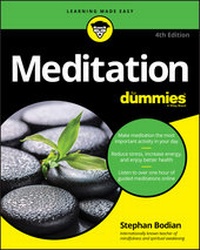
Meditation For Dummies
Description

More details
Other editions
Additional editions
Previous edition
Person
Content
Introduction
Everyone seems to want to know how to meditate these days. From anxious teens to their overwhelmed parents, harried construction workers to hurried executives, retired Baby Boomers to busy Gen Xers and curious Millennials, more and more people are seeking solutions for the stressful, time-urgent, overstimulated lives we lead. Because the Internet can't provide satisfying answers to all of life's questions, people are turning in increasing numbers to time-honored practices like meditation for proven remedies to life's inevitable ills.
Indeed, according to a recent government survey, more than 10 percent of adults in the United States meditate regularly. That's tens of millions of people! Why do they bother? Because it works. Whether you're seeking greater focus to get your job done more efficiently, less stress and more peace of mind, or a deeper appreciation of the beauty and richness of life, the simple practice of sitting down and turning your attention inward can do wonders for your body and your mind.
The truth is, you can learn the basics of meditation in five minutes. Just sit in a comfortable position, straighten your back, breathe deeply, and rest your attention on the coming and going of your breath. It's as simple as that! If you do it regularly, you'll find that it won't be long before you're feeling more relaxed and enjoying life more. I speak from personal experience: I've been practicing meditation and teaching it to others for more than 40 years.
Simple though it may be, meditation also has tremendous subtlety and depth, if you're interested in pursuing it further. It's a lot like painting: You can buy your materials, take a few lessons, and have fun applying paint to paper. Or you can attend classes at your local education center or community college, specialize in a particular medium in art school, and make painting a central part of your life. In meditation, as in art, you can keep it simple - just get up every day and sit quietly for five or ten minutes - or explore the subtleties to your heart's content. It all depends on your needs, your intentions, and your level of interest and passion.
About This Book
When I began teaching meditation, I was always hard-pressed to come up with a single book that taught the basics, provided a comprehensive overview of techniques and practices, and offered guidance in going deeper. Global surveys generally ignore the nuts and bolts - what to focus on, how to sit, what to do about your crazy mind, and so on. Books that teach you how to meditate tend to offer just a few techniques. And those that show you how to explore the rich inner world of meditation often have a sectarian spiritual perspective that limits the breadth of their presentation. (In other words, you may have to be a Buddhist or a yogi or a Sufi to know what they're talking about.)
Unlike those other books on meditation, Meditation For Dummies, 3rd Edition, covers all the bases. If you're looking for simple, easy-to-follow meditation instructions, you can find state-of-the-art guidance here that's filled with helpful tips from seasoned meditators as well as time-honored wisdom from the great teachers of old. If you want to get an overview of the meditation field before you zero in on a particular method or teaching, you can catch a glimpse of the primary approaches that are readily available these days. If you've been meditating in a particular way and want to expand your horizons to include other techniques, you'll be pleased to discover that this book features dozens of different meditations for a variety of purposes. They're drawn from a range of sources and traditions. And if you just want to understand why other people meditate - for instance, your partner, your friends, the guy in the office next to yours - and why you may want to join them, jump on board! You can read through whole chapters on how meditation makes you happier (and healthier), what science has learned about the physical and psychological benefits of meditation, and how you can get the most from meditation.
As a special bonus, this book includes instructional tracks, which are available online at www.dummies.com/go/meditation. With these tracks, I guide you step by step through a dozen of the most powerful and effective meditations described in the book. When you've had your fill of reading and want something more experiential, you can sit down in a comfortable position, pop in the disc, and let my voice lead you effortlessly through the complete meditation process, from start to finish. What could be more accessible and user-friendly than that?
This book is many things at once: an instructional manual, a survey course, and a guidebook for deeper exploration. Feel free to read it from cover to cover if you want, or just browse until you find the chapters that appeal to you. Throughout the book, you find meditations and exercises you can experiment with and enjoy. Some of them are also offered at www.dummies.com/go/meditation, so you can discover how to practice them directly without referring to the text.
The best thing about this book, in my humble estimation, is that it's fun to read. Meditation doesn't have to be a dull or somber affair. Quite the contrary: The whole point of meditating in the first place is to lighten up and experience more peace and joy in your life. So forget those stereotypes of the enigmatic Zen monk or the reclusive navel-gazer! You can find out everything you ever wanted to know about meditation and enjoy yourself in the process.
Feel free to skip the sidebars that appear throughout the book; these shaded gray boxes contain interesting info that isn't essential to your understanding of meditation.
Within this book, you may note that some web addresses break across two lines of text. If you're reading this book in print and want to visit one of these web pages, simply key in the web address exactly as it's noted in the text, pretending as though the line break doesn't exist. If you're reading this as an e-book, you've got it easy - just click the web address to be taken directly to the web page.
Foolish Assumptions
When I wrote this book, I made a few assumptions about you, dear reader, that I thought I should share with you before we begin:
- You're intrigued enough by the topic of meditation to pick up this book, but you haven't yet discovered how to meditate. Or if you have, you still feel the need for more guidance.
- You want less stress and more happiness and peace of mind, and you're willing to devote a little of your precious time to achieve it.
- Because you can't afford to spend long hours meditating in a monastery or ashram, you want instruction that you can put to use right now at home or at work.
- You don't live on a desert island or in some isolated part of the globe; instead, you inhabit the ordinary world and confront the usual stresses, pressures, and responsibilities that most people face.
If these assumptions apply to you, you're definitely in the right place!
Icons Used in This Book
Throughout this book, I use icons in the margins to draw your attention to particular kinds of information. Here's a key to what those icons mean:
For direct personal guidance in practicing the meditations marked by this icon, just put down your book, cue up the audio track, and follow my lead.
If I haven't said it before, I should have - it's important information that bears repeating.
If you want your meditations to be easier and more effective, follow these tidbits of insider advice.
Beyond the Book
In addition to the material in the print or e-book you're reading right now, this product comes with some access-anywhere goodies on the web. Check out the free Cheat Sheet for tips on how to prepare for meditation, how to get the most from your meditation, how to make sure you're meditating correctly, and more. To get this Cheat Sheet, simply go to www.dummies.com and type Meditation For Dummies Cheat Sheet in the Search box.
Where to Go from Here
After you know the lay of the land, your next step is to decide where to go. Remember that you don't have to read the book sequentially, from cover to cover - you can pick it up anywhere your interests lead you. I've written it intentionally with just such an approach in mind.
If you're drawn to a more theoretical discussion of the philosophical, historical, and scientific background of meditation, by all means start with Part 1, in which I discuss meditation's history, its health benefits, and its positive effects on the body and brain. But if you're eager to get to the nitty-gritty and can't wait to sit down and start practicing, you may want to head directly for Part 2, which provides everything you need to know to meditate effectively.
After you've been practicing for a few weeks or months, you can return for a refresher course and fine-tune your meditation by reading in Part 3 about the various difficulties and obstacles that may arise as well as about strategies for developing and expanding your practice. And if you have particular areas of interest, such as spirituality, healing, or...
