

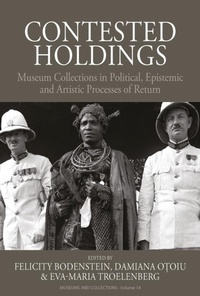
Contested Holdings
Description

Going beyond strictly legal and property-oriented aspects of the restitution debate, restitution is considered as part of a larger set of processes of return that affect museums and collections, as well as notions of heritage and object status. Covering a range of case studies and a global geography, the authors aim to historicize and bring depth to contemporary debates in relation to both the return of material culture and human remains. Defined as contested holdings, differing museum collections ranging from fine arts to physical anthropology provide connections between the treatment and conceptualization of collections that generally occupy separate realms in the museum world.
More details
Other editions
Additional editions
Persons
Felicity Bodenstein is a lecturer in the history of museums and heritage studies at Sorbonne University, Paris. She is also a principal investigator of the digital humanities project, financed by the Ernest von Siemens foundation, "Digital Benin" (https://digital-benin.org/) that will bring together data from close to 200 museums holding pieces from the 1897 British colonial expedition to Benin in their collections.
Content
List of Illustrations
Acknowledgements
Abbreviations
Introduction
Felicity Bodenstein, Damiana Otoiu, and Eva-Maria Troelenberg
Part I: From Objects Back to People: Ways of Life and Loss
Chapter 1. The Value of Art - a Human Life? Works of Art in the Crosshairs of the Persecution of Jews under National Socialism
Ulrike Saß
Chapter 2. Return as Reconstruction: The Gwozdziec Synagogue Replica in the Museum of Polish Jews
Ewa Manikowska
Chapter 3. The Other Nefertiti: Symbolic Restitutions
Ruth E. Iskin
Part II: The Subject of Return: Between Artefacts and Bodies
Chapter 4. Blurring Objects: Life-Casts, Human Remains and Art History
Noémie Etienne
Chapter 5. Of Phrenology, Reconciliation and Veneration: Exhibiting the Repatriated Life Cast of Maori Chief Takatahara at the Akaroa Museum
Christopher Sommer
Chapter 6. Ancestors or Artefacts: Contention in the Definition, Retention and Retun of Ngarrinderji Old People
Cressida Fforde, Major Sumner, Loretta Sumner, Tristram Besterman and Steve Hemming
Part III: 'The Making of Law': Politics and Museum Ethics
Chapter 7. A Long Term Perspective on the Issue of the Return of Congolese Cultural Objects : Entangled Relations between Kinshasa and Tervuren (1930-1980)
Placide Mumbembele Sanger
Chapter 8. 'How Would You Like to See Your Great-Grandfather in a Museum?': The Issue of 'Human Dignity' in Repatriation Processes (Cases Involving French Museums)
Cristina Golomoz
Chapter 9. (De)Museifying Racial Taxonomies: The Display and/ or the Restitution of Human Remains of Indigenous Peoples from Southern Africa
Damiana Otoiu
Part IV: Partial and Paused Returns
Chapter 10. Baroque Returns: The Donations and Reuses of Francesco Gualdi
Fabrizio Federici
Chapter 11. Getting the Benin Bronzes back to Nigeria: The Art Market and the Formation of National Collections and Concepts of Heritage in Benin City and Lagos
Felicity Bodenstein
Chapter 12. What Future for Looted Syrian Antiquities?: The Clash Between the Law and Practice for the Repatriation of Cultural Property to Countries in Crisis
Erin Thompson
Conclusion: Unfinished Projects of 'Decentering' Western Museum Practices
Felicity Bodenstein, Damiana Otoiu and Eva-Maria Troelenberg
Index
