

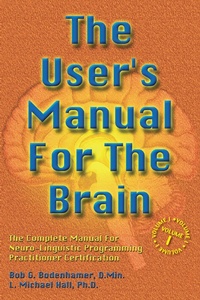
The User's Manual For The Brain Volume I
The Complete Manual For Neuro-Linguistic Programming Practitioner Certification
Published on 8. September 1998
424 pages
978-1-84590-382-4 (ISBN)
Description

The most comprehensive NLP Practitioner course manual ever written. A fully revised and updated edition, it contains the very latest in Neuro-Linguistic Programming, particularly with regard to the Meta-states model and the Meta-model of language. For all those embarking on Practitioner training or wishing to study at home, this book is your essential companion. Written and designed by two of the most important theorists in NLP today.
More details
Language
English
Place of publication
Carmarthen
United Kingdom
Target group
College/higher education
Professional and scholarly
File size
2,70 MB
ISBN-13
978-1-84590-382-4 (9781845903824)
Copyright in bibliographic data and cover images is held by Nielsen Book Services Limited or by the publishers or by their respective licensors: all rights reserved.
Schweitzer Classification
Other editions
Additional editions
Bob G. Bodenhamer | L. Michael Hall
The User's Manual For The Brain Volume I
The Complete Manual For Neuro-Linguistic Programming Practitioner Certification
Book
09/1998
Crown House Publishing
€48.00
Shipment within 3-4 weeks
Persons
Dr. Bodenhamer's under-graduate degree (BA) is from Appalachian State University in Boone, NC (1972). His major at Appalachian State University was Philosophy and Religion with a minor in Psychology. He received the Master of Divinity (1976) and the Doctor of Ministry Degree (1978) from Southeastern Baptist Theological Seminary in Wake Forest, NC. The Master of Divinity Degree included training in Pastoral Care with both classroom and clinical work. Dr. Bodenhamer received one unit of Clinical Pastoral Education from Wake Medical Center in Raleigh, N. C. while working on his doctorate. His marriage to Linda now spans 43 years.His NLP Practitioner's Certification comes from L.E.A.D.'s Consultants in Reynoldsburg, OH, Dr. Gene Rooney, Trainer. Dr. Bodenhamer's NLP Master Certification and Master Time Line TherapyTMPractitioner Certification came from Tad James, Ph.D. of Advanced Neuro-Dynamics of Honolulu, HI. Additional training has been received from NLP conferences. Dr. Bodenhamer has approximately 1500 hours of formal NLP training. He taught NLP for 10 years in the Corporate/Community Education program at Gaston College. Dr. Bodenhamer received his certification as a Trainer of NLP from Tad James, Ph.D., Advance Neuro Dynamics, Honolulu, Hawaii and Wyatt Woodsmall, Ph.D. of Advanced Behavioral Modeling, Inc., Arlington, VA.As an International Master NLP Trainer, he offers both certified training for Practitioners and Master Practitioners of NLP. He has a private NLP Therapy practice. Dr. Bodenhamer has served four Southern Baptist churches as pastor. He is presently serving as pastor of a mission church called Christ Fellowship Community Church. His time in the pastorate spans 44 years. All of his pastorates have been in North Carolina. Bob has had the privilege of being married to Linda for the past 45 years (10/17/1965).He has co-authored 10 NLP books and is the sole author of I Have a Voice: How to Stop Stuttering.The NLP in Healthcare Award was presented to Bob G Bodenhamer at the NLP award ceremony 2017. L. Michael Hall is a Cognitive Psychologist who through research into NLP and Self-Actualization Psychology is now a modeler of human excellence; he has completed 15 modeling projects from Resilience, Women in Leadership, Self-Actualization, Coaching, Self-Actualizing Leaders, Managers, and Companies, Selling, Defusing, Wealth Creation, etc. He has authored 50 NLP books and a series on Meta-Coaching. Michael co-founded the ISNS (International Society of Neuro-Semantics) and the MCF (Meta-Coaching Foundation) and is an internationally renowned trainer.
Content
- Intro
- Title Page
- Table of Contents
- Table Of Figures
- How To Use This Manual
- Introduction
- 1 : The NLP Model And Techniques
- 2 : The Content Of The Model: The Representational System
- 3 : The Basics
- 4 : Perceptual Positions
- 5 : NLP Presuppositions For Building Resourcefulness
- 6 : NLP As As Communication Model: Excellence In Communicating
- 7 : Framing For Resourcefulness
- 8 : The Art Of State Management
- 2 : The NLP Language Model
- 9 : The Meta-model of Language: Structure and Meaning
- 10 : Hypnosis Part I
- 11 : Hypnosis Part II
- 12 : Hypnosis Part III
- 13 : Satir Categories
- 3 : The NLP Neurology Model
- 14 : Anchoring: Managing Neurology
- 15 : Focusing On Submodalities
- 4 : Advanced Neuro-Linguistic Programming Modeling
- 16 : Strategies
- 17 : An Introduction To Time-Lining
- Endnotes
- Bibliography
- Glossary Of Terms
- Acknowledgments
- Copyright
- Advertisement
