

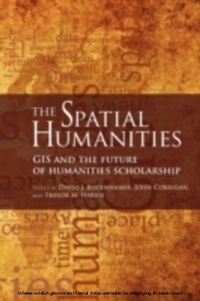
The Spatial Humanities
GIS and the Future of Humanities Scholarship
1st Edition
Published on 28. June 2010
222 pages
978-0-253-01363-7 (ISBN)
Description

Geographic information systems (GIS) have spurred a renewed interest in the influence of geographical space on human behavior and cultural development. Ideally GIS enables humanities scholars to discover relationships of memory, artifact, and experience that exist in a particular place and across time. Although successfully used by other disciplines, efforts by humanists to apply GIS and the spatial analytic method in their studies have been limited and halting. The Spatial Humanities aims to re-orient-and perhaps revolutionize-humanities scholarship by critically engaging the technology and specifically directing it to the subject matter of the humanities. To this end, the contributors explore the potential of spatial methods such as text-based geographical analysis, multimedia GIS, animated maps, deep contingency, deep mapping, and the geo-spatial semantic web.
Reviews / Votes
The first attempt to tackle the issue of the humanities as an epistemic unit head-on, and to consider what the use of GIS . . . can bring to them. . . . The technical quality of the chapters is uniformly high: side-by-side they form a wide-ranging account, admirable in its ambition and scope, and authored by contributors who are recognized experts in their fields. The documentation and footnoting are exemplary, and the reader new to the field will find the further reading sections at the end extremely valuable.(Literary and Linguistic Computing)
All prices
More details
Language
English
Place of publication
Bloomington, IN
United States
Target group
Professional and scholarly
Product notice
Reflowable
Illustrations
25 b&w illus.
File size
1,98 MB
ISBN-13
978-0-253-01363-7 (9780253013637)
Copyright in bibliographic data and cover images is held by Nielsen Book Services Limited or by the publishers or by their respective licensors: all rights reserved.
Schweitzer Classification
Other editions
Additional editions
David J. Bodenhamer | John Corrigan | Trevor M. Harris
The Spatial Humanities
GIS and the Future of Humanities Scholarship
Book
06/2010
Indiana University Press
€19.50
Shipment within 10-20 days
David J. Bodenhamer | John Corrigan | Trevor Harris
The Spatial Humanities
GIS and the Future of Humanities Scholarship
Book
06/2010
Indiana University Press
€66.85
Article exhausted; check for reprint
Persons
David J. Bodenhamer is Executive Director of the Polis Center and Professor of History at Indiana University Purdue University Indianapolis.
John Corrigan is Lucius Moody Bristol Distinguished Professor of Religion and Professor of History at Florida State University.
Trevor M. Harris is Eberly Professor of Geography and Chair of the Department of Geology and Geography at West Virginia University.
John Corrigan is Lucius Moody Bristol Distinguished Professor of Religion and Professor of History at Florida State University.
Trevor M. Harris is Eberly Professor of Geography and Chair of the Department of Geology and Geography at West Virginia University.
Content
Introduction
1. Turning toward Place, Space, and Time / Edward L. Ayers
2. The Potential of Spatial Humanities / David J. Bodenhamer
3. Geographic Information Science and Spatial Analysis for the Humanities / Karen K. Kemp
4. Exploiting Time and Space: A Challenge for GIS in the Digital Humanities / Ian Gregory
5. Qualitative GIS and Emergent Semantics / John Corrigan
6. Representations of Space and Place in the Humanities / Gary Lock
7. Mapping Text / May Yuan
8. The Geospatial Semantic Web, Pareto GIS, and the Humanities / Trevor M. Harris, L. Jesse Rouse, and Susan Bergeron
9. GIS, e-Science, and the Humanities Grid / Paul S. Ell
10. Challenges for the Spatial Humanities: Toward a Research Agenda / Trevor M. Harris, John Corrigan, and David J. Bodenhamer
Suggestions for Further Reading
List of Contributors
Index
1. Turning toward Place, Space, and Time / Edward L. Ayers
2. The Potential of Spatial Humanities / David J. Bodenhamer
3. Geographic Information Science and Spatial Analysis for the Humanities / Karen K. Kemp
4. Exploiting Time and Space: A Challenge for GIS in the Digital Humanities / Ian Gregory
5. Qualitative GIS and Emergent Semantics / John Corrigan
6. Representations of Space and Place in the Humanities / Gary Lock
7. Mapping Text / May Yuan
8. The Geospatial Semantic Web, Pareto GIS, and the Humanities / Trevor M. Harris, L. Jesse Rouse, and Susan Bergeron
9. GIS, e-Science, and the Humanities Grid / Paul S. Ell
10. Challenges for the Spatial Humanities: Toward a Research Agenda / Trevor M. Harris, John Corrigan, and David J. Bodenhamer
Suggestions for Further Reading
List of Contributors
Index
