

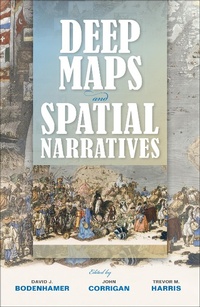
Deep Maps and Spatial Narratives
1st Edition
Published on 4. February 2015
277 pages
978-0-253-01567-9 (ISBN)
Description

Deep maps are finely detailed, multimedia depictions of a place and the people, buildings, objects, flora, and fauna that exist within it and which are inseparable from the activities of everyday life. These depictions may encompass the beliefs, desires, hopes, and fears of residents and help show what ties one place to another. A deep map is a way to engage evidence within its spatio-temporal context and to provide a platform for a spatially-embedded argument. The essays in this book investigate deep mapping and the spatial narratives that stem from it. The authors come from a variety of disciplines: history, religious studies, geography and geographic information science, and computer science. Each applies the concepts of space, time, and place to problems central to an understanding of society and culture, employing deep maps to reveal the confluence of actions and evidence and to trace paths of intellectual exploration by making use of a new creative space that is visual, structurally open, multi-media, and multi-layered.
All prices
More details
Language
English
Place of publication
Bloomington, IN
United States
Target group
Professional and scholarly
Illustrations
36 b&w illus., 5 maps, 2 tables
ISBN-13
978-0-253-01567-9 (9780253015679)
Copyright in bibliographic data and cover images is held by Nielsen Book Services Limited or by the publishers or by their respective licensors: all rights reserved.
Schweitzer Classification
Other editions
Additional editions
David J. Bodenhamer | John Corrigan | Trevor M. Harris
Deep Maps and Spatial Narratives
Book
02/2015
Indiana University Press
€65.50
Shipment within 10-20 days
David J. Bodenhamer | John Corrigan | Trevor M. Harris
Deep Maps and Spatial Narratives
Book
02/2015
Indiana University Press
€24.50
Shipment within 10-20 days
Persons
David Bodenhamer is Executive Director of The Polis Center at IUPUI and Professor of History. He is co-editor (with John Corrigan and Trevor M. Harris) of The Spatial Humanities: GIS and the Future of Humanities Scholarship (IUP, 2010).
John Corrigan is the Lucius Moody Bristol Distinguished Professor of Religion and Professor of History at Florida State University. He has authored or edited numerous books on the history of religion, including Religion and Space in the Atlantic World (forthcoming).
Trevor M. Harris is Eberly Professor of Geography at West Virginia University. He is one of the early contributors to the GIS and Society critique of spatial technologies.
John Corrigan is the Lucius Moody Bristol Distinguished Professor of Religion and Professor of History at Florida State University. He has authored or edited numerous books on the history of religion, including Religion and Space in the Atlantic World (forthcoming).
Trevor M. Harris is Eberly Professor of Geography at West Virginia University. He is one of the early contributors to the GIS and Society critique of spatial technologies.
Content
Introduction. Between Matter and Meaning: Deep Maps and the Spatial Humanities
1. Narrating Space and Place / David J. Bodenhamer
2. Deep Geography-Deep Mapping: Spatial Storytelling and a Sense of Place / Trevor M. Harris
3. Genealogies of Emplacement / John Corrigan
4. Inscribing the Past: Depth as Narrative in Historical Spacetime / Philip Ethington and Nobuko Toyosawa
5. Quelling Imperious Urges: Deep Emotional Mappings and the Ethnopoetics of Space / Stuart C. Aitken
6. Deep Mapping and Neogeography / Barney Warf
7. Spatializing and Analysing Digital Texts: Corpora, GIS and Places / Ian Gregory, David Cooper, Andrew Hardie, and Paul Rayson
8. GIS as a Narrative Generation Platform / May Yuan, Grant DeLozier, and John McIntosh
9. Warp and Weft on the Loom of Lat/Long / Worthy Martin
Conclusion: Engaging Deep Maps
Notes
Contributors
Index
1. Narrating Space and Place / David J. Bodenhamer
2. Deep Geography-Deep Mapping: Spatial Storytelling and a Sense of Place / Trevor M. Harris
3. Genealogies of Emplacement / John Corrigan
4. Inscribing the Past: Depth as Narrative in Historical Spacetime / Philip Ethington and Nobuko Toyosawa
5. Quelling Imperious Urges: Deep Emotional Mappings and the Ethnopoetics of Space / Stuart C. Aitken
6. Deep Mapping and Neogeography / Barney Warf
7. Spatializing and Analysing Digital Texts: Corpora, GIS and Places / Ian Gregory, David Cooper, Andrew Hardie, and Paul Rayson
8. GIS as a Narrative Generation Platform / May Yuan, Grant DeLozier, and John McIntosh
9. Warp and Weft on the Loom of Lat/Long / Worthy Martin
Conclusion: Engaging Deep Maps
Notes
Contributors
Index

