


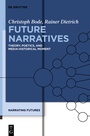
Future Narratives
Theory, Poetics, and Media-Historical Moment
1st Edition
Published on 29. October 2013
XI, 226 pages
978-3-11-027237-6 (ISBN)
Description

This head volume of the 'Narrating Futures' series defines and identifies Future Narratives. It parses their characteristic features and aims at an abstract classification of the whole corpus, irrespective of its concrete manifestations across the media. Drawing on different theorems and approaches, it offers a unified theory and a poetics of Future Narratives. Locating the media-historical moment of their emergence, this volume paves the way for the following volumes, which deal with how Future Narratives are refracted through different media.
More details
Other editions
Additional editions
Book
10/2013
1st Edition
De Gruyter
€124.95
Shipment within 7-9 days
Persons
Christoph Bode, Ludwig-Maximilians-Universität München, Germany.
Content
1 - Preface and Acknowledgements [Seite 7]
2 - 1 The Theory and Poetics of Future Narratives: A Narrative [Seite 13]
2.1 - 1.1 Future Narratives: A New Kind of Narrative [Seite 13]
2.2 - 1.2 What Narratives Do for You [Seite 16]
2.3 - 1.3 Approaching the Future I: Great Shock - Utopian Tales No Future Narratives! [Seite 21]
2.4 - 1.4 Approaching the Future II: The Unbearable Gravity of the Present [Seite 24]
2.5 - 1.5 Capturing the Openness of the Moment: Some Basics About Nodes as Building Blocks of Future Narratives [Seite 28]
2.6 - 1.6 Run Lola Run - Only a Pre-Cursor? [Seite 33]
2.7 - 1.7 The Road Not Taken [Seite 36]
2.8 - 1.8 Doing the Shuffle: Lola Runs Again, Books in Boxes, and Slatted Pages [Seite 37]
2.9 - 1.9 Decision (Choice) Theory and Game Theory, in Relation to FNs [Seite 43]
2.10 - 1.10 Into the Heart of the Matter: A Node's Interior Life - Character, Space, Time [Seite 54]
2.11 - 1.11 Nodal Power [Seite 59]
2.12 - 1.12 Varieties of Nodes [Seite 61]
2.13 - 1.13 Interactivity [Seite 63]
2.14 - 1.14 Simulation [Seite 66]
2.15 - 1.15 As Node Leads on to Node: Nodal Structures and Their Representations [Seite 68]
2.16 - 1.16 Why 'Narrative' Anyway? [Seite 79]
2.17 - 1.17 Stranger than Fiction: The Failure of Prediction, the Virtue of Scenarios, and Why FNs Are the Key to Our Future [Seite 87]
2.18 - 1.18 The Human Brain as an 'Anticipation Machine' [Seite 109]
2.19 - 1.19 The Way Ahead [Seite 117]
3 - 2 Formal Models for Future Narratives [Seite 121]
3.1 - 2.1 Introduction [Seite 121]
3.2 - 2.2 Representations of FNs [Seite 121]
3.2.1 - 2.2.1 Nodal Graphs [Seite 121]
3.2.2 - 2.2.2 Aspects [Seite 124]
3.2.3 - 2.2.3 Consequences [Seite 127]
3.2.4 - 2.2.4 Reaching the same Situation in two different Ways [Seite 129]
3.3 - 2.3 Quantification of Openness [Seite 130]
3.3.1 - 2.3.1 The Spectrum of Consequences [Seite 130]
3.3.2 - 2.3.2 The Spectrum of the Agent [Seite 139]
3.3.3 - 2.3.3 The Degree of Openness of a Situation: Nodal Power [Seite 139]
3.4 - 2.4 Advanced Models for Similarities [Seite 142]
3.4.1 - 2.4.1 Similarity [Seite 143]
3.4.2 - 2.4.2 Formal Definition for Models of Type II [Seite 145]
3.4.3 - 2.4.3 Models of Type II without underlying Subtractive Aspects [Seite 147]
3.4.4 - 2.4.4 Path Dependency of External Aspects [Seite 147]
3.4.5 - 2.4.5 Computing Nodal Power in the Presence of External Aspects [Seite 149]
3.5 - 2.5 Reversibility [Seite 151]
3.5.1 - 2.5.1 Undoing Choices [Seite 151]
3.5.2 - 2.5.2 Degree of Reversibility [Seite 151]
3.6 - 2.6 Topological Classification of Future Narratives [Seite 153]
3.6.1 - 2.6.1 The Topology of the Nodal Graph [Seite 153]
3.6.2 - 2.6.2 Geometrical Classification: Homology Groups [Seite 157]
3.6.3 - 2.6.3 Classification including Aspects: Cohomology Groups [Seite 160]
3.6.4 - 2.6.4 Conclusion [Seite 165]
3.7 - 2.7 Appendix: Basic Mathematical Concepts [Seite 166]
3.7.1 - 2.7.1 Sets and Functions [Seite 166]
3.7.2 - 2.7.2 Basic Graph Theory [Seite 167]
3.7.3 - 2.7.3 Integration [Seite 168]
4 - 3 Future Narratives: The Media-Historical Moment [Seite 174]
4.1 - 3.1 The Historicity of 'Future' [Seite 174]
4.2 - 3.2 The Probability Calculus [Seite 180]
4.3 - 3.3 Insurances [Seite 189]
4.4 - 3.4 Projects and the Stock Market: Great Expectations [Seite 197]
4.5 - 3.5 The Coffeehouse and the Idea of Truth-as-Process [Seite 202]
4.6 - 3.6 The Plot Thickens: The Modern Realist Novel [Seite 212]
4.7 - 3.7 Future Narratives and Historical Mediality [Seite 219]
5 - Works Cited [Seite 229]
2 - 1 The Theory and Poetics of Future Narratives: A Narrative [Seite 13]
2.1 - 1.1 Future Narratives: A New Kind of Narrative [Seite 13]
2.2 - 1.2 What Narratives Do for You [Seite 16]
2.3 - 1.3 Approaching the Future I: Great Shock - Utopian Tales No Future Narratives! [Seite 21]
2.4 - 1.4 Approaching the Future II: The Unbearable Gravity of the Present [Seite 24]
2.5 - 1.5 Capturing the Openness of the Moment: Some Basics About Nodes as Building Blocks of Future Narratives [Seite 28]
2.6 - 1.6 Run Lola Run - Only a Pre-Cursor? [Seite 33]
2.7 - 1.7 The Road Not Taken [Seite 36]
2.8 - 1.8 Doing the Shuffle: Lola Runs Again, Books in Boxes, and Slatted Pages [Seite 37]
2.9 - 1.9 Decision (Choice) Theory and Game Theory, in Relation to FNs [Seite 43]
2.10 - 1.10 Into the Heart of the Matter: A Node's Interior Life - Character, Space, Time [Seite 54]
2.11 - 1.11 Nodal Power [Seite 59]
2.12 - 1.12 Varieties of Nodes [Seite 61]
2.13 - 1.13 Interactivity [Seite 63]
2.14 - 1.14 Simulation [Seite 66]
2.15 - 1.15 As Node Leads on to Node: Nodal Structures and Their Representations [Seite 68]
2.16 - 1.16 Why 'Narrative' Anyway? [Seite 79]
2.17 - 1.17 Stranger than Fiction: The Failure of Prediction, the Virtue of Scenarios, and Why FNs Are the Key to Our Future [Seite 87]
2.18 - 1.18 The Human Brain as an 'Anticipation Machine' [Seite 109]
2.19 - 1.19 The Way Ahead [Seite 117]
3 - 2 Formal Models for Future Narratives [Seite 121]
3.1 - 2.1 Introduction [Seite 121]
3.2 - 2.2 Representations of FNs [Seite 121]
3.2.1 - 2.2.1 Nodal Graphs [Seite 121]
3.2.2 - 2.2.2 Aspects [Seite 124]
3.2.3 - 2.2.3 Consequences [Seite 127]
3.2.4 - 2.2.4 Reaching the same Situation in two different Ways [Seite 129]
3.3 - 2.3 Quantification of Openness [Seite 130]
3.3.1 - 2.3.1 The Spectrum of Consequences [Seite 130]
3.3.2 - 2.3.2 The Spectrum of the Agent [Seite 139]
3.3.3 - 2.3.3 The Degree of Openness of a Situation: Nodal Power [Seite 139]
3.4 - 2.4 Advanced Models for Similarities [Seite 142]
3.4.1 - 2.4.1 Similarity [Seite 143]
3.4.2 - 2.4.2 Formal Definition for Models of Type II [Seite 145]
3.4.3 - 2.4.3 Models of Type II without underlying Subtractive Aspects [Seite 147]
3.4.4 - 2.4.4 Path Dependency of External Aspects [Seite 147]
3.4.5 - 2.4.5 Computing Nodal Power in the Presence of External Aspects [Seite 149]
3.5 - 2.5 Reversibility [Seite 151]
3.5.1 - 2.5.1 Undoing Choices [Seite 151]
3.5.2 - 2.5.2 Degree of Reversibility [Seite 151]
3.6 - 2.6 Topological Classification of Future Narratives [Seite 153]
3.6.1 - 2.6.1 The Topology of the Nodal Graph [Seite 153]
3.6.2 - 2.6.2 Geometrical Classification: Homology Groups [Seite 157]
3.6.3 - 2.6.3 Classification including Aspects: Cohomology Groups [Seite 160]
3.6.4 - 2.6.4 Conclusion [Seite 165]
3.7 - 2.7 Appendix: Basic Mathematical Concepts [Seite 166]
3.7.1 - 2.7.1 Sets and Functions [Seite 166]
3.7.2 - 2.7.2 Basic Graph Theory [Seite 167]
3.7.3 - 2.7.3 Integration [Seite 168]
4 - 3 Future Narratives: The Media-Historical Moment [Seite 174]
4.1 - 3.1 The Historicity of 'Future' [Seite 174]
4.2 - 3.2 The Probability Calculus [Seite 180]
4.3 - 3.3 Insurances [Seite 189]
4.4 - 3.4 Projects and the Stock Market: Great Expectations [Seite 197]
4.5 - 3.5 The Coffeehouse and the Idea of Truth-as-Process [Seite 202]
4.6 - 3.6 The Plot Thickens: The Modern Realist Novel [Seite 212]
4.7 - 3.7 Future Narratives and Historical Mediality [Seite 219]
5 - Works Cited [Seite 229]
