

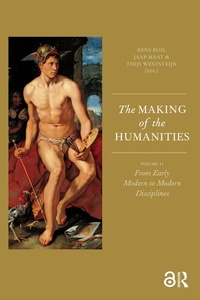
The Making of the Humanities
Volume II - From Early Modern to Modern Disciplines
Published on 1. October 2025
428 pages
978-1-040-79712-9 (ISBN)
Description

This much-awaited second volume investigates the changes in subject, method and institutional context of the humanistic disciplines around 1800, offering a wealth of insights for specialists and students alike. Point of departure is the pivotal question whether there was a paradigm shift in the humanities around 1800 or whether these changes were part of a much longer process. The authors provide an overarching perspective including philology, musicology, art history, linguistics, historiography, philosophy and literary theory. They also make clear that the influence from the East, from the Ottoman Empire to China, was crucial for the development of the European humanistic disciplines.
Reviews / Votes
The book brings to light a very important moment in the development of Western civilization and perhaps one of its last significant contributions to world culture. The material is fascinating, with numerous implications for the broader fields not only of history and sociology of science and universities, but of nationalism and civilization studies as well. The volume is a real contribution to knowledge, extending far beyond the field to which it ostensibly belongs of the history of the humanities. - Liah Greenfeld, Boston UniversityThe scholarly editors of this volume have wished to open up the route towards a comparative and interdisciplinary history of the humanities ... bringing to the fore the unity of the field of the humanistic sciences at the onset of the modern era, the interconnections between domains of knowledge that are now separated, and the necessity of approaching the history of the humanities over a longer period. - Sandrine Maufroy on The Making of the Humanities Volume 1 in H-Soz-u-Kult (les editeurs scientifiques de ce volume ont souhaite ouvrir la voie a une approche comparative et interdisciplinaire de l'histoire des humanites ...on peut leur reconnaitre le merite de mettre en evidence l'unite du champ des sciences humaines au debut de l'epoque moderne, les liens entre des domaines du savoir aujourd'hui separes et la necessite d'envisager l'histoire des sciences humaines dans la longue duree.)
'Few collections of conference proceedings rival the erudite scope of this second installment of a three-part project; the first volume, subtitled Early Modern Europe (CH, Oct'11, 49-0643) appeared in 2011. Originating from a gathering of predominantly European specialists in linguistics, history, mathematics, science, musicology, literature, and other disciplines, the essayists embrace broad topics and those more narrowly defined. Tracing the development of theories, some to their origins in the 17th century, each selection offers innovative perspectives about the precursors of prevailing intellectual movements in the 19th century, with which the volume is primarily concerned. Each of the 19 essays assembled by Bod, Maat, and Weststeijn (all, Univ. of Amsterdam) deserves mention. Hybridization, a recurrent idea in this compendium, is developed in a compelling essay by Bart Karstens, who challenges specialization as the driving force in the creation of modern disciplines. Michiel Leezenberg, in delineating the career of 18th-century, Ottoman-born Dimitrie Cantemir, shows convincingly the invalidity of the assumption that Western knowledge traditions have displaced local agency in the treatment of subjects such as Orientalism (Edward Said notwithstanding). This volume and its companions will prove indispensable to understanding the intricate processes that resulted in forming the modern study of the humanities. Summing Up: Highly recommended. Graduate students, researchers, and faculty.' -- L.A. Brewer, Georgia Northwestern Technical College. Copyright 2013 American Library Association. [In: Choice. Reviews Online. September 2013]
More details
Language
English
Place of publication
London
United Kingdom
Publishing group
Taylor & Francis Ltd
Target group
Professional and scholarly
File size
14,06 MB
ISBN-13
978-1-040-79712-9 (9781040797129)
Copyright in bibliographic data and cover images is held by Nielsen Book Services Limited or by the publishers or by their respective licensors: all rights reserved.
Schweitzer Classification
Other editions
Additional editions
Rens Bod | Jaap Maat | Thijs Weststeijn
The Making of the Humanities
Volume II - From Early Modern to Modern Disciplines
Book
10/2012
Amsterdam University Press
€88.00
Article not available at the moment
Persons
Rens Bod is Vici-Laureate and Full Professor in Computational Humanities at the University of Amsterdam. Books: Beyond Grammar (CSLI/Cambridge University Press), Probabilistic Linguistics (MIT Press), Data-Oriented Parsing (University of Chicago Press), A New History of the Humanities (Oxford University Press).
Jaap Maat is Professor in Philosophy at the University of Amsterdam. Books: Philosophical Languages in the Seventeenth Century: Dalgarno, Wilkins, Leibniz (Synthese Historical Library, Kluwer, 2004), George Dalgarno on Universal Language (Oxford University Press, 2001).|Thijs Weststeijn is a researcher and lecturer at the department of Art History of the University of Amsterdam.
Jaap Maat is Professor in Philosophy at the University of Amsterdam. Books: Philosophical Languages in the Seventeenth Century: Dalgarno, Wilkins, Leibniz (Synthese Historical Library, Kluwer, 2004), George Dalgarno on Universal Language (Oxford University Press, 2001).|Thijs Weststeijn is a researcher and lecturer at the department of Art History of the University of Amsterdam.
Content
Introduction: The Dawn of the Modern Humanities Rens Bod Part I. Linguistics and Philology 1. The Rise of Philology: The Comparative Method, the Historicist Turn and the Surreptitious Influence of Giambattista Vico Joep Leerssen 2. Linguistics ante litteram: Compiling and Transmitting Views on Language Diversity and Relatedness before the Nineteenth Century Toon van Hal 3. The Rise of General Linguistics as an Academic Discipline: Georg von der Gabelentz as a Co-Founder Els Elffers Part II. The Humanities and the Sciences 4. The Mutual Making of Sciences and Humanities: Willebrord Snellius, Jacob Golius, and the Early Modern Entanglement of Mathematics and Philology Fokko Jan Dijksterhuis 5. A 'Human' Science: Hawkins's Science of Music Maria Semi 6. Bopp the Builder. Discipline Formation as Hybridization: The Case of Comparative Linguistics Bart Karstens Part III. Writing History and Intellectual History 7. Nineteenth-Century Historicism and its Predecessors: Historical Experience, Historical Ontology and Historical Method Jacques Bos 9. Fact and Fancy in Nineteenth-Century Historiography and Fiction: The Case of Macaulay and Roidis Foteini Lika 8. The Humanities as the Stronghold of Freedom: John Milton's Areopagitica and John Stuart Mill's On Liberty Hilary Gatti Part IV. The Impact of the East 10. The Impact on the European Humanities of Early Reports from Catholic Missionaries from China, Tibet and Japan between 1600 and 1700 Gerhard F. Strasser 11. The Middle Kingdom in the Low Countries: Sinology in the Early Modern Netherlands Thijs Weststeijn 12. The Oriental Origins of Orientalism: The Case of Dimitrie Cantemir Michiel Leezenberg Part V. Artworks and Texts 13. The Role of Emotions in the Development of Artistic Theory and the System of Literary Genres Mats Malm 14. Philology and the History of Art Adi Efal Part VI. Literature and Rhetoric 15. Bourgeois versus Aristocratic Models of Scholarship: Medieval Studies at the Academie des Inscriptions, 1701-1751 Alicia C. Montoya 16. Ancients, Moderns and the Gothic in Eighteenth-Century Historiography Neus Rotger 17. The Afterlife of Rhetoric in Hobbes, Vico and Nietzsche David L. Marshall Part VII. Academic Communities 18. The Documents of Feith: The Centralization of the Archive in Nineteenth-Century Historiography Pieter Huistra 19. Humboldt in Copenhagen: Discipline Formation in the Humanities at the University of Copenhagen in the Nineteenth Century Claus Moller Jorgensen 20. The Scholarly Self: Ideals of Intellectual Virtue in Nineteenth-Century Leiden Herman Paul, List of Contributors, List of Illustrations, Index.
