

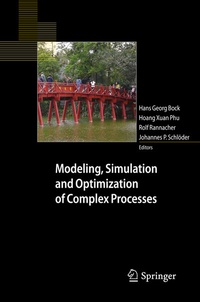
Modeling, Simulation and Optimization of Complex Processes
Proceedings of the Fourth International Conference on High Performance Scientific Computing, March 2-6, 2009, Hanoi, Vietnam
1st Edition
Published on 3. February 2012
X, 338 pages
978-3-642-25707-0 (ISBN)
Description

This proceedings volume contains a selection of papers presented at the Fourth International Conference on High Performance Scientific Computing held at the Hanoi Institute of Mathematics, Vietnamese Academy of Science and Technology (VAST), March 2-6, 2009. The conference was organized by the Hanoi Institute of Mathematics, the Interdisciplinary Center for Scientific Computing (IWR), Heidelberg, and its Heidelberg Graduate School of Mathematical and Computational Methods for the Sciences, and Ho Chi Minh City University of Technology. The contributions cover the broad interdisciplinary spectrum of scientific computing and present recent advances in theory, development of methods, and applications in practice. Subjects covered are mathematical modelling, numerical simulation, methods for optimization and control, parallel computing, software development, applications of scientific computing in physics, mechanics, biology and medicine, engineering, hydrology problems, transport, communication networks, production scheduling, industrial and commercial problems.
More details
Other editions
Additional editions
Hans Georg Bock | Xuan Phu Hoang | Rolf Rannacher
Modeling, Simulation and Optimization of Complex Processes
Proceedings of the Fourth International Conference on High Performance Scientific Computing, March 2-6, 2009, Hanoi, Vietnam
Book
02/2012
Springer
€160.49
Shipment within 7-9 days
Persons
Content
- Intro
- Modeling, Simulation and Optimization of Complex Processes
- Proceedings of the Fourth International Conference on High Performance Scientific Computing, March 2-6, 2009, Hanoi, Vietnam
- Preface
- Contents
- A Cutting Hyperplane Method for Generalized Monotone Nonlipschitzian Multivalued Variational Inequalities
- 1 Introduction
- 2 Generalized Monotonicity and Algorithm
- 3 Convergence of the Algorithm
- 4 An Application to Nonlinear Complementarity Problems
- References
- Robust Parameter Estimation Based on Huber Estimator in Systems of Differential Equations
- 1 Motivation
- 2 Parameter Estimation in Systems of Differential Equations
- 2.1 Discretization of the Dynamics
- 2.2 Parameter Estimation Problem with Huber Estimator
- 2.3 Constrained Gauss-Newton Method
- 2.4 Local Convergence
- 2.5 Global Convergence
- 2.6 Numerical Solution of the Linearized Problem
- 3 Numerical Results
- 4 Conclusions
- References
- Comparing MIQCP Solvers to a Specialised Algorithm for Mine Production Scheduling
- 1 Introduction
- 2 Open Pit Mine Production Scheduling with Stockpiles
- 3 MIQCP Formulations
- 3.1 Basic Formulation
- 3.1.1 Assumption S
- 3.2 Warehouse Formulation
- 4 Computational Study
- 4.1 Application-Specific Benchmark Algorithm
- 4.2 General-Purpose MIQCP Solvers
- 4.3 Test Instances
- 4.4 Computational Results
- 4.4.1 Solver Settings
- 4.4.2 Results for the Basic Formulation
- 4.4.3 Results for the Warehouse Formulation
- 4.4.4 Comparison of LP Based Solvers BARON, Couenne, and SCIP
- 5 Conclusion
- References
- A Binary Quadratic Programming Approach to the Vehicle Positioning Problem
- 1 Introduction
- 2 The Vehicle Positioning Problem
- 3 Two-Index Models
- 4 Three-Index Models
- References
- Determining Fair Ticket Prices in Public Transport by Solving a Cost Allocation Problem
- 1 Introduction
- 2 Game Theoretical Setting
- 3 Cost Allocation Methods
- 4 Ticket Pricing as a Cooperative Game
- 5 Fair IC Ticket Prices
- References
- A Domain Decomposition Method for Strongly Mixed Boundary Value Problems for the Poisson Equation
- 1 Introduction
- 2 A Domain Decomposition Method for a Strongly Mixed BVP
- 2.1 Description of the Method
- 2.2 Convergence of the Method
- 3 A Parallel Algorithm for Solving a Problem of Semiconductors
- 3.1 Description of the Algorithm
- 3.2 Convergence of the Iterative Process
- 3.3 Numerical Experiments
- 4 Conclusion
- References
- Detecting, Monitoring and Preventing Database Security Breaches in a Housing-Based Outsourcing Model
- 1 Introduction
- 2 Related Work
- 2.1 Detecting Techniques
- 2.2 Monitoring Techniques
- 2.3 Preventing Techniques
- 3 Problem Analysis
- 3.1 Database Security Flaw Classification
- 3.2 Monitoring Activity Classification
- 4 The Proposed Architecture
- 4.1 Client Side
- 4.2 Service Server Side
- 4.3 Client Server Side (Housing Provider Side)
- 4.4 Detecting Engine
- 4.5 Monitoring Engine
- 5 Prototype and Evaluation
- 5.1 Prototype
- 5.2 Evaluation
- 6 Open Research Issues
- 7 Conclusion and Future Work
- References
- Real-Time Sequential Convex Programming for Optimal Control Applications
- 1 Introduction and Motivation
- 1.1 Contribution
- 2 The RTSCP Method
- 3 RTSCP Contraction Estimate
- 4 Numerical Example: Control of an Underactuated Hovercraft
- References
- SuperQuant Financial Benchmark Suite for Performance Analysis of Grid Middlewares
- 1 Introduction
- 2 SuperQuant Financial Benchmark Suite
- 3 Components of SuperQuant Financial Benchmark Suite
- 3.1 Embarrassingly Parallel Kernel
- 3.1.1 European Option Pricing
- 3.1.2 European Greeks Hedging
- 3.2 Input/Output Data and Grid Metrics Format
- 3.3 Output Evaluator
- 3.3.1 Evaluation Criteria
- 3.3.2 ``Reference'' Results Validation
- 4 Proof of Concept: The V Grid Plugtest and Contest
- 4.1 Challenge Results
- 5 Conclusion and Perspectives
- References
- A Dimension Adaptive Combination Technique Using Localised Adaptation Criteria
- 1 Introduction
- 2 Dimension Adaptive Combination Technique for Regression
- 2.1 Adaptive Grid Choice
- 2.2 Localized Adaptation Criteria
- 3 Numerical Experiments
- 4 Conclusions and Outlook
- References
- Haralick's Texture Features Computation Accelerated by GPUs for Biological Applications
- 1 Introduction
- 2 Methods
- 2.1 State of the Art
- 2.2 Co-occurrence Matrix
- 2.3 Previous Versions
- 2.4 Optimizations with Profiling
- 2.5 Implementation Changes
- 3 Results
- 4 Discussion
- 5 Conclusion
- References
- Free-Surface Flows over an Obstacle: Problem Revisited
- 1 Introduction
- 2 Mathematical Formulation
- 2.1 Fully Nonlinear Problem
- 2.2 Weakly Nonlinear Problem
- 3 Results and Discussion
- 3.1 Free-Surface Flows over an Obstacle Without Surface Tension
- 3.1.1 Bump (hob & 0)
- 3.1.2 Dip (hob & 0)
- 3.2 Free-Surface Flows over an Obstacle with Surface Tension
- 3.2.1 Bump (hob & 0)
- 3.2.2 Dip (hob & 0)
- 4 Conclusion
- References
- The Relation Between the Gene Network and the Physical Structure of Chromosomes
- 1 Introduction
- 2 Modelling on the 30nm Scale
- 3 Modelling on the Large Scale
- 4 Discussion
- References
- Generalized Bilinear System Identification with Coupling Force Variables
- 1 Introduction
- 2 Basic Formulation
- 3 System Identification Method
- 3.1 Identification of Ac, C, and D
- 3.2 Identification of Bc, Nci and Ncji
- i,j = 1,2,.,r
- 4 Numerical Example
- 5 Concluding Remarks
- References
- Reduced-Order Wave-Propagation Modeling Using the Eigensystem Realization Algorithm
- 1 Introduction
- 2 State-Space Model
- 3 Eigensystem Realization Algorithm (ERA)
- 4 Computationally Efficient Version of ERA
- 5 Numerical Illustration
- 6 Conclusions
- References
- Complementary Condensing for the Direct Multiple ShootingMethod
- 1 Introduction
- 2 Direct Multiple Shooting for Optimal Control
- 2.1 Optimal Control Problem Formulation
- 2.2 Direct Multiple Shooting Discretization
- 2.3 Block Sparse Quadratic Subproblem
- 3 Block Sparse Quadratic Programming
- 3.1 Classical Condensing
- 3.2 The KKT System's Block Sparse Structure
- 3.3 Hessian Projection Schur Complement Factorization
- 3.4 Computational Complexity
- 4 Example: A Vehicle Mixed-Integer Optimal Control Problem
- 5 Summary and Future Work
- References
- Some Inverse Problem for the Polarized-Radiation TransferEquation
- 1 Introduction
- 2 Formulation and Solution of the Inverse Problem
- 2.1 Tomography Problem
- 2.1.1 Direct Problem
- 3 Numerical Results
- References
- Finite and Boundary Element Energy Approximations of Dirichlet Control Problems
- 1 Introduction
- 2 Dirichlet Control Problems
- 2.1 Continuous Solution of the Control Problem
- 3 Finite Element Approximations
- 4 Symmetric Boundary Element Approximations
- 4.1 Boundary Integral Equations
- 4.1.1 State Equation
- 4.1.2 Adjoint Boundary Value Problem
- 4.1.3 Optimality Condition
- 4.2 Galerkin Boundary Element Discretization
- 5 Numerical Example
- 6 Conclusions
- References
- Application of High Performance Computational Fluid Dynamics to Nose Flow
- 1 Introduction
- 2 Long-Term Simulation Targets
- 2.1 Medical Targets
- 2.2 Steady State Simulations
- 2.3 Unsteady Simulations of 1/2 Nose
- 2.4 Unsteady Simulations of 2/2 Nose
- 2.5 Unsteady Simulations of a Breathing Cycle
- 3 Simulations
- 3.1 Grid Generation
- 3.2 Solver Properties
- 3.3 Unsteady Simulations: Sects.2.3 and 2.4
- 3.3.1 Without Specific Wall Heating
- 3.3.2 With Heated Wall
- 3.4 Validation Issues
- 3.5 Outlook Unsteady Simulations: Sect.2.5
- 4 Computational Performance
- 5 Conclusions and Outlook
- References
- MaxNet and TCP Reno/RED on Mice Traffic
- 1 Introduction
- 2 Equilibrium Queueing Delay at RED and MaxNet Router
- 2.1 Queueing Delay at RED Router
- 2.2 Queueing Delay at MaxNet Router
- 3 Magnitude of Transient Queue of RED and MaxNet Routers
- 4 Experiment and Evaluation
- 4.1 Testbed Layout
- 4.2 Response Time of HTTP Connections
- 4.3 Throughput of Elephant Flow
- 4.4 Transient Queue
- 5 Conclusions and Future Work
- References
- Superstable Models for Short-Duration Large-Domain Wave Propagation
- 1 Introduction
- 2 Full-Order Superstable Representation
- 3 Reduced-Order Superstable Representation
- 4 Features of the Superstable Representation
- 5 Numerical Illustration
- 6 Conclusions
- References
- Discontinuous Galerkin as Time-Stepping Scheme for the Navier-Stokes Equations
- 1 Introduction
- 2 Discretization
- 2.1 Temporal Discretization
- 2.2 Spatial Discretization
- 2.3 The Fully Discrete Scheme
- 3 Solution Scheme for the Linear System
- 3.1 Preconditioned Schur Complement Richardson
- 3.2 Solution of the Pressure Problem
- 3.3 Approximation of the Velocity Problem
- 4 Numerical Experiment
- 5 Conclusion
- References
- Development of a Three Dimensional Euler Solver Using the Finite Volume Method on a Multiblock Structured Grid
- 1 Introduction
- 2 Governing Equations
- 3 Numerical Methods
- 3.1 Space Discretization
- 3.2 Time Discretization
- 4 Parallel Implementation
- 5 Results
- 5.1 RAE2822 Supercritical Airfoil
- 5.2 DLRF6 Body/Wing/Nacelle Configuration
- 6 Conclusion
- References
- Hybrid Algorithm for Risk Conscious Chemical Batch Planning Under Uncertainty
- 1 Introduction
- 2 Two-Stage Stochastic Mixed-Integer Programs
- 3 Decomposition of a Two-Stage Stochastic Program
- 4 Risk Conscious Planning Under Uncertainty
- 5 Multi-Objective Evolutionary Approach
- 5.1 Multi-Objective Evolutionary Algorithm (MO-EA)
- 5.1.1 Representation and Initialization
- 5.1.2 Evaluation
- 5.1.3 Mutation
- 5.1.4 Maintenance of Bounds
- 5.1.5 Selection for Population Replacement
- 6 Numerical Study
- 6.1 Chemical Batch Planning Example
- 6.2 Experimental Setup
- 6.3 Computational Results
- 7 Conclusions
- References
- On Isogeometric Analysis and Its Usage for Stress Calculation
- 1 Introduction
- 2 Preserving the Geometry
- 2.1 Parametrization of the Domain
- 2.2 Galerkin Projection
- 3 NURBS and Isogeometric Analysis
- 3.1 Splines
- 3.2 Boundary Conditions, Quadrature, Refinement
- 4 Numerical Example
- 5 Conclusions
- References
- On the Efficient Evaluation of Higher-Order Derivatives of Real-Valued Functions Composed of Matrix Operations
- 1 Introduction
- 2 Algorithmic Differentiation
- 3 Algorithmic Differentiation on Matrices
- 4 Automatic Differentiation of Existing NLA Algorithms
- 5 Experimental Performance Comparison
- 6 Summary
- References
- Modeling of Non-ideal Variable Pitch Valve Springs for Use in Automotive Cam Optimization
- 1 Introduction
- 1.1 Cam Profile Design
- 1.2 Optimizing Spring Properties to Maintain Contact
- 2 Valve Train Basics
- 3 Modeling of the Valve Spring
- 3.1 Variable Pitch Spring Constant
- 3.2 Friction
- 3.3 Coil Collisions
- 4 Example of Spring Model Use
- 4.1 Valve Float
- 4.2 Adjusting Pitch to Prevent Float
- 5 Conclusions
- References
