

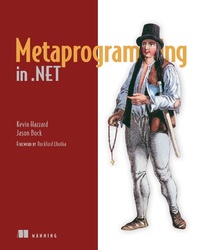
Metaprogramming in .NET
Published on 30. December 2012
360 pages
978-1-63835-181-8 (ISBN)
Description

Summary
Metaprogramming in .NET is designed to help readers understand the basic concepts, advantages, and potential pitfalls of metaprogramming. It introduces core concepts in clear, easy-to-follow language and then it takes you on a deep dive into the tools and techniques you'll use to implement them in your .NET code. You'll explore plenty of real-world examples that reinforce key concepts. When you finish, you'll be able to build high-performance, metaprogramming-enabled software with confidence.
About the Technology
When you write programs that create or modify other programs, you are metaprogramming. In .NET, you can use reflection as well as newer concepts like code generation and scriptable software. The emerging Roslyn project exposes the .NET compiler as an interactive API, allowing compile-time code analysis and just-in-time refactoring.
About this Book
Metaprogramming in .NET is a practical introduction to the use of metaprogramming to improve the performance and maintainability of your code. This book avoids abstract theory and instead teaches you solid practices you'll find useful immediately. It introduces core concepts like code generation and application composition in clear, easy-to-follow language.
Written for readers comfortable with C# and the .NET framework?no prior experience with metaprogramming is required.
Purchase of the print book comes with an offer of a free PDF, ePub, and Kindle eBook from Manning. Also available is all code from the book.
What's Inside
About the Authors
Kevin Hazzard is a Microsoft MVP, consultant, teacher, and developer community leader in the mid-Atlantic USA. Jason Bock is an author, Microsoft MVP, and the leader of the Twin Cities Code Camp.
"An excellent way to start fully using the power of metaprogramming."?From the Foreword by Rockford Lhotka, Creator of the CSLA .NET Framework
Table of Contents
Metaprogramming in .NET is designed to help readers understand the basic concepts, advantages, and potential pitfalls of metaprogramming. It introduces core concepts in clear, easy-to-follow language and then it takes you on a deep dive into the tools and techniques you'll use to implement them in your .NET code. You'll explore plenty of real-world examples that reinforce key concepts. When you finish, you'll be able to build high-performance, metaprogramming-enabled software with confidence.
About the Technology
When you write programs that create or modify other programs, you are metaprogramming. In .NET, you can use reflection as well as newer concepts like code generation and scriptable software. The emerging Roslyn project exposes the .NET compiler as an interactive API, allowing compile-time code analysis and just-in-time refactoring.
About this Book
Metaprogramming in .NET is a practical introduction to the use of metaprogramming to improve the performance and maintainability of your code. This book avoids abstract theory and instead teaches you solid practices you'll find useful immediately. It introduces core concepts like code generation and application composition in clear, easy-to-follow language.
Written for readers comfortable with C# and the .NET framework?no prior experience with metaprogramming is required.
Purchase of the print book comes with an offer of a free PDF, ePub, and Kindle eBook from Manning. Also available is all code from the book.
What's Inside
- Metaprogramming concepts in plain language
- Creating scriptable software
- Code generation techniques
- The Dynamic Language Runtime
About the Authors
Kevin Hazzard is a Microsoft MVP, consultant, teacher, and developer community leader in the mid-Atlantic USA. Jason Bock is an author, Microsoft MVP, and the leader of the Twin Cities Code Camp.
"An excellent way to start fully using the power of metaprogramming."?From the Foreword by Rockford Lhotka, Creator of the CSLA .NET Framework
Table of Contents
- Metaprogramming concepts
- Exploring code and metadata with reflection
- The Text Template Transformation Toolkit (T4)
- Generating code with the CodeDOM
- Generating code with Reflection.Emit
- Generating code with expressions
- Generating code with IL rewriting
- The Dynamic Language Runtime
- Languages and tools
- Managing the .NET Compiler
More details
Other editions
Additional editions
Kevin Hazzard
Metaprogramming in NET
Book
01/2013
Manning Publications
€42.00
Article exhausted; check different version
Persons
Jason Bock is a Microsoft MVP and a principal consultant for Magenic. He is a leader of the Twin Cities Code Camp and runs the Twin Cities Languages User Group. Jason is the author of four books and many articles on software development.
Kevin Hazzard is a consultant, entrepreneur and Microsoft MVP based in Richmond, Virginia. He co-founded the Richmond Software Craftsmanship Group and runs the Richmond Code Camp. Kevin has served multiple terms on Virginia's Joint Commission on Te
Kevin Hazzard is a consultant, entrepreneur and Microsoft MVP based in Richmond, Virginia. He co-founded the Richmond Software Craftsmanship Group and runs the Richmond Code Camp. Kevin has served multiple terms on Virginia's Joint Commission on Te
Content
- Intro
- Copyright
- Brief Table of Contents
- Table of Contents
- Foreword
- Preface
- Acknowledgments
- About this Book
- About the Cover Illustration
- Part 1. Demystifying metaprogramming
- Chapter 1. Metaprogramming concepts
- Chapter 2. Exploring code and metadata with reflection
- Part 2. Techniques for generating code
- Chapter 3. The Text Template Transformation Toolkit (T4)
- Chapter 4. Generating code with the CodeDOM
- Chapter 5. Generating code with Reflection.Emit
- Chapter 6. Generating code with expressions
- Chapter 7. Generating code with IL rewriting
- Part 3. Languages and tools
- Chapter 8. The Dynamic Language Runtime
- Chapter 9. Languages and tools
- Chapter 10. Managing the .NET Compiler
- Appendix A. Metaprogramming in Windows 8
- Appendix B. Usage guide
- Index
- List of Figures
- List of Tables
- List of Listings
