

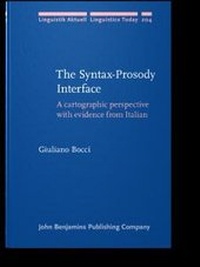
The Syntax-Prosody Interface
A cartographic perspective with evidence from Italian
1st Edition
Published in September 2013
IX, 213 pages
978-90-272-7229-4 (ISBN)
Description

This book presents an experimental and theoretical investigation of the interplay between information structure, word order alternations, and prosody in Italian. Left/right dislocations, focus fronting, and other reordering phenomena are analyzed, taking into account their morphosyntactic and prosodic properties. It is argued that a restricted set of discourse-related properties are inserted in the numeration as formal features. These discourse-related features drive the syntactic derivation and the formation of the prosodic representation in compliance with the T-model of grammar. Based on the cartographic approach, this study proposes a model of the syntax-prosody interface in which the phonological computation of prosody is fed by syntactically encoded properties of information structure. However, this computation is also governed by structural requirements intrinsic to the phonological domain, and thus, a bijective relation between information structure and prosodic representation is not guaranteed. The monograph will be of interest to any linguist concerned with syntax, information structure, and prosody.
More details
Other editions
Additional editions
Book
08/2013
John Benjamins Publishing Co
€100.70
Shipment within 10-15 days
Person
Content
- The Syntax-Prosody Interface
- Editorial page
- Title page
- LCC data
- Table of contents
- Acknowledgments
- Introduction
- 1. The cartographic approach and the left periphery of the clause in Italian
- 1.1 The cartographic approach
- 1.2 Background: The fine structure of the left periphery in Italian
- 1.2.1 Some properties opposing topic and focus in the left periphery in Italian
- 1.3 The criterial model
- 2. The right periphery of the clause
- 2.1 Postverbal focus
- 2.2 (Clitic) Right Dislocation
- 2.2.1 (Clitic) Right Dislocation is not a device to assign focus
- 2.2.2 Right-Dislocated Topics are clause-internal topics
- 3. Crosslinguistic variation: Uniqueness versus multiplicity of focus
- 3.1 Alternative semantics and focus in Italian
- 3.1.1 Alternative semantics for focus
- 3.1.2 Farmer's sentences
- 3.2 Issues on uniqueness of focus
- 3.2.1 Focus-sensitive operators and uniqueness of focus
- 3.2.2 Focus uniqueness, focus coordination
- 3.2.3 Some speculations on uniqueness of focus and crosslinguistic variation
- 4. Focus on subjects in preverbal position
- 4.1 Two hypotheses
- 4.2 Contrastive focalization in Rural Florentine
- 4.3 Ne-cliticization test
- 4.4 Focused preverbal subjects and Weak Crossover
- 4.5 Focused subjects, Principle C, and reconstruction
- 4.6 Discussion and conclusion
- 5. Focus on Topics: The strange case of Contrastively Focused Left Dislocated Topics
- 5.1 The strange case of Contrastively Focused Left Dislocated Topics
- 5.2 Contexts for Contrastively Focused Left Dislocation
- 5.3 Contrastive Focus Left Dislocation is not contrastive topicalization
- 5.4 Contrastively Focused Left Dislocation as Clitic Left Dislocated Topics prosodically focused in
- 5.5 Focus, Topic, and Contrastively Focused Left Dislocation in reduced left peripheries
- 5.6 Analysis of Contrastively Focused Left Dislocation: Head movement from Top0 to Foc0
- 5.7 Postfocal Clitic Left Dislocated Topics, definiteness, and CFLD
- 5.8 Conclusion
- 6. From syntax to prosody
- 6.1 Introduction to prosody
- 6.2 Mapping rules
- 6.2.1 Two sets of rules
- 6.2.2 Default mapping rules
- 6.2.3 Feature-sensitive mapping rules
- 6.2.4 A note on the notion of nuclear pitch accent
- 6.3 Experimental procedures and corpora
- 6.3.1 Experiment A
- 6.3.2 Experiment B
- 6.4 Pitch accents and types of focus
- 6.4.1 L+H* on Contrastive Focus
- 6.4.2 H+L* on broad and narrow informational focus
- 6.4.3 Theoretical implications
- 6.4.4 The last pitch accent of the focus constituent and the projection of focus
- 6.5 The Focus Defining Rule and the role of L* in Tuscan Italian
- 6.5.1 The pitch contour on postfocal material
- 6.5.2 L*-association is ruled by the linear position of focus
- 6.6 Focus and phrasing
- 6.7 Focus, main prominence, and main wh-questions in Italian
- 6.8 On the phonetic reality of postfocal phrasal heads
- 6.9 On the (non-)isomorphism between the prosodic representation and the syntactic and information s
- 6.10 Summary
- References
- Index
