

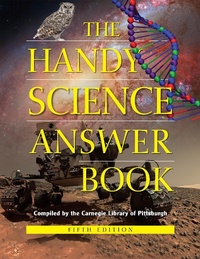
The Handy Science Answer Book
Description

Science is everywhere, and it affects everything! DNA and CRISPR. Artificial sweeteners. Sea level changes caused by melting glaciers. Gravitational waves. Bees in a colony. The human body. Microplastics. The largest active volcano. Designer dog breeds. Molecules. The length of the Grand Canyon. Viruses and retroviruses. The weight of a cloud. Forces, motion, energy, and inertia. It can often seem complex and complicated, but it need not be so difficult to understand. The thoroughly updated and completely revised fifth edition of The Handy Science Answer Book makes science and its impact on the world fun and easy to understand.
Clear, concise, and straightforward, this informative primer covers hundreds of intriguing topics, from the basics of math, physics, and chemistry to the discoveries being made about the human body, stars, outer space, rivers, mountains, and our entire planet. It covers plants, animals, computers, planes, trains, and cars. This friendly resource answers more than 1,600 of the most frequently asked, most interesting, and most unusual science questions, including ...
- When was a symbol for the concept of zero first used?
- How large is a google?
- Why do golf balls have dimples?
- What is a chemical bond?
- What is a light-year?
- What was the grand finale of the Cassini mission?
- How many exoplanets have been discovered?
- Where is the deepest cave in the United States?
- How long is the Grand Canyon?
- What is the difference between weather and climate?
- What causes a red tide?
- What is cell cloning and how is it used in scientific research?
- How did humans evolve?
- Do pine trees keep their needles forever?
- What is the most abundant group of organisms?
- How do insects survive the winter in cold climates?
- Which animals drink seawater?
- Why do geese fly in formation?
- What is FrogWatch?
- Why do cats' eyes shine in the dark?
- Which industries release the most toxic chemicals?
- What causes most wildfires in the United States?
- Which woman received the Nobel Prize in two different fields (two different years)?
- What is the difference between science and technology?
For anyone wanting to know how the universe, Earth, plants, animals, and human beings work and fit into our world, this informative book also includes a helpful bibliography, and an extensive index, adding to its usefulness. It will help anyone's science questions!
More details
Other editions
Additional editions
Persons
Content
Acknowledgments
Preface
Introduction
1. Overview
2. Mathematics
3. Physics
4. Chemistry
5. Astronomy and Space
6. Geology and Earth Sciences
7. Meteorology and Climatology
8. Biology
9. Genetics
10. Botany
11. Zoology
12. Anatomy and Physiology
13. Ecology
14. Applied Science and Technology
Bibliography
Glossary
Index
